There are few things more quintessentially “unexpected consequences” than a protest intended to shield neighbors from heavy-handed deportations but inadvertently stalling the arrest of a suspected cartel affiliate moving piles of narcotics. Sometimes, reality delivers the kind of twist even the most jaded archivist would double-check for credibility.
A Protest in the Wrong Place at the Wrong Time
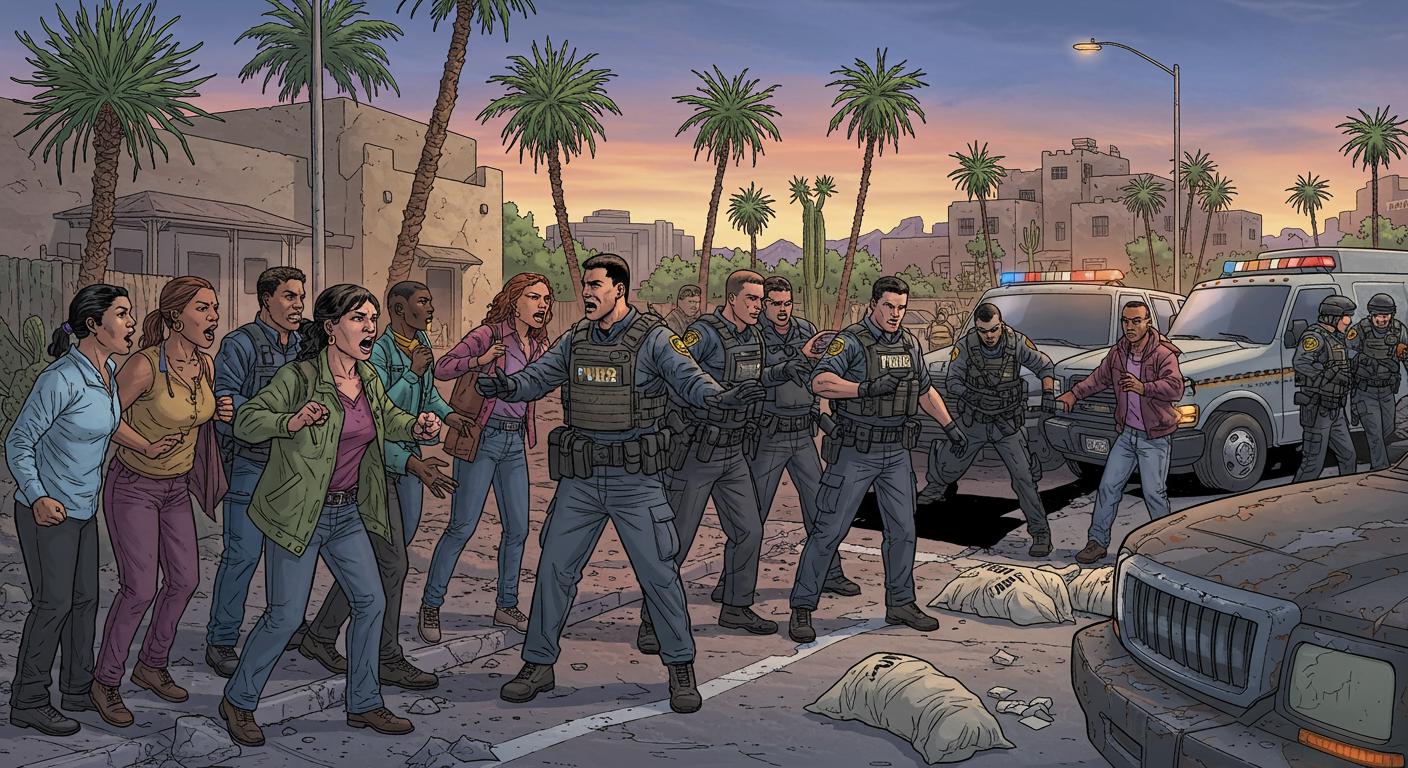
Midweek in Tucson, as outlined in a detailed report by 13 News, a law enforcement sweep brought an outsized response, but not all from the authorities. Nearly a hundred protesters appeared on the scene near Midvale and Irvington, drawn by the rumor mill which had apparently labeled the event an ICE immigration raid.
By the time the crowd arrived—many just hours removed from a separate, rowdy anti-ICE rally elsewhere in town—officers were deep into serving a warrant. The facts, as shared by federal agents and the Pinal County Sheriff’s Office with reporters, paint a picture less “family separation” and more “Breaking Bad”: over 120 pounds of fentanyl, 20 pounds of meth, 35 pounds of cocaine, and a quartet of firearms seized. At least one person, described as both a migrant and a former cartel member, ended the night in cuffs facing drug and weapon charges.
What followed, according to accounts from officials and neighbors alike, was a kind of standoff between two parallel realities. While law enforcement attempted to clarify—sometimes loudly and repeatedly—that this was a narcotics operation, many protesters held their ground, convinced ICE was at work. Sheriff Ross Teeple, voicing his exasperation to journalists, argued that even direct explanation couldn’t shake what he called “group think,” coloring the interference as dangerously uninformed.
Disinformation, Snap Judgments, and Unintended Irony
The pattern is nothing new, it turns out. The same outlet notes that local activists have, with growing frequency, responded at a sprint to law enforcement activity involving federal agencies. Officers from Homeland Security Investigations in Peoria faced a near-identical situation earlier in the week: crowds, assuming an ICE raid, converged mid-operation. There, misunderstandings eventually escalated to physical altercations, resulting in several arrests.
Video released by the Pinal County Sheriff’s Office, reviewed by reporters, captures the dynamic in Tucson: protesters shouting as deputies attempt to serve a warrant, while police on loudspeaker attempt to distinguish narcotics enforcement from immigration crackdowns. Tucson Police Chief Chad Kasmar emphasized to those present—multiple times, apparently—that the action involved drugs, not deportations, but frustration and confusion persisted.
Some activists, undeterred by such distinctions, framed the incident as a people-powered victory over what they still believed was an immigration enforcement action. In statements on social media highlighted by the station, representatives with the Party for Socialism & Liberation Tucson claimed the crowd had “driven ICE and cops… out of our streets,” despite the reality that the operation’s target was a suspected high-level trafficker, not someone being whisked away by ICE for a paperwork issue.
Meanwhile, nearby residents offered their own perspectives to journalists: while some defended the right to protest, others described the event as intrusive and stressful for the neighborhood. Maria Martinez reflected on the unusual spectacle, remarking on the invasion of so many police—and protesters—onto otherwise quiet streets. Others, preferring anonymity, accused activists of overstepping boundaries in the pursuit of their cause.
Is it possible, one wonders, that the sheer speed with which rumors move through activist networks, especially in an era dominated by social media urgency, makes these scenarios almost inevitable? When information snowballs before facts materialize, what’s left for nuance?
Free Speech, Real Risks
Where protest meets active law enforcement, the legal line is notoriously thin. Russ Richelsoph, a local defense attorney whose remarks were included in the reporting, laid out the risk: interfering with a federal operation, regardless of intention, can easily cross into criminal conduct. It puts both demonstrators and officers on a collision course with consequences that extend well beyond a night of shouting across police tape.
The ICE spokesperson, as noted in coverage, emphasized respect for peaceful protest but drew a hard line at actions impeding federal agents, citing the risk of legal repercussions for crossing that threshold. Recent events—three detained after a related protest in Tucson earlier in the day, and the escalation in Peoria—highlight how swiftly things can slide from spirited demonstration to felony charges.
All the while, the logic knots up: in trying to protect one group from what they viewed as unjust targeting, protesters inadvertently complicated the takedown of an alleged drug smuggler. It’s hard not to marvel at the sheer oddity—would anyone have predicted that, in 2025 Tucson, opposing ICE would mean slowing down a major fentanyl seizure?
A Murky Intersection
If you squint, there’s almost a classic tragicomic element here. Protesters, conditioned by history and recent events to expect ICE behind any federal badge, rush to defend vulnerable neighbors—only to end up interrupting the very process meant to remove a reported trafficker from their midst. Law enforcement, for its part, communicates poorly or too late, and residents are left watching the commotion from their doorsteps, baffled that their neighborhood suddenly became the unlikely intersection of principle, error, and 120 pounds of fentanyl.
What’s the lesson here? Perhaps it’s that the speed of outrage will always outpace the deliberation of facts. Perhaps, too, these are the inevitable growing pains of a society still figuring out how to reconcile privacy, activism, law enforcement, and a steady diet of online misinformation. Is there a perfect way for protesters to know which sirens signal injustice, and which presage an overdue cleaning of the streets?
Whatever the answer, the events in Tucson will sit for a while in the archive of irony, an episode where everyone seemed earnest, if not entirely accurate. Maybe the real question is: next time the crowd forms, will the facts have time to catch up? Or do we just have to accept a future where activism, confusion, and the surreal dance endlessly overlap?