
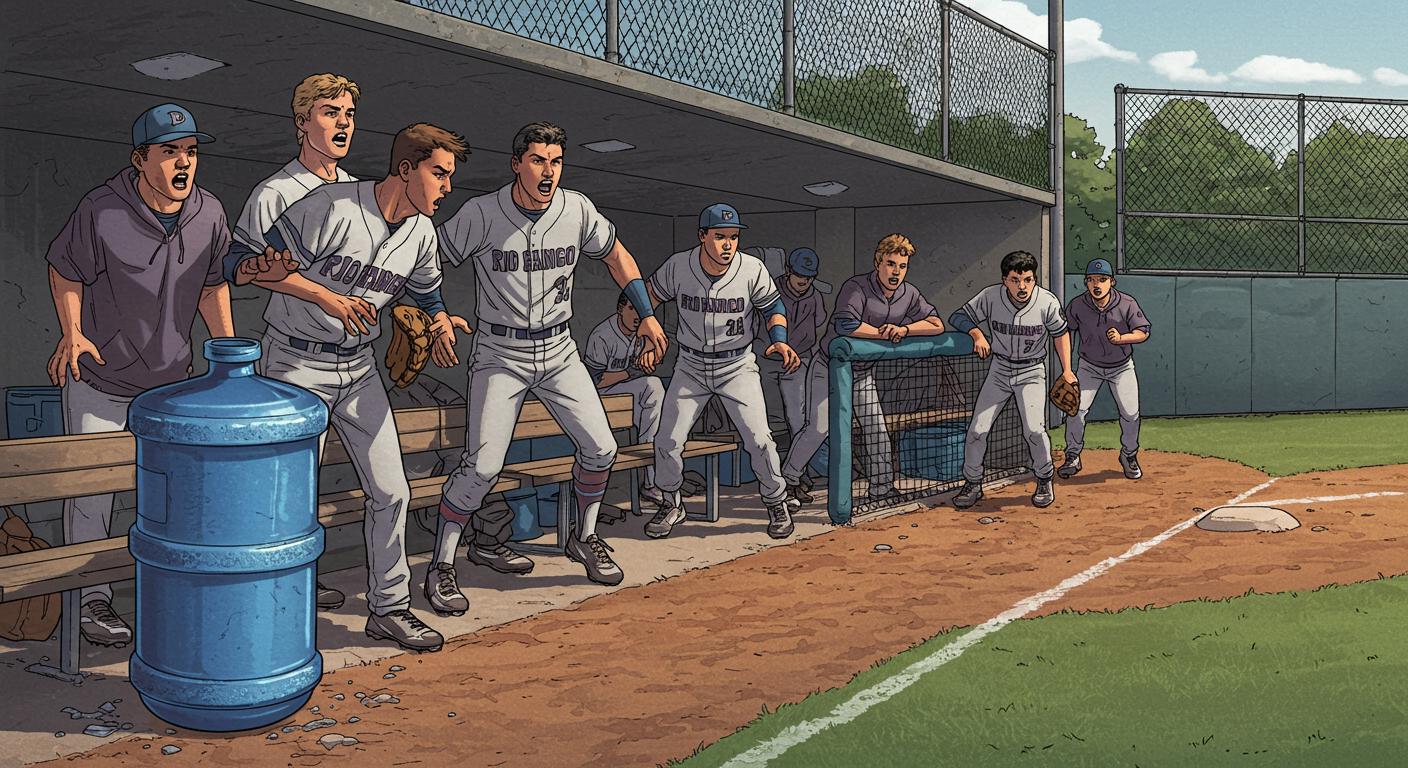
If you’ve ever wondered what happens when life imitates the plot of a particularly regrettable college comedy, Rio Rancho, New Mexico, just offered up an answer—no criminal charges, but plenty of awkward questions left behind.
A Baseball Caper with No Play at the Plate
Back in March, during a junior varsity baseball game between Rio Rancho High and La Cueva High, a 16-year-old Rio Rancho player admitted, in a detail outlined by KRQE, to urinating in the opposing team’s water jug—a situation decidedly less refreshing than anything found in the sports drink aisle. According to an email from the La Cueva principal to parents, several La Cueva players and coaches unknowingly drank from the contaminated jug.
Further reporting by KRQE confirms that Rio Rancho police took the incident seriously enough to investigate and ultimately recommended 15 counts of battery—one for each unsuspecting sipper.
KOB’s coverage adds that the incident originally took place in April, matching game schedules and highlighting the speed at which rumors and outrage can swirl through a high school sports community. The police forwarded their findings and recommended charges to the 13th Judicial District Attorney’s Office. A letter, cited in both KOB and KOAT’s reporting, confirmed that the Rio Rancho student had admitted his role, and disciplinary measures loomed.
What’s a Crime When No One Gets Touched?
According to statements provided by Jessica Martinez, Chief Deputy District Attorney, and documented by all three local outlets, the DA’s office was left in a bind. In New Mexico, battery is defined as “the unlawful touching of another person in a rude and insolent manner.” Put plainly, Martinez told KRQE and KOAT that “there is no criminal statute currently that deems this conduct criminal therefore charges cannot be filed.” In her words, “While the act is gross and not right…it’s not a crime in New Mexico.”
Community members expressed their frustrations over what some called a “terrible message,” as relayed by KOB, with Attorney Ahmad Assed suggesting that public nuisance or disorderly conduct could have been alternative legal avenues, but ultimately, those were not pursued. Assed also floated the idea of considering petty misdemeanors, emphasizing these could “send a message” without “ruining a kid’s life.”
KOAT further notes that the District Attorney’s Office consulted with the Juvenile Probation and Parole Board before reaching the decision not to file charges, underlining that multiple authorities reviewed the unique circumstances and statutory holes.
Benched for the Season, Not for the Record
Rio Rancho Public Schools issued a statement to KRQE reiterating the district’s inability to comment on individual student discipline or external agency actions but confirmed that the junior varsity team was suspended for the remainder of the season. KOAT also documents that this suspension applied to the entire Rio Rancho JV roster while investigations played out, meaning the punishment was swift, broad, and left no ambiguity about the district’s disapproval.
The district made clear, in its statement as described by KRQE, that the “behavior exhibited does not represent the standards and values expected of all students….” Meanwhile, the La Cueva High community—players, coaching staff, and families alike—found themselves grappling with a scenario arguably absent from even the most thorough team handbooks.
Statutory Gaps and the Folklore of Foolishness
Grouping together insights from KOAT, KOB, and KRQE, it’s apparent this is the kind of scenario that blurs the border between adolescent pranks and legal dilemmas. At what stage does a notorious prank become a prosecutable offense? Should laws evolve to anticipate creative (if revolting) mischief, or do public embarrassment and institutional discipline suffice?
From the perspective of someone who enjoys the dustier corners of archival misadventures, the story is a case study in oddities intersecting with the law. Imagine, for a moment, a legislative hearing on beverage-tampering by student-athletes. Would a law even catch up to the next outlandish stunt, or would the boundary lines just keep moving?
Reflections from the Dugout
At the end of this messy inning, the legal bases remain untouched. The student won’t face criminal charges, and New Mexico statutes do not—at least for now—include a section on urinating in rivals’ beverage containers. Still, the tale is destined for some sort of folklore shelf, lingering with a whiff of discomfort and those classic “remember when” anecdotes passed down in dugouts.
So where do we stand: does the absence of a criminal charge mean the field is clear for future hijinks, or is the public shaming and team-wide punishment enough to close the case? Review of the law can be as strange as the acts people invent to test it, and sometimes, as happens here, you end up right back where you started—confused, slightly amused, and quietly relieved you only heard about it after the fact.