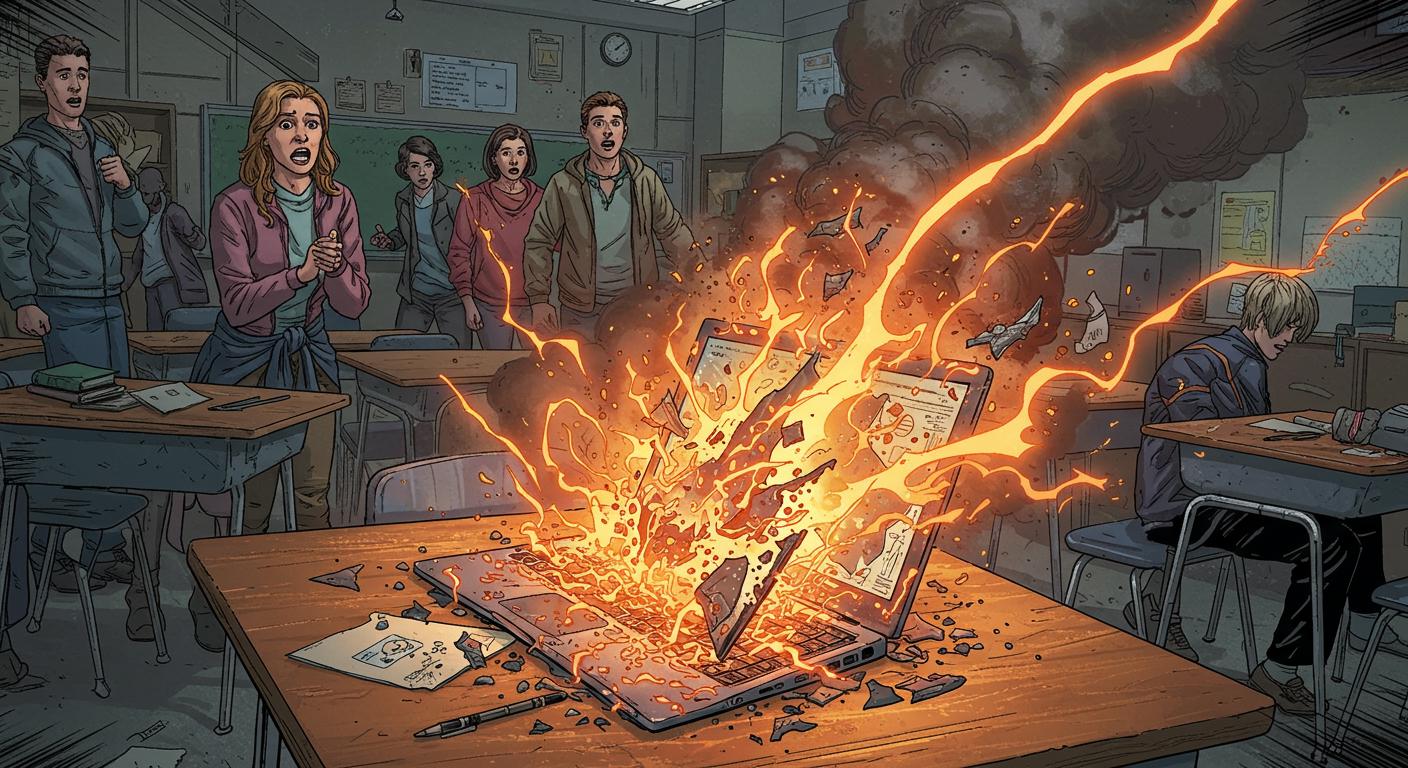
Sometimes after scrolling through the endless churn of “challenges” and “pranks” that bubble up from TikTok’s primordial soup, I find myself re-reading the fine print, just to confirm that yes, I am actually awake and yes, this is genuinely happening. The latest offering from the ever-churning cauldron of adolescent mischief: the “Chromebook Challenge,” wherein students intentionally set their school laptops on fire. Not metaphorically. Literally. For the purpose of short-lived online clout.
If you’re expecting some nuanced digital-age social commentary from the challenge itself, keep waiting. As reported by NBC News, kids are sticking paper clips, pencils, or even, for the truly determined, gum wrappers into Chromebook USB ports to short-circuit the devices. The resulting havoc isn’t confined to fried circuits—a growing handful of these pranks have escalated to full-on flames, emergency evacuations, and will-it-smell-this-way-forever school hallways.
“Let Me Be Clear; We Are Taking This Very Seriously”
Schools, not renowned for their sense of whimsy about property damage, have started issuing warnings with just a touch of apocalyptic flair. Scranton School District in Pennsylvania called the trend “reckless, dangerous, and has no place in our schools or homes,” also pleading with parents to “work together to keep our students and our buildings safe,” as NBC News details. In Prince George’s County, Maryland, officials confirmed up to 10 reported incidents and have “informed our community about the risks,” according to the same report.
Elsewhere, Oklahoma’s Mid-Del Schools have capped the replacement cost for a toasted Chromebook at $274 and confirmed families would be billed accordingly, not to mention the threat of “serious disciplinary consequences.” NBC News also notes that school districts in Texas and Jefferson-Morgan, Pennsylvania have joined the chorus of preemptive warnings, spelling out that penalties could include expulsion and possible legal action. For at least one New Jersey teen, the fun ended with charges of third-degree arson and criminal mischief—NJ.com documented the criminal complaint, as highlighted by NBC.
Law enforcement hasn’t been idle. Maryland’s acting state fire marshal Jason Mowbray has urged a “culture of safety and responsibility regarding electronic devices,” stressing collaboration between parents and educators. As described by NBC News, criminal investigations related to the challenge are underway at schools in Arizona following incidents that damaged property, prompted evacuations, and left lingering clouds of burnt plastic.
A Fire in the USB Port (and the Nurse’s Office)
Connecticut, never one to be left out of bizarre trends, has also had its moment. According to Greenwich Time, at the Middle School of Plainville, a student intentionally shoved scissors into a laptop, filling the classroom with smoke and triggering an evacuation. The student was hospitalized for smoke inhalation; police say juvenile court is next. The outlet also notes that just one day prior at Southington High School, staff responded to a similar incident by tossing a smoldering Chromebook out a second-floor window. Quick thinking, though honestly, not a job description most teachers would have anticipated.
Greenwich Time further compiles several similar incidents—fires or near-fires at high schools in Cromwell, Derby, and Newington—prompting a series of warnings from fire officials. State Fire Marshal Lauri Volkert’s written statement underscores the urgency: fire “can become uncontrolled and turn deadly in just a few seconds.” Additional comments from State Fire Administrator Jeff Morrissette emphasize that these “risky” social media trends are increasing, and both students and parents should be aware of the inherent danger.
Guilford fire officials, the outlet notes, added that the “challenge” can even trigger explosions, not just toxic smoke. Their Facebook post summed it up: “This challenge is no joke. It’s a real fire hazard, and intentionally damaging electronics in this way can lead to criminal charges, serious injuries, and long-term consequences.”
The Allure of Online Clout (and Smoldering Plastic)
There’s something comically, even classically, adolescent about the whiff of self-destruction mixed with groupthink. The desire to “go viral” clearly hasn’t met a circuit board it won’t destroy. Both NBC News and Greenwich Time convey that fire officials and school administrators are unified in their frustration—and concern. The refrain is unmistakable: TikTok views are not a replacement for functioning electronics or basic safety.
It’s not just about reckless teens, either. There’s a faint echo of the old eighties and nineties scare about swallowing Tide Pods, or the gentler “eraser burn” phase—but now with global reach and a distribution platform fine-tuned for maximum spectacle. What’s new, perhaps, is the administrative scramble to keep pace: from coordinated warnings across state lines to a menu of disciplinary and criminal penalties, there is a collective effort to make sure this becomes a cautionary tale rather than a recurring feature.
But is anyone surprised? We’ve reached a stage where technology is so embedded in the daily grind that it’s become both the canvas and the casualty for every stunt. In 2025, school laptops aren’t just homework vessels; they’re objects of daring, rebellion, and, evidently, brief-lived bonfire fodder.
The Absurdity of the Everyday
You have to wonder—did anyone setting out on the Chromebook Challenge pause to consider what happens after the smoke clears? Or does it all fade away in that few seconds of pixelated fame, with nothing but the acrid smell of melted plastic and a formal letter to mom and dad as souvenirs?
If there’s any lesson lurking amid the singed USB ports, maybe it’s that the quest for internet notoriety remains as unpredictable—and combustible—as ever. And in a world where viral stunts scroll by at a mile a minute, perhaps it makes sense that the actual hardware gets sacrificed next.
In the meantime, maybe spare a thought for the IT staff patching together the aftermath, and the archivists documenting the era when laptops weren’t just for typing—they were, for a brief moment, the hottest entertainment in homeroom.