Every so often, a news story comes along that unfolds with a kind of narrative symmetry you almost couldn’t invent—a detail so on-the-nose it briefly feels like a script draft. Such is the continuing misadventure of Nathaniel Radimak, better known in Southern California media as the “Tesla road rage guy.” His legend, long built over a string of metal pipe-wielding attacks on Los Angeles freeways, has now crossed the Pacific, and, as it turns out, Hawaiian jails present their own… interpersonal bottlenecks.
Rage on the Road, Rage on the Rock
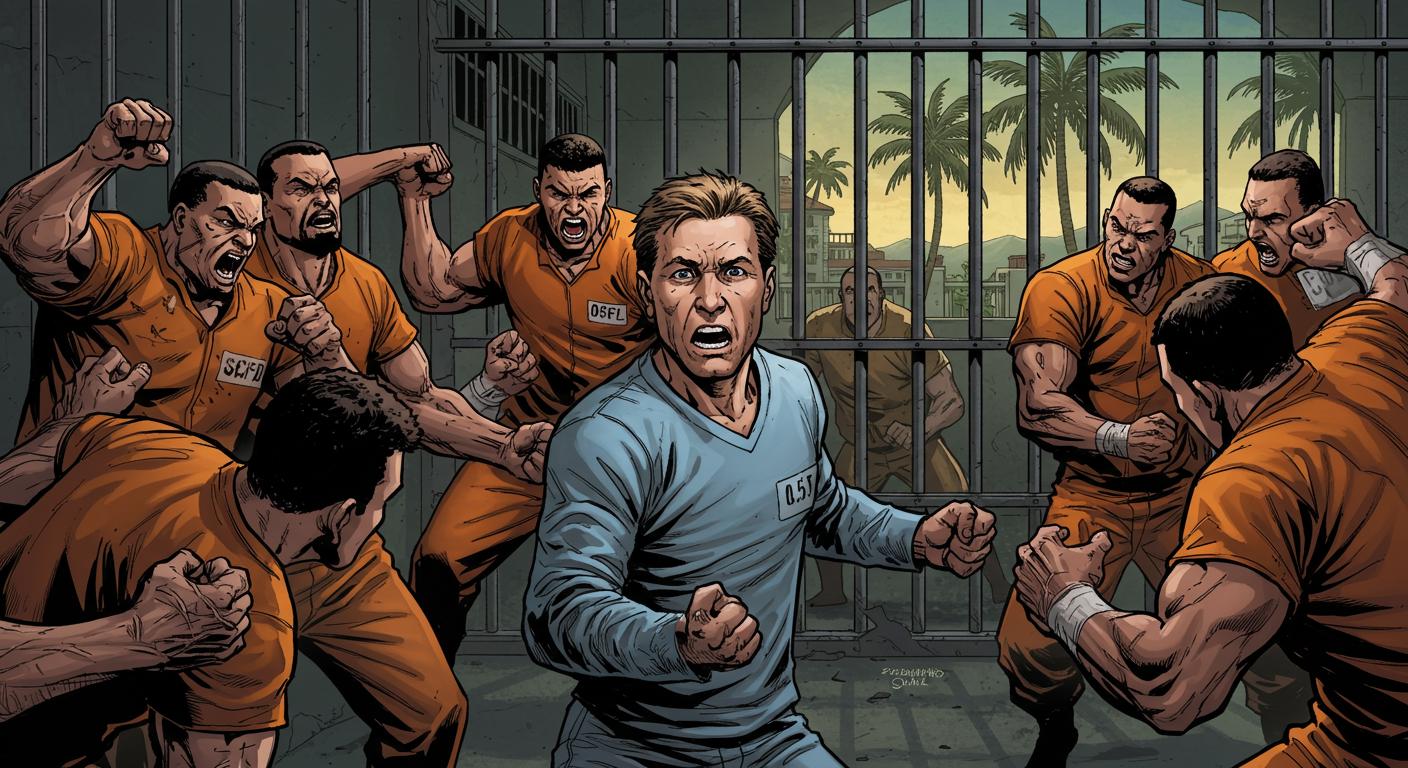
According to CBS Los Angeles, Radimak ended up hospitalized after a group of fellow inmates at Honolulu’s Hālawa Correctional Facility decided to introduce him to a much less scenic version of island life. Authorities confirmed he suffered injuries to the face and torso after the Monday altercation—one suspects, not unlike the kind he distributed to others on the mainland. In an image shared by the outlet, the 38-year-old sits in a hospital lobby, a living cautionary tale for anyone considering creative uses for a Model 3’s autopilot.
This was not your average tourist’s week in Waikiki. As detailed in SFGate’s report, Radimak made a characteristically loud entrance to the islands: allegedly assaulting an 18-year-old woman and her mother during a driving lesson. Surveillance footage, as described by KABC-TV and cited by SFGate, shows a gray Tesla making a sudden U-turn, its driver leaping from the car to rage and strike—seemingly oblivious to the presence of a sleeping baby in the backseat.
The mother, Diane Ung, recounted to KABC-TV (quoted by SFGate) how her iced coffee (and her motherly instincts) were no match for Radimak’s fists. The details would verge on slapstick if they weren’t so grim: she reportedly retaliated by flinging her McDonald’s iced coffee at the Tesla, to which Radimak responded with what she termed a “Superman punch” to her face. The altercation ended with Radimak fleeing the scene and Ung left on the pavement with a significant head gash.
While the Yahoo story aggregated these details as part of the wider media coverage, it did not contribute additional facts beyond those reported by CBS Los Angeles and SFGate.
Fast Cars, Fast Release, and a Sudden Stop
Court records referenced in both CBS and SFGate note Radimak’s previous Southern California conviction, which saw him sentenced in October 2023 for a series of road-rage outbursts, pipe in hand, from as far back as 2020. He was, for a time, somewhat of a rolling local legend: videos of his freeway showdowns went viral, sometimes bordering on performance art with a menacing flavor.
Still, as attorney Gloria Allred explained to CBS, Radimak’s “five-year” sentence evaporated in less than a year, partially thanks to a patchwork of credit for time served and good behavior, with the added wrinkle of jail overcrowding also noted in SFGate’s summary. That he quickly found himself on a Hawaiian street, behind the wheel of yet another Tesla, illustrates the porousness of the justice system when it comes to serial road menaces.
Details in SFGate also highlight that Radimak had a previous outstanding traffic warrant in Hawaii, stemming from a January 2023 citation for driving without a valid license and speeding more than 30 miles over the limit. His reappearance in court after the latest assaults seems less a twist than an inevitability.
When “Main Character Energy” Backfires
Radimak’s arc, at its core, offers a sort of cautionary parable. The modern “road rage” genre, especially when filmed from a luxury EV, is intensely internet-age: spectacle, escalation, and a dash of impunity until reality finally makes a U-turn. This case isn’t exactly a moral victory for anyone—in fact, it’s a reminder of how thin the line between notorious and anonymous can be once the cameras are off and the courtroom doors close.
The Hālawa Correctional Facility, for all its faults, apparently does not offer a “Ludicrous Mode” for reputation. There might be some grim suggestion of poetic justice—a serial aggressor facing mob justice behind bars—but that narrative tempts us into too-easy storytelling. SFGate’s and CBS’s details make it clear that jail violence, even when inflicted on infamous offenders, remains part of a messier reality that is neither entertainment nor simple comeuppance.
What will Hawaii’s Department of Corrections investigation ultimately turn up—beyond another line in the long, strange logbook of Radimak’s life, as CBS reports? Is there a point where notoriety outpaces accountability, or does the cycle simply accelerate until, as chronicled here, someone else draws the hard brake?
There’s an irony here, almost Shakespearean in its way—though probably none of the players feel like they’re in a drama so much as a farce. One thing’s certain: the intersection between public spectacle, repeat offenders, and the unyielding bureaucracy of justice isn’t getting any less crowded. Who, if anyone, finally gets the right of way?