
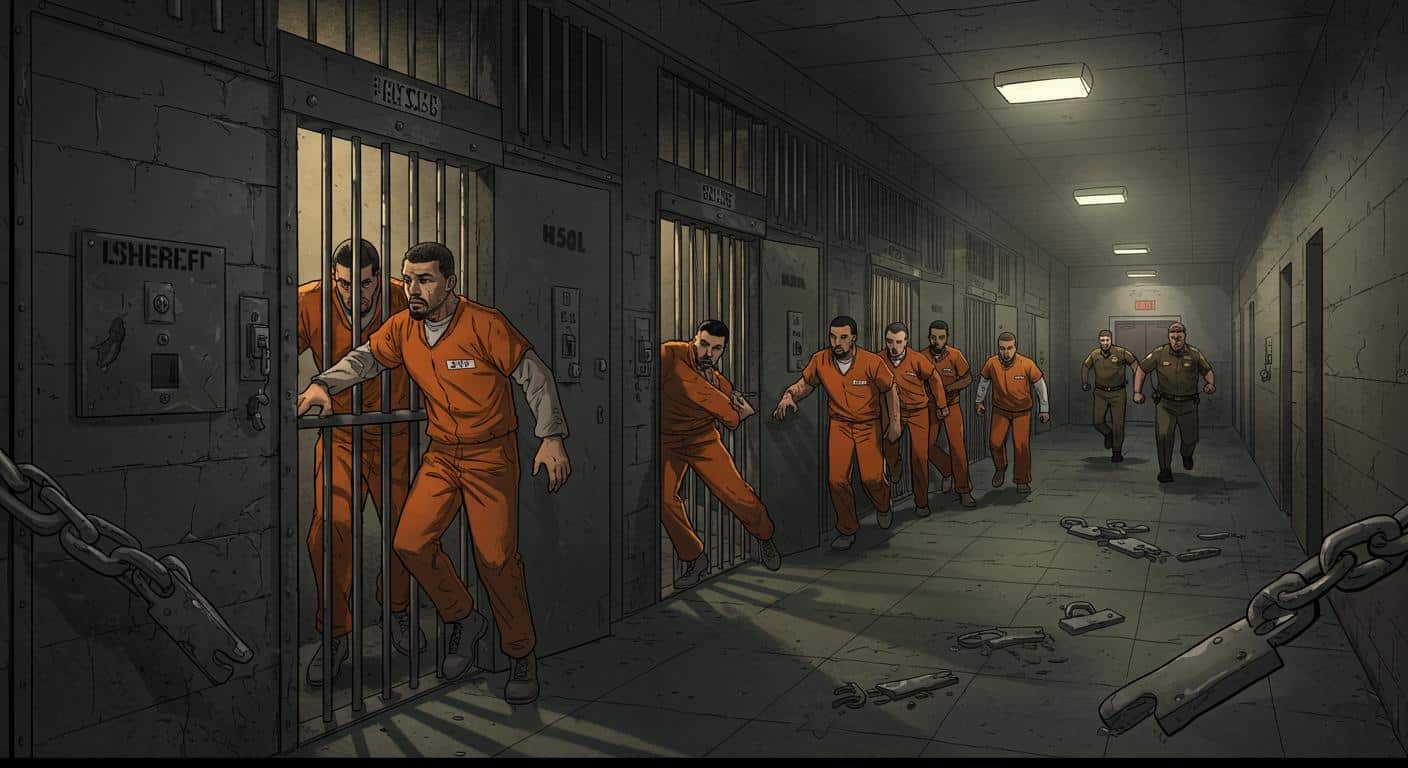
There’s something both comic and quietly menacing about the image: ten men squeezing through a hole behind a jailhouse toilet, hoisting themselves over a barbed wire fence with—in a pinch of creative flair—blankets, then vanishing into the early morning gloom. “Easy,” they scrawled on the wall above the narrow escape hatch, presumably with a sense of accomplishment mingled with disbelief. In a saga detailed by the Associated Press, this wasn’t some meticulous, months-long Shawshank operation; it was more a case of “the locks barely worked and nobody was really watching.”
Deficiencies by Design (or Neglect)
The heart of this jailbreak, as outlined in the AP’s reporting, lies not in criminal ingenuity but in that most unglamorous of failures: infrastructure. Faulty locks and malfunctioning cell doors—a problem Sheriff Susan Hutson insists she’s raised since taking office in 2022—were, quite literally, the weak link. The AP explains that the Orleans Justice Center, designed for minimum-security inmates, currently houses many classified as high security: individuals awaiting trial for violent crimes, including murder and assault. Yet the hardware, never upgraded to match this new reality, lagged behind. Jeworski “Jay” Mallet, chief of corrections, went on record in a city hearing to describe cell doors “manipulated” to the point that not only could they not secure anyone inside, some could not even manage to close.
One can almost picture the planning session—“Gentlemen, the locks open if you jiggle them hard enough, and there’s a whole unsupervised hour after midnight. Thoughts?”
The cycle is depressingly familiar. Attempts to secure funding for new lock systems and repairs have become annual rituals, with Hutson writing to almost every official who’ll listen. As described by the AP, despite spooky tales of chronic malfunction and warnings that federal monitors were still watching, the jail limped along with over 1,400 detainees. The highest-risk were eventually shifted to more secure locations, but clearly not soon enough.
Blankets, Power Tools, and a Headcount—Seven Hours Later
The specifics, chronicled in the AP’s coverage, are rich with overlooked warning signs. Surveillance footage reviewed by authorities reportedly shows the men yanking an already compromised cell door off its track before squeezing through a hole behind a toilet—an opening which officials suspect was formed using power tools. The escapees next slipped out a loading dock door, scaled a barbed-wire fence aided by the humble blanket, and disappeared into the pre-dawn dark. According to the AP, a key failure in monitoring played right into their hands: the jail employee responsible for watching the pod had left to grab food.
Perhaps the most striking detail? The escape wasn’t even noticed until a morning headcount, some seven hours after the exodus. As the AP reports, by then, murals of blame had already started appearing almost as quickly as the prisoners vanished. Three sheriff’s employees were suspended amid suspicions that the breakout may have been aided “from within.” The notion of an “inside job” began to circulate, with the evidence—missing oversight and a suspiciously accommodating escape route—fitting a pattern none too reassuring.
Finger Pointing and the Politics of Broken Locks
As noted in AP’s account, few events gather political steam like a prison break. State Rep. Aimee Adatto Freeman called for Hutson’s resignation, arguing that her emphasis on funding shortfalls was simply “a deflection, not an excuse.” At the state level, Governor Jeff Landry ordered an investigation and an audit of jail standards, insisting there could be “no excuse” for allowing violent offenders, some awaiting trial for murder, to simply walk free. The AP further explains that the governor is weighing whether to move those high-risk detainees to state custody for safekeeping.
Broken locks became a proxy for years of institutional inertia, as Mayor LaToya Cantrell and sheriff’s office staff sparred publicly over whether the budget had ever truly matched the scale of the problem. The jail, built in 2015 to wipe away the legacy of its infamously porous predecessor, has nevertheless spent much of its existence under federal monitoring and apparent scorn from those inside and outside its walls.
Easy In, Easier Out?
It’s tempting to chalk this jailbreak up as a one-off—just a freak accident of disrepair, inattention, and bad timing. But the reality, according to the AP’s findings, is less about a single escape and more about a longstanding invitation to disaster. A modern jail, haunted by outdated locks and a culture slow to fix the basics, ultimately delivered a scenario so “easy” that even the escapees couldn’t help but editorialize on their way out.
When the barriers meant to separate “in” from “out” can be jostled out of place or cut through behind a communal toilet, is it really a marvel that someone took the opportunity? Or have the probabilities simply been catching up with official hopefulness? The real absurdity, perhaps, is that it doesn’t happen more often.
In the end, the New Orleans jailbreak is a case study in what happens when ignored warnings, budget bottlenecks, and the hidden scaffolding of public institutions finally collapse together. Ten men didn’t so much break out as step through the cracks—at once a literal and figurative indictment. The parting message, “easy,” lands harder the longer you look: because sometimes the only thing really locked in is our own refusal to fix what’s obviously broken.