If you thought the era of remote, inescapable island prisons belonged to the history books (or at least to Steve McQueen and Hollywood nostalgia), France has just unveiled plans to one-up the concept—by building a €400 million fortress for gangsters and radical extremists smack in the Amazonian wilds of French Guiana. As detailed by BBC News, this isn’t a plot twist in a gritty streaming drama—it’s official French policy in 2025.
A New Era—or a Historical Echo?
Justice Minister Gérald Darmanin made the announcement in Saint-Laurent-du-Maroni, a riverport town that, as both BBC News and The Economic Times recall, used to funnel unlucky souls into Devil’s Island: France’s own sun-drenched slice of penal colony lore. Over a century, about 70,000 convicts were shuffled through those gates—and while Henri Charrière’s Papillon (later immortalized with Steve McQueen and Dustin Hoffman) made gritty heroics out of escape attempts, the colony’s main feature was grim inescapability.
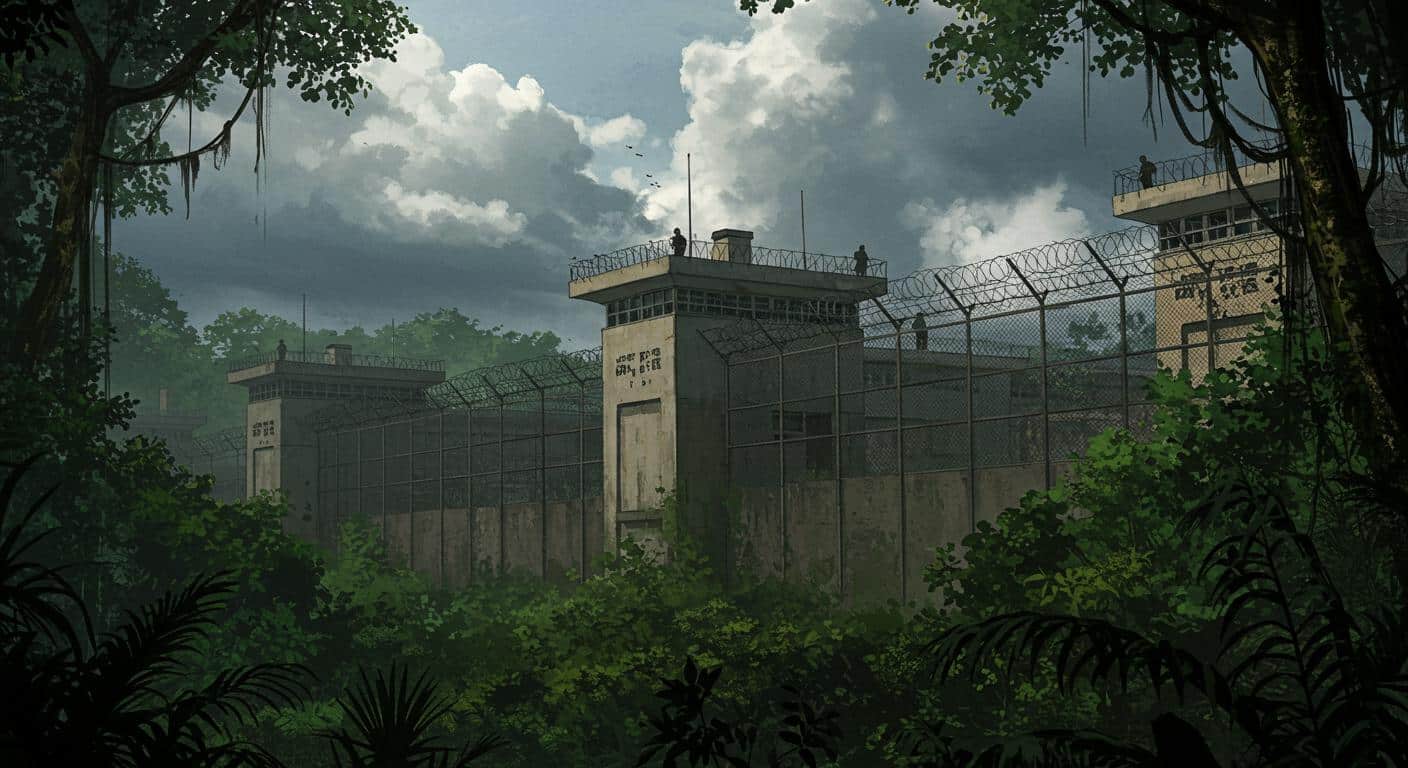
Now, in what feels more déjà vu than innovation, officials say the new high-security facility will rise deep in the jungle and open as early as 2028. The numbers around how many inmates the facility will eventually hold are still in flux. BBC News reports the prison could accommodate up to 500 people, with a special wing for the most dangerous criminals, while The Economic Times describes an initial plan for just 60 inmates, with 15 places reserved specifically for those convicted of Islamist extremism according to justice ministry officials. This discrepancy could reflect evolving planning or shifting policy announcements—either way, it’s clear the intent is to create a fortress designed for the most high-profile offenders, rather than a mass holding pen.
But instead of malaria and leaky hammocks, the new prison promises strict regime, 21st-century surveillance, and the kind of geographical inconvenience that would make even the most connected kingpin think twice about prison Wi-Fi.
The “No More Phone Smuggling” Gambit
French prison authorities have long struggled to keep mobile phones out of inmates’ hands. Tens of thousands of these devices, BBC News reports, circulate through French jails, enabling imprisoned leaders to orchestrate operations, communicate with criminal associates, and generally undermine any sense of real isolation. According to Darmanin, as quoted in both outlets, the remote, protected setting in French Guiana is intended specifically to “incapacitate the most dangerous drug traffickers” by making contact with the outside world almost impossible.
The idea is that a jungle fortress will present far higher barriers—not just literal bars, but rivers, rainforest, and, presumably, a lot of mud—to both contraband and communication. Even the most resourceful smugglers would have to innovate well beyond the usual means. Is anyone working on a drone-canoe hybrid for smartphone delivery yet?
Crime Rates and Symbolism in the Swamp
The choice of location isn’t just about topography; it’s got a criminal logic too. The Economic Times reports that Saint-Laurent-du-Maroni acts as a “strategic hub for drug mules,” serving as a crossroads for flows from Brazil and Suriname into the broader European market. The region itself has the highest crime rate of any French department, with data from 2023 showing 20.6 homicides per 100,000 inhabitants—nearly 14 times the national average.
BBC News also highlights how the symbolism resonates: the same town that once presided over one of France’s most infamous penal outposts is being reimagined for a modern, high-tech era of crime and terror. Whether this is poetic justice, grim historical recursion, or simply pragmatic use of remote acreage probably depends on your perspective.
Extremists, Drug Barons, and Legislation on Steroids
A series of violent incidents across France—including attacks on prisons and staff, arson, and even gunfire—has accelerated the government’s rush toward harsher penalties and more severe containment measures. BBC News notes that recent attacks have occasionally been framed by perpetrators as defenses of prisoners’ rights. In this context, the French government has rolled out new legislation to fight back: expanded prosecutorial powers, new protections for informers, and now, as both BBC News and The Economic Times describe, a “war against narcotrafficking” sharply focused on both geography and technology.
Darmanin lays out the strategy plainly in The Economic Times: hit organized crime at every level, “where drug trafficking begins; in mainland France, by neutralizing network leaders; and all the way to the end users.” The new jungle facility, in this vision, isn’t just punishment—it’s meant as a surgical excision of influence and communication.
The Absurdity of It All?
So here we are: France is doubling down on a return to its most infamous colonial outpost, betting that history’s least sympathetic travel destination now holds the key to 21st-century security. Is this forward-thinking innovation, or a tropically humid throwback? The plan raises the question of whether sheer remoteness, rather than deeper reforms, can truly sever the ties of organized crime.
Maybe this modern-day “Devil’s Island” will finally outwit the smugglers and smartphone tinkerers. Or maybe, years from now, some enterprising memoirist will pen Papillon 2.0: Digital Edition. For now, it seems France’s most notorious criminals are about to face a new kind of digital detox—one with very bad Wi-Fi and, if nothing else, a lot more piranhas.
Is isolation by geography really the silver bullet, or just a dramatic Band-Aid wrapped in jungle vines? Hard not to picture future criminologists—and perhaps a few Netflix producers—debating that somewhere far less humid.