
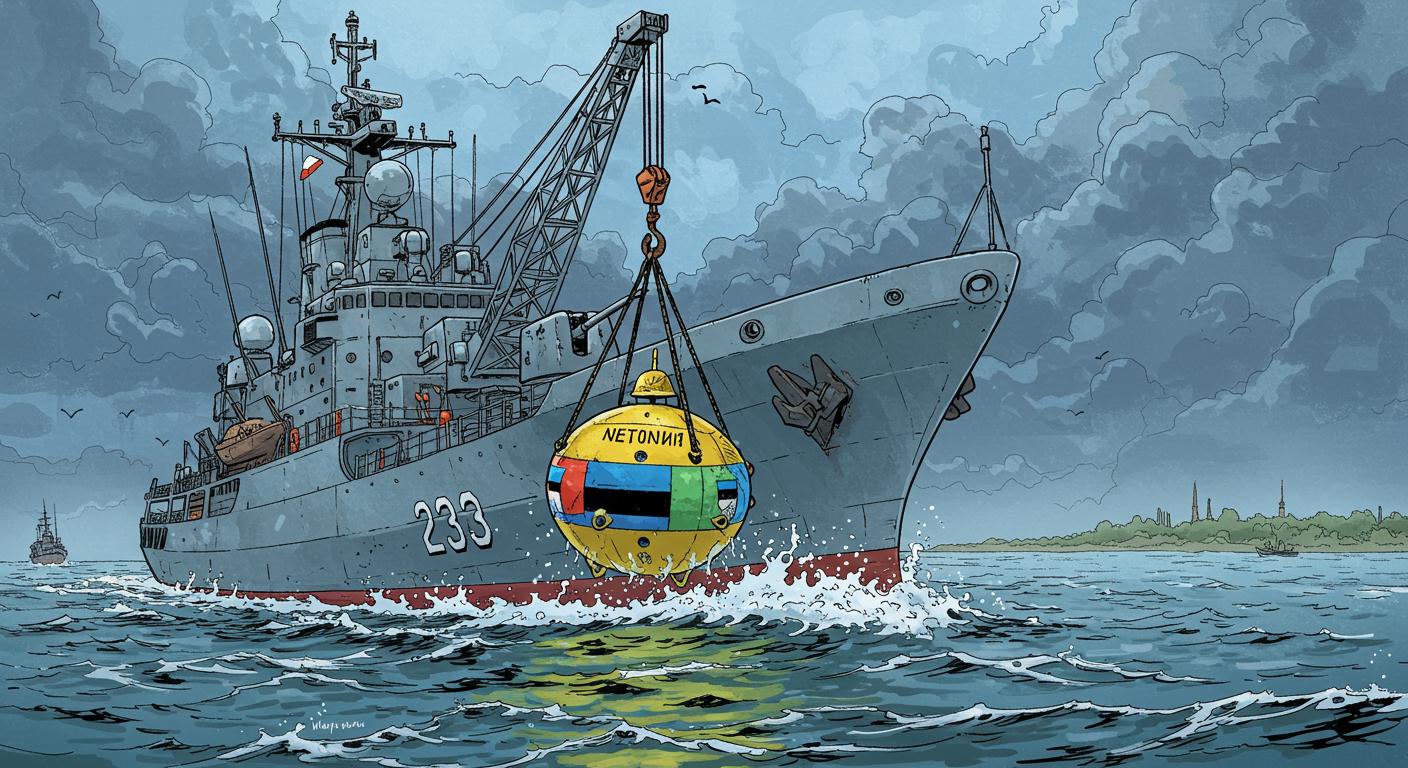
If you’ve been losing sleep over the safety of oceanographic measuring devices in the Baltic, consider this a gentle warning: things have just gotten a little stranger. As reported by ERR News, the Russian Navy has, quite literally, picked up a wandering Estonian wave buoy and escorted it to none other than the Kaliningrad naval headquarters. This isn’t your everyday international incident—but it does raise a rather specific question: are we witnessing the start of the first great Buoy Crisis?
Buoy Meets Bureaucracy, Meets Bureau
The saga began quietly enough. In late April, amidst the choppy waters off Hiiumaa, Estonia’s second-largest island, a wave-measuring buoy—purpose-built and diligently maintained by scientists at Tallinn University of Technology (TalTech)—was hard at work doing whatever it is that good buoys do. According to ERR News, the 50-centimeter device, floating in Estonia’s exclusive economic zone, was engaged in quietly monitoring wave characteristics—a relatively benign candidate for international intrigue.
ERR News describes how the buoy’s GPS data suddenly began defying the rules of wind and wave, prompting curiosity (and likely raised eyebrows) among TalTech researchers. Rather than drifting idly, the buoy appeared to be making purposeful progress—toward Russia. Rivo Uiboupin, director at TalTech’s marine systems center, noted that this deviation quickly triggered an investigation. Since the buoy’s registered location was outside Estonia’s strict territorial waters but within its economic rights, the situation swiftly entered that gray legal area where sovereignty and nautical etiquette do a slow waltz.
Mystery Ship, Mystery Motive
ERR News further reports that, after noticing the anomaly in the buoy’s data over April 26–29, TalTech reached out to Estonia’s navy, which in turn involved Latvia’s navy since the location neighbored Latvia’s waters. Latvia dispatched a vessel, but by then, the buoy—and any evidence of its presence—had vanished. With the help of Latvian naval analysis, the researchers matched patterns in the buoy’s unexpected movement directly to two nearby Russian Navy corvettes, described in ERR News as Bujan M-class ships. Notably, both ships had their automatic identification systems switched off—a move not uncommon for vessels preferring their activities go unnoticed.
According to statements relayed in ERR News by Cdr Ivo Värk of the Estonian navy, the Russian ships may have considered the research buoy a navigation hazard, especially if its presence wasn’t included in their charts. He suggested the operation was, at least on the Russian side, viewed as routine. This slightly charitable interpretation lands at an amusing intersection of safety concern and bureaucratic overzealousness.
The outlet also notes this is not the first buoy to “visit” Russia uninvited. Last year, Russian border guards removed over 20 Estonian demarcation buoys from the Narva River—none of which have ever been returned, and all of which now form an unlikely subchapter in the region’s history of cross-border friction.
Not Your Everyday Diplomatic Note
In a detail highlighted by ERR News, Estonia’s Ministry of Foreign Affairs has routinely submitted diplomatic notes to Moscow about such aquatic losses, but as with the still-missing Narva River buoys, official responses remain elusive. It’s not hard to imagine the fatigue that must come with regularly invoking “regarding your removal of our buoys” in international correspondence.
ERR News describes how Uiboupin and his colleagues were able to follow their missing buoy’s GPS signal as it traced a slow march to Kaliningrad, all the way into the naval base itself—a journey fit for a device usually destined for little more than marine data collection. One wonders if the Baltic Fleet HQ has set aside a corner for wave science relics.
Buoyant Resistance (and a Dash of Irony)
Despite a lack of international outrage—after all, not many naval thefts look quite this innocuous—ERR News confirms that TalTech has no plans to cancel its research. Another wave buoy will soon take up duty at the exact same location next week, defying whatever unwritten rules exist about discouraging small floating objects from trespassing into geopolitical theater.
The irony, as noted throughout ERR News’ coverage, is difficult to ignore. How often does a half-meter disk built for scientific research end up as both diplomatic football and unintended lesson in the absurdities of modern border tensions? One can only speculate—perhaps hydrography truly is the new espionage, or maybe the Russian navy simply enjoys the novelty of university-built gadgets.
And does anyone else wonder what the debrief was like for the Russian crew tasked with capturing a single Estonian buoy? It’s hard to imagine where “buoy retrieval” fits into the daily logbook of a Baltic Fleet patrol.
Summary (Buoys Will Be Buoys)
So, as TalTech prepares its next device and Estonia sharpens yet another diplomatic note, there’s a reminder in all this: international relations sometimes play out in the most unexpected venues, with the most unlikely protagonists. ERR News has documented an incident that is both low-stakes and quietly surreal, highlighting how the humble ocean buoy can find itself swept up in geopolitical currents far bigger than itself.
Are these incidents about safety, bureaucratic overreach, or just habit? File this under “Oddly Specific International Incidents”—and perhaps keep an eye out for the next Estonian research device embarking on an unscheduled Russian holiday.