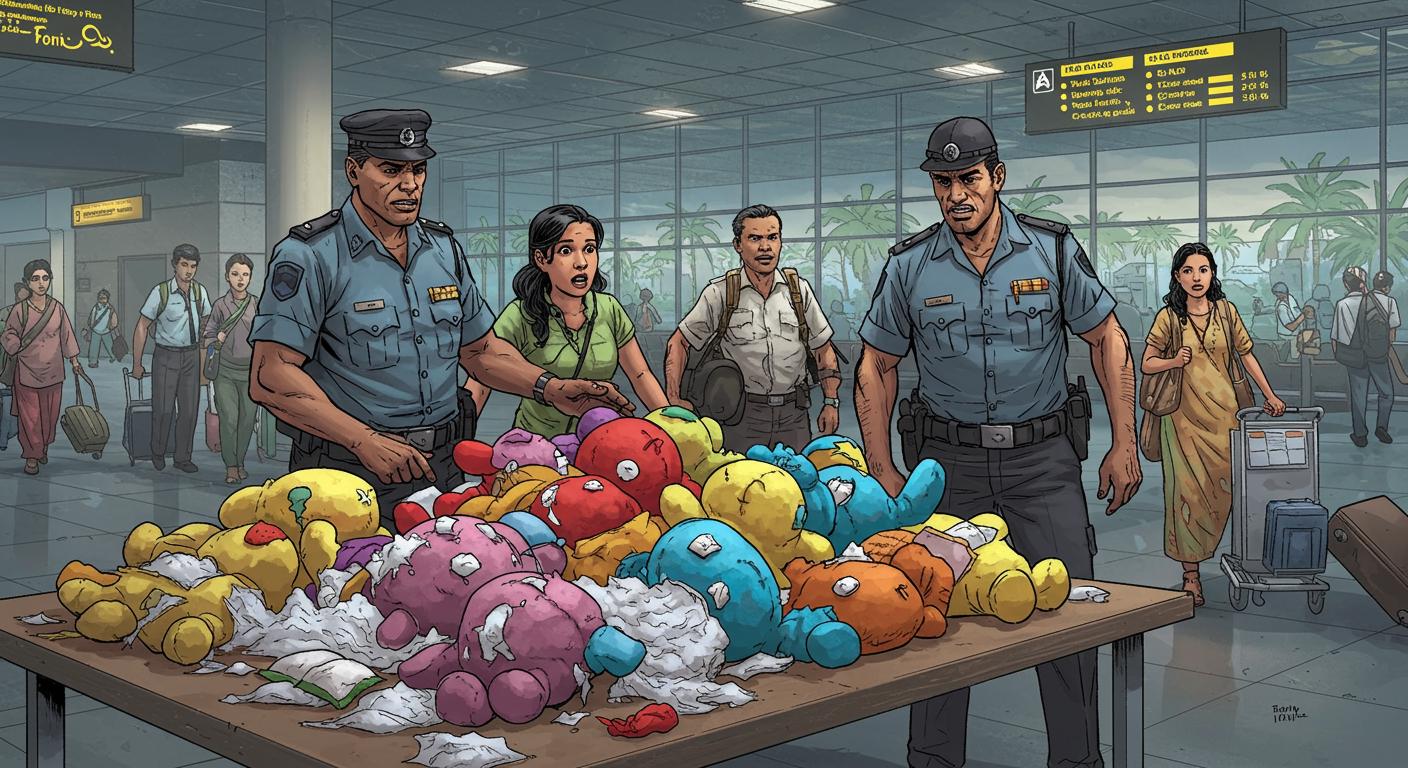
If you’ve ever idly wondered what separates a child’s bedtime companion from a record-breaking international drug bust, Sri Lanka’s customs agents now have a rather definitive answer. According to CBS News, the country’s main airport recently witnessed its largest-ever cocaine seizure—not in a high-security shipping container, nor a suspicious suitcase, but tucked neatly inside three innocent-looking plush toys.
Authorities at Bandaranaike International Airport apprehended a 38-year-old woman from Thailand after discovering nearly 10 kilograms (about 22 pounds) of cocaine ingeniously packed into more than 500 plastic capsules, all hidden within the stuffed animals. Seevali Arukgoda, a senior customs official, described this as the most significant cocaine smuggling attempt ever intercepted at the country’s airport. The haul’s estimated street value was reported to be a rather eye-popping $1.72 million. One imagines the customs team posing for their victory photo, a plush bear under one arm and a record-setting drug bust under the other—certainly not your average workday.
Velvet Fur and Velvet Rope
This dramatic plushie seizure arrived at the tail end of a particularly eventful month for Sri Lankan customs, which, as highlighted in the same CBS News report, had already netted nearly 60 kilograms of synthetic cannabis across several separate incidents. Three foreign nationals from Britain, India, and Thailand were arrested, each occasion hinting at a pattern of outsiders tasked with moving contraband through the island nation.
Among these, a notably awkward moment arose for Charlotte May Lee, a 21-year-old British former cabin crew member. She found herself detained after being discovered with 46 kilograms of synthetic “kush” packed into her suitcases. In her statement to the BBC, Lee described somewhat spartan conditions in a local prison, as well as her surprise at finding herself in Sri Lanka at all. Her journey, ostensibly to renew a Thai visa, seems to have taken an unexpected detour—though perhaps not the sort travel agencies typically advertise.
Is the new playbook for trafficking simply “blend in with tourist traffic” and “choose your smuggling vessel from the children’s aisle”? It raises the question of whether there’s any object left in the gift shop that hasn’t doubled as an attempted drug mule.
Sri Lanka’s Shifting Role
All of these curious seizures point to Sri Lanka’s growing role as a transit hub for international narcotics. The CBS News article notes that, beyond the current plushie plotline, the country’s authorities have a history of intercepting significant amounts of heroin offshore. Life sentences have been handed down in recent years to foreign nationals for smuggling offenses reaching well into the triple-digit kilogram range, including a 2016 incident where customs uncovered 800 kilograms of cocaine hidden among timber, demonstrating that, if nothing else, traffickers are committed to hiding their product anywhere a customs dog’s nose might not immediately land.
Earlier in the article, it’s emphasized that recent cases—whether synthetic or plant-based—are increasingly involving overseas couriers. These arrests illustrate the shifting strategies and the tough penalties awaiting those caught. This situation invites speculation: are traffickers becoming more creative, or are customs officials now simply better equipped to spot camouflage, however plush or bizarre?
The Absurdity of Outrageous Packaging
There is an unmistakable absurdity in major drug trafficking operations opting for containerized innocence—hundreds of plastic capsules tucked into animals meant for comfort, not criminal enterprise. Customs officials, finding themselves face-to-fur with the unexpected, are engaged in a modern cat-and-mouse game where the mouse sometimes wears a bow tie and comes pre-stuffed.
Yet, as described throughout the CBS coverage, the consequences remain severe, brushing aside the comedic surface of these escapades. Underneath the layers of cartoon logic is a very real, relentlessly evolving challenge for law enforcement—one where new packaging innovations are rarely cause for celebration.
Reflection: Strange Packages, Serious Stakes
In the end, this episode—like so many in the archives of the profoundly weird—manages to straddle the line between audacious and absurd. There’s a peculiar logic to hiding nearly two million dollars’ worth of narcotics inside objects drawn from the world of childhood, though perhaps we’ll now think twice about what’s really behind a teddy bear’s unblinking smile.
Just how many other not-so-cuddly surprises pass through airport X-ray machines every day, I wonder? With traffickers apparently willing to gamble both life and liberty on a plush decoy, it seems there’s no end to the ingenuity—or desperation—of modern smuggling. If even stuffed animals aren’t safe, what mundane object is off-limits for the next cunning twist?