There’s a phrase I’ve always liked: “Truth is stranger than fiction, because fiction has to make sense.” Nowhere does it ring more true than the revolving door oddly affixed to Sweden’s national security adviser post—a door that recently spun thanks to a dating app, some old photos, and the mysteries of government vetting.
Grindr, the Vetting Nemesis
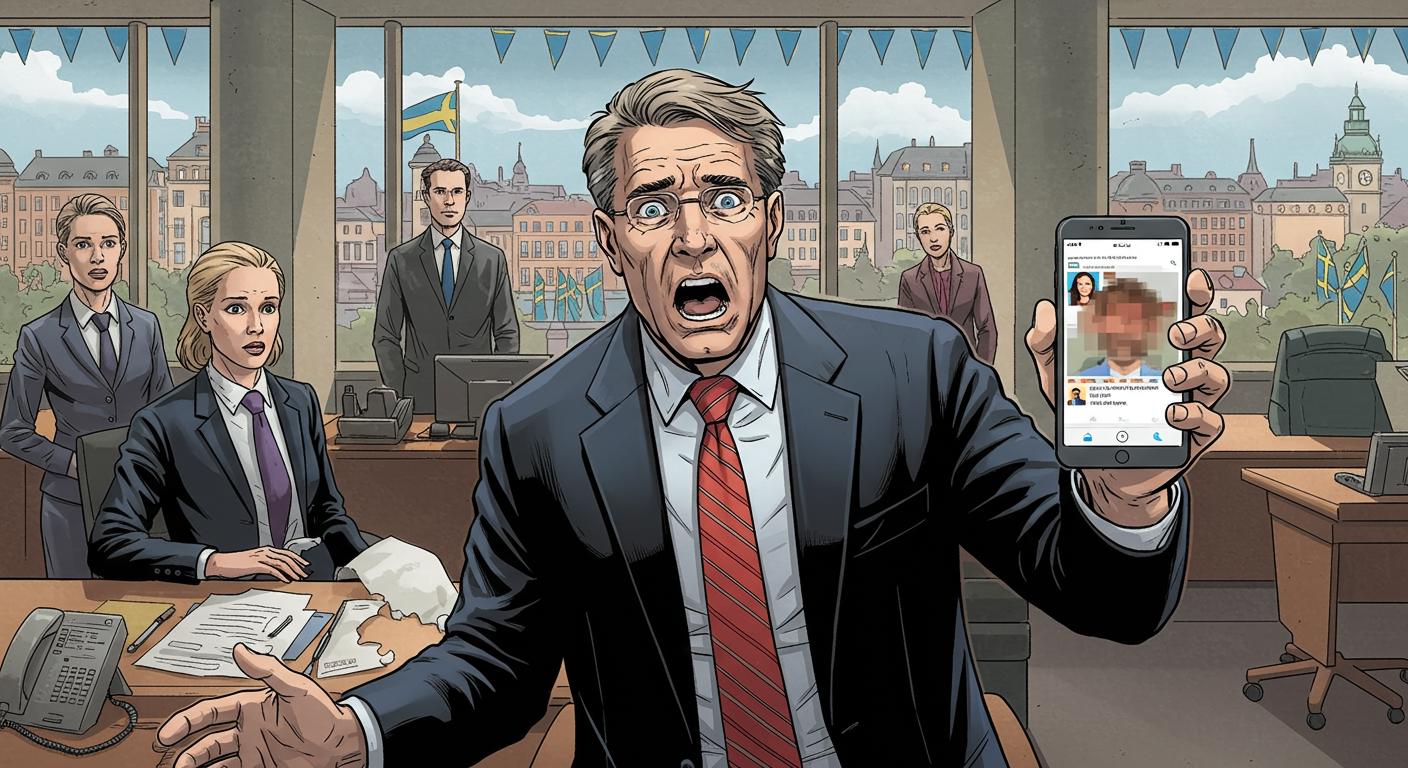
According to a BBC News report, Sweden’s freshly appointed national security adviser, Tobias Thyberg, managed to resign mere hours after accepting the role. The catalyst? Sensitive images from his prior Grindr account were anonymously forwarded to the Swedish government almost immediately after his appointment was announced.
The Local, summarizing details from the Swedish newspaper Dagens Nyheter, explains that DN’s inquiry about a “sensitive” picture prompted Thyberg himself to address the situation: he acknowledged, “These are old pictures from an account I previously had on the dating site Grindr. I should have informed [the government] about this but I didn’t.” This frank, if belated, admission was echoed in his message to DN, quoted in both BBC and The Local.
The speed of this episode is almost comedic: The press release naming Thyberg as adviser landed, and, almost on cue, an anonymous sender delivered compromising material to the government, as detailed by Expressen and relayed by BBC. Thyberg’s expected debut event with the prime minister in Norway was quietly cancelled. Government officials, including Kristersson’s senior aide Johan Stuart, emphasized to newswire TT (via The Local) that “completely new personal information” about Thyberg had emerged post-appointment, triggering an immediate new security conversation.
In Oslo, Prime Minister Ulf Kristersson described the scenario as a clear “systemic failure,” according to Reuters as cited by BBC. One imagines Sweden’s vetting team frantically updating their protocols—possibly adding a crash course in dating app footprint for future candidates.
The Curse of the Security Adviser
Sweden, it seems, can’t catch a break when it comes to filling this high-stakes position. The Local helpfully lays out the recent history: Thyberg’s predecessor, Henrik Landerholm, resigned just months earlier under a very different but equally striking cloud. Landerholm, considered a close confidant of the prime minister and originally tapped as a safe pick, found himself under investigation for leaving highly classified documents behind in an unlocked safe at a hotel during a conference.
As reported by BBC and summarized in Swedish media, prosecutors charged Landerholm with careless handling of secret information—his alleged negligence reportedly exposing confidential details whose disclosure could, in theory, harm Sweden’s security. His lawyer, as noted in Swedish outlets, maintains that Landerholm is not guilty.
Two advisers, two quite distinctive brandings of trouble, and all within the brief life span of this still-newly created security post. The assembled pieces start to look less like isolated incidents and more like a pattern worthy of an enterprising archivist’s attention.
A Den of Irony: Security and Secrets in the Digital Age
Thyberg’s professional background—ambassador to Afghanistan, then Ukraine, most recently overseeing Sweden’s Eastern Europe and Central Asia portfolio—was plainly credible, as summarized by The Local. What it didn’t immunize him against was the ghost of an old dating profile lurking somewhere, discoverable by those with motivation and basic internet skills.
There’s a certain absurd inevitability here. Government vetting, designed to catch vulnerabilities, missed a potential target not due to ignorance, but because no one thought to ask about outdated but still accessible digital dalliances. Thyberg’s resignation, as reported by both The Local and the BBC, underscores a uniquely modern truth: Security risks are equally likely to lurk in abandoned safe boxes and abandoned servers.
Meanwhile, Stuart’s comments to TT suggest that future vetting will involve a more wide-ranging conversation. One wonders if their updated checklist will begin with, “Have you ever, at any point, uploaded a photo of yourself anywhere for any reason?” (A safe bet: most hands at the table go up.)
Odd Patterns, Stranger Futures
A pattern emerges, hard to ignore: consecutive advisers, each forced out not by direct malfeasance in their advice, but by peculiar lapses—one physical, one digital. Where officials and commentators might see red flags, archivists and the ever-curious might also notice the accumulating folder of national security near-misses.
Sweden’s continuing search for a national security adviser able to keep both secrets and their digital trail tidy now borders on the folkloric. Is this just extraordinary bad luck, or are we watching the security landscape evolve in real time—where vulnerabilities come from encrypted chats and old app accounts as much as from physical slip-ups in hotel safes?
And so, the coveted adviser’s chair remains vacant, the line-up of outlandish challenges grows, and somewhere in Stockholm, a government HR officer may be brainstorming the next evolution of the interview questionnaire.
In the meantime, it’s fair to ask: In an age of digital ephemera and viral leaks, what’s more dangerous for a national security adviser—misplaced files, misjudged passwords, or the simple persistence of things we once put on the internet and forgot? Some truths, it seems, are best left archived—preferably in password-protected folders.