
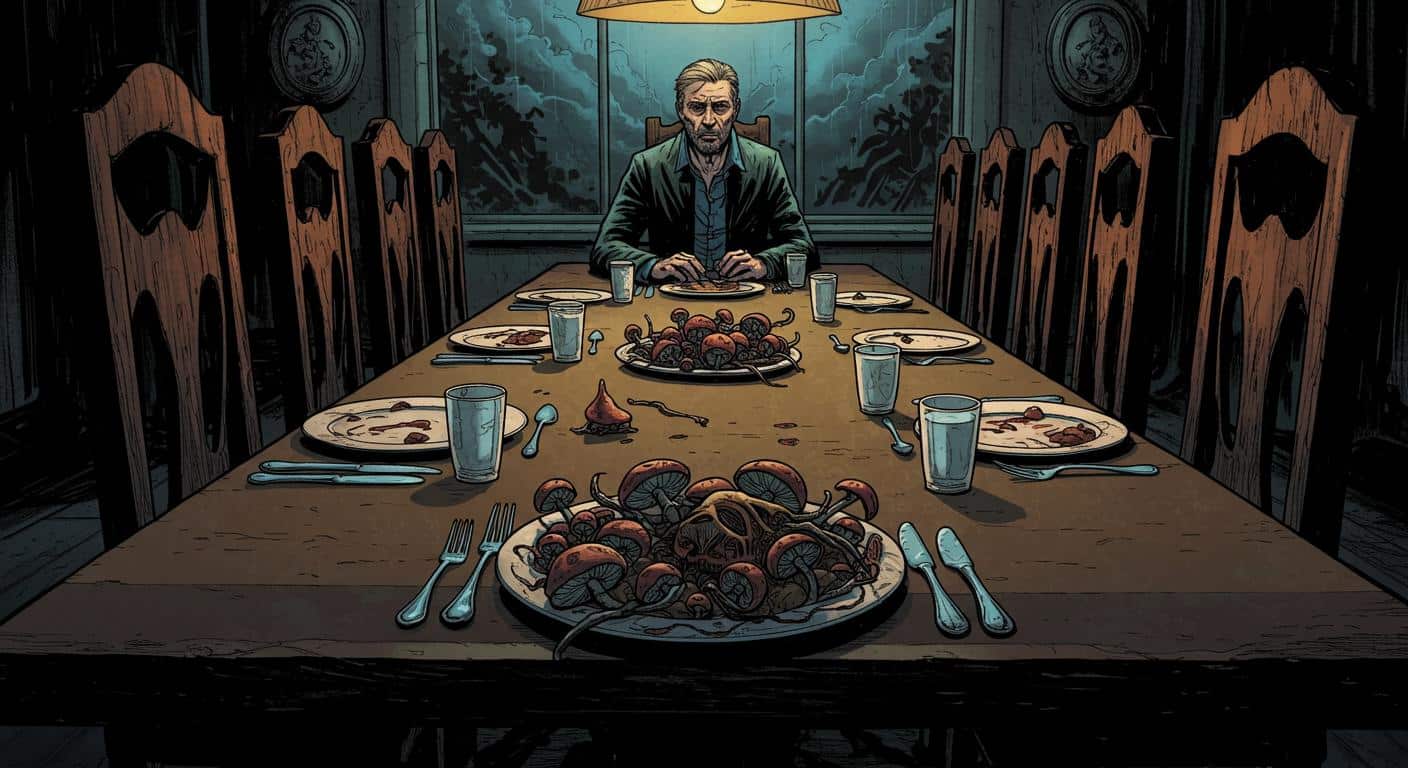
There are few party fouls quite as severe as serving up toxic death cap mushrooms to your in-laws—yet that’s precisely the quietly devastating scenario explored in a Morwell, Victoria courtroom this week. In this uniquely Australian tragedy, the stakes are far more dire than overcooked meat or a forgotten allergy: a single lunch, three deaths, and a slow, methodical investigation trying to untangle whether this was orchestrated malice, catastrophic mishap, or something even stranger.
“We Were Happy to Be Invited”
As chronicled in detail by the BBC, Ian Wilkinson—local pastor, sole survivor, and perhaps unintended chronicler of the event—painted a scene of understated normalcy. The invitation arrived in the most benign fashion: Heather, his wife, jotted “Erin for lunch” into her diary, and the couple, not close but “amicable” acquaintances of their hostess, were “very happy to be invited.” Wilkinson’s reflections on the invitation, and his hope that “maybe our relationship was going to improve,” now read like grains of sand drifting through an hourglass you hope never runs out.
Testimony recounted by the Otago Daily Times matches that tone: Wilkinson recalled a mundane morning, a drive to Leongatha, a look at the host’s garden, and a polite offer to help with plating the food—gently refused by Erin Patterson.
The Curious Case of the Plates
Digging into the odd, detail-obsessed corners of the case, the BBC notes that four guests were served on matching grey plates, while Patterson herself used an “orangey tan” one. In a moment that only a veteran of the family dinner circuit might notice, Heather Wilkinson later remarked to her husband in hospital about the different color. Both outlets mention that all the food was plated personally by Patterson, despite offers of culinary assistance from her guests. Whether this plate-color quirk suggests anything nefarious, as both sources report, or simply the usual chaos of mismatched dinnerware, remains up for debate.
As reflected in both the BBC and the Otago Daily Times, meal service was unremarkable—each guest received an individual, pastry-wrapped beef Wellington, which “when we cut into it, there was steak and mushrooms.” Post-meal, there was as much teasing as you’d expect over who finished whose leftovers: Don, it appears, was not shy about helping Gail polish off her serving.
Sudden Sickness and the Diagnosis That Changed Everything
The transformation from routine to crisis was rapid and, in the moment, inexplicable. According to Wilkinson, they spent the evening preparing for church; Heather, he said, “abruptly got up and ran to the laundry” to be violently ill. Sympathy for suspected food poisoning (“suspicion was falling on the meat,” as he recalled, via BBC reports) quickly gave way to alarm when nobody recovered overnight.
Events then rolled forward with the kind of bureaucratic urgency familiar from every hospital drama but altogether more grim: the BBC details how Wilkinson and his wife were “abruptly woken up by a group of nurses who literally ran us down the corridor in our beds.” Medical staff then informed the couple that communication from specialists suggested it was a case of suspected mushroom poisoning, not ordinary foodborne illness. “He was very frank. He said it is a very serious situation. He said there was time critical treatment available,” Wilkinson told the court, per the BBC. The pair were then transferred by ambulance for further care.
Ultimately, Don, Gail, and Heather died in Melbourne hospitals in early August. Wilkinson was left to endure seven weeks hospitalized, including three under intensive care—details consistent across the BBC’s account and the Otago Daily Times’ summary of his statement.
Motive, Mushrooms, and a Moment of Prayer
Intent is at the undoubted center of the legal wrangle, and here the case twists into the peculiar. Patterson’s defense, noted by both the BBC and Otago Daily Times, is that this was all a tragic, panicked accident. The facts—that death cap mushrooms were responsible—aren’t disputed; what’s in question is how, and why, they’d join the menu.
Within the post-lunch conversation, a strange tangent emerges. As captured in Wilkinson’s measured testimony—again, per the BBC—Patterson told her guests she had cancer, seeking advice on how to tell her children. “In that moment, I thought this is the reason we’ve been invited to the lunch,” Wilkinson explained. He offered a prayer for her and her family’s well-being, describing a “relatively short conversation” that was cut off when children returned to the house. It’s a detail that is as odd in context as it is impossible to overinterpret from a distance.
On the topic of mushrooms, the BBC also highlights evidence shown in court, including images of a dehydrator brimming with mushrooms Patterson shared online, and a text message in which she wrote, “I’ve been hiding powdered mushrooms in everything”—an admission, her lawyers say, born of a parent’s culinary struggle to feed fussy children, rather than sinister forethought.
Court documents cited by the BBC and further discussed in the Otago Daily Times reference Patterson’s recent true crime social media activity and her online queries about preparing beef Wellington, all in the months leading up to the event.
The Disarming Normalcy—and Enduring Uncertainty
Wilkinson’s observations, as relayed by the BBC, perhaps best capture the enduring oddness: “She just seemed like a normal person to me… We never had arguments or disputes. She just seemed like an ordinary person.” The lunch invitation was a minor gesture towards amity, not the prelude to disaster. The meal, in his account, was typical. The outcome, unthinkable.
What lingers is the way small things—a mismatched plate, a jotted diary entry—become central evidence in a sprawling, tragic mystery. How often does a case hinge on something as innocuous as the color of ceramics or the offhand comment about one’s pantry? Can a meal pivot so swiftly from communal comfort to catastrophe?
If Wilkinson had not survived, one wonders if any of this would have been so painstakingly examined. Perhaps in the ordinary, the subtle, and the polite, there’s much more that escapes our daily notice—culinary accidents, sincere kindness, and sometimes, sadly, fatal error. The court will continue to untangle intent from incident. In the meantime, even the most everyday meal takes on just a bit more gravity.