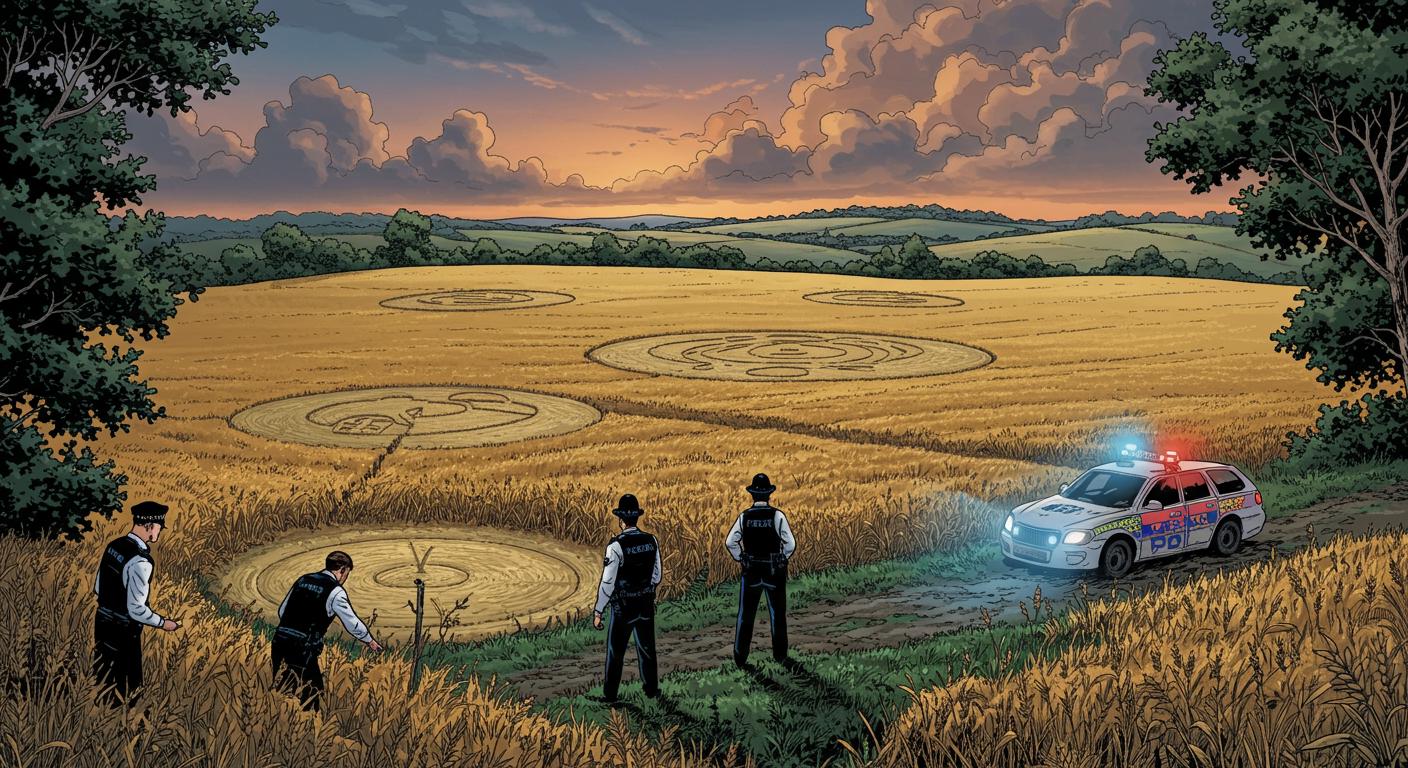
The summer fields of Wiltshire are no strangers to intrigue. Over the years, this patch of the English countryside has become a kind of open-air gallery for the world’s most ambitious (and possibly extraterrestrial) doodlers. As BBC News details, crop circles have become such a frequent local spectacle that Wiltshire Police are now, once again, stepping in—not to solve any close encounters, but to remind everyone that even the most artful trampling of barley is, at the end of the day, a matter for the law.
Circles of Contention
According to reporting by Sophie Parker for BBC News, Wiltshire Police are putting out a public plea: report any crop circles you come across, because creating them without a landowner’s blessing counts as criminal damage. Even geometrically satisfying spirals don’t override agricultural impact, it seems, and police warn the acts can cause “serious short and long-term damage to crops and fields.” The tone is almost refreshingly businesslike—no government secrets, just concern for property rights under threat from would-be artists.
BBC News also indicates that while crop circles certainly appear across Wiltshire, not all are unauthorized. Some are arranged with permission—the phrase “legal crop circles” stands out here—but the unauthorized ones bring a suite of issues, from illegal drone use to aggravated trespass or even theft from farm buildings. Even for E.T., there’s evidently no exception from damage assessments or insurance paperwork.
Signs, Drones, and Field-Day Liability
Guidance detailed in the BBC’s report outlines practical steps for landowners who awake to find fresh geometries crisscrossing their fields. Police recommend those wishing to avoid a steady trickle of visitors should mark circles with “no public access” signs. If landowners are, in fact, happy to host curious onlookers, they take on health and safety responsibilities, and may need to consult their insurers (ideally before the first UFO enthusiast stumbles into a rabbit hole).
The force is clear: report sightings of crop circles—no cosmic hotline needed, just the local 101 phone number or online portal. You have to wonder if there’s an internal Wiltshire Police flowchart that sits neatly between “lost livestock” and “mysterious ring in the wheat.” And while the BBC notes police remain silent on any extraterrestrial input, the guidelines are less about decoding messages from the stars and more about keeping summer field traffic orderly.
Earlier BBC reporting has dipped into the perennial debate—are crop circles vestiges of ancient pathways, bits of performance art, or simply well-coordinated mischief? Wiltshire, steadfast in its role as both historical heartland and curiosity magnet, finds itself at the intersection of the practical and the peculiar, letting speculation run as free as new wheat—so long as nobody’s trespassing.
Art or Offense? Depends on Permission
There’s something quietly delightful in the understated way local officials address the phenomenon. Crop circles are, in this context, neither apocalyptic warnings nor sacred omens—just another seasonal wrinkle in rural management. Perhaps, as reflected in the BBC’s coverage, the sight of whorled barley has become routine enough to elicit more of a sigh than a gasp.
It raises the question: how many law enforcement agencies keep a standing file on unexplained crop artistry? Wiltshire likely has a folder somewhere labeled “Seasonal Circularities,” buried next to the paperwork for rogue tractors and overzealous revelers. For the rest of us, it’s a minor marvel to note that in these fields, ordinary law applies, no matter how extraordinary the artwork.
While the mystery of their creation remains tantalizing for some, for Wiltshire Police—and their 101 reporting system—it’s simply a case of keeping the peace among circles and crops alike. Whether you’re a believer, a skeptic, or just in it for the symmetry, at least you know whom to call if the aliens (or your neighbor) get overzealous with their night-time designs.