
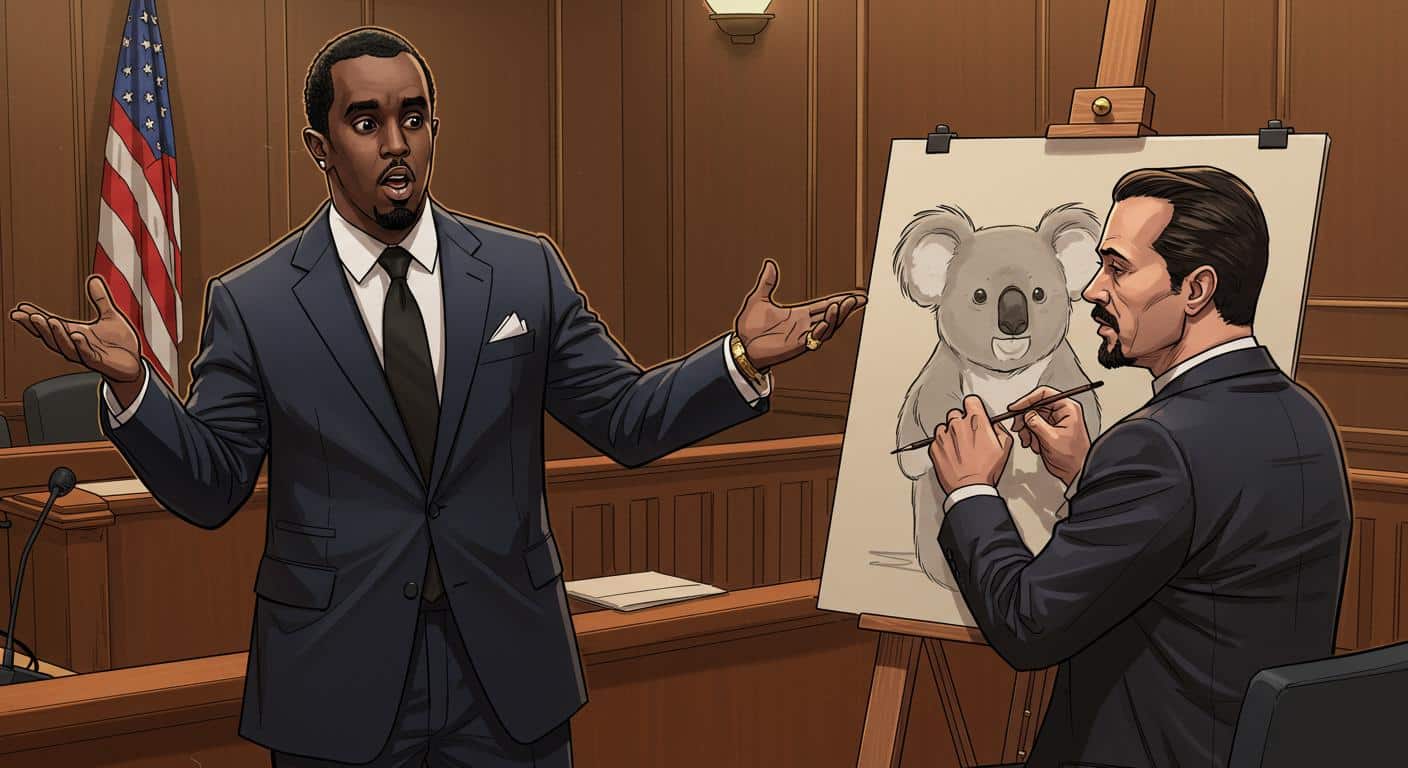
It wouldn’t be the first time a high-profile defendant locked eyes with a courtroom artist and, for a brief moment, forgot the gravity of their predicament. But Sean “Diddy” Combs, now in the dock on federal sex trafficking and racketeering charges, may have set a new benchmark for disarming candidness during his New York trial. According to Reuters, amidst the suits and procedural tension, Diddy turned to veteran sketch artist Jane Rosenberg, offering a plaintive critique: “Soften me up a bit, you’re making me look like a koala bear.”
Art Meets Allegation
The average courtroom is not a setting known for levity or vulnerability. Cameras aren’t allowed, so artists like Rosenberg serve as our collective proxies, rendering fraught moments in pastel or graphite. Diddy, gray bearded and stocky at 55, has reportedly worn sweaters and sported his new look throughout the four weeks he’s spent in court, as Reuters reports. Maybe no one expects to look their best in a courtroom sketch, but comparing oneself to a koala—a famously round and perpetually bemused marsupial—reveals a rare note of self-awareness, or perhaps just good old-fashioned vanity with a dash of humor.
According to CBS News New York, Rosenberg is well accustomed to fielding requests for artistic leniency. She recounted that Donald Trump Jr. once asked her to “make me look sexy” during a civil fraud trial. Meanwhile, Rudy Giuliani, in a separate case, remarked that Rosenberg’s rendition made him look like his own dog. Rosenberg, having covered high-profile trials for four decades—including the likes of Ghislaine Maxwell and Dzohkhar Tsarnaev—simply takes these critiques in stride. In her own words, “Art is different. Anything that is handmade, touched by a human, I think it adds an element that draws people in,” as highlighted by CBS News New York. Criticism, it seems, comes with the territory.
The Sketch Heard ‘Round the Court
Diddy’s outburst—or perhaps just a sheepish request—came as the jury filed out for a lunch break. NewsNation reports that in an aside to Rosenberg, Combs asked her to “soften” his depiction and elaborated with his now-infamous koala comparison. Vanity, it seems, finds a foothold even when the possibility of life in prison hangs overhead. Is it possible to blame him? There’s something innately human about worrying over one’s public image—especially when the resulting sketch, destined for collective memory, might portray you as a creature more suited to eucalyptus than cross-examination.
Yet the backdrop is far from lighthearted. As CBS News New York notes, Combs is facing five charges: racketeering, sex trafficking, and what federal prosecutors describe as “a persistent and pervasive pattern of abuse toward women and other individuals.” The allegations include arranging for sex workers to attend “freak offs” and using his wealth and influence to control alleged victims. Still, even in the midst of such grave proceedings, Combs’s comment offers a flash of unscripted humanity. How does someone accustomed to media mastery react to being captured, warts and all, by an unfiltered hand?
A Tradition of Artistic Adjustments
Rosenberg’s sketchbook seems to attract more feedback than a social media thread. CBS News New York describes how, in addition to Donald Trump Jr. and Giuliani, Ghislaine Maxwell at one point started sketching Rosenberg from the defense table. This strange feedback loop—artist drawing defendant, defendant drawing artist—highlights a courtroom tradition where the rendered contend with the renderer. Even across such serious contexts, the focus sometimes shifts, if only momentarily, from justice to the oddities of personal representation.
Reuters further documents that Rosenberg, tasked with illustrating without the luxury of retakes or touch-ups, has become an unofficial observer of collective public anxiety—especially among the high-profile and image-conscious. Is there something universal about the desire for a more flattering likeness, or is it heightened when you know your sketch could be splashed across the news?
Why the Koala?
The animal kingdom offers a broad palette—so why the koala? Whether it’s the soft cheeks, the rounded features, or simply an aura of approachable cuddliness, the choice is oddly apt and inexplicably funny, given the gravity of the moment. NewsNation also notes that Combs made this request as the jury left for lunch, further underlining the surreal, almost gentle interruption in the otherwise stern ritual of federal trial.
Of course, none of this erases the severe allegations at hand, but it does add a layer of strange, almost endearing humanity to an otherwise unrelenting courtroom scene.
Reflections at the Edge of the Sketchpad
This exchange between Combs and Rosenberg, noted across Reuters, CBS News New York, and NewsNation, prompts an admittedly odd question: in the midst of dire legal proceedings, what does it mean to care about looking like a koala? Is it mere vanity, a hopeful attempt at image management, or just a nervous blurt?
For onlookers, it’s a reminder that people—even those staring down enormous consequences—are never just their worst or most public moments. Sometimes, they’re just hoping they look a little less round in pastel. In the end, maybe being immortalized as a koala is a peculiar sort of solace—a soft focus in an otherwise unforgiving spotlight.