
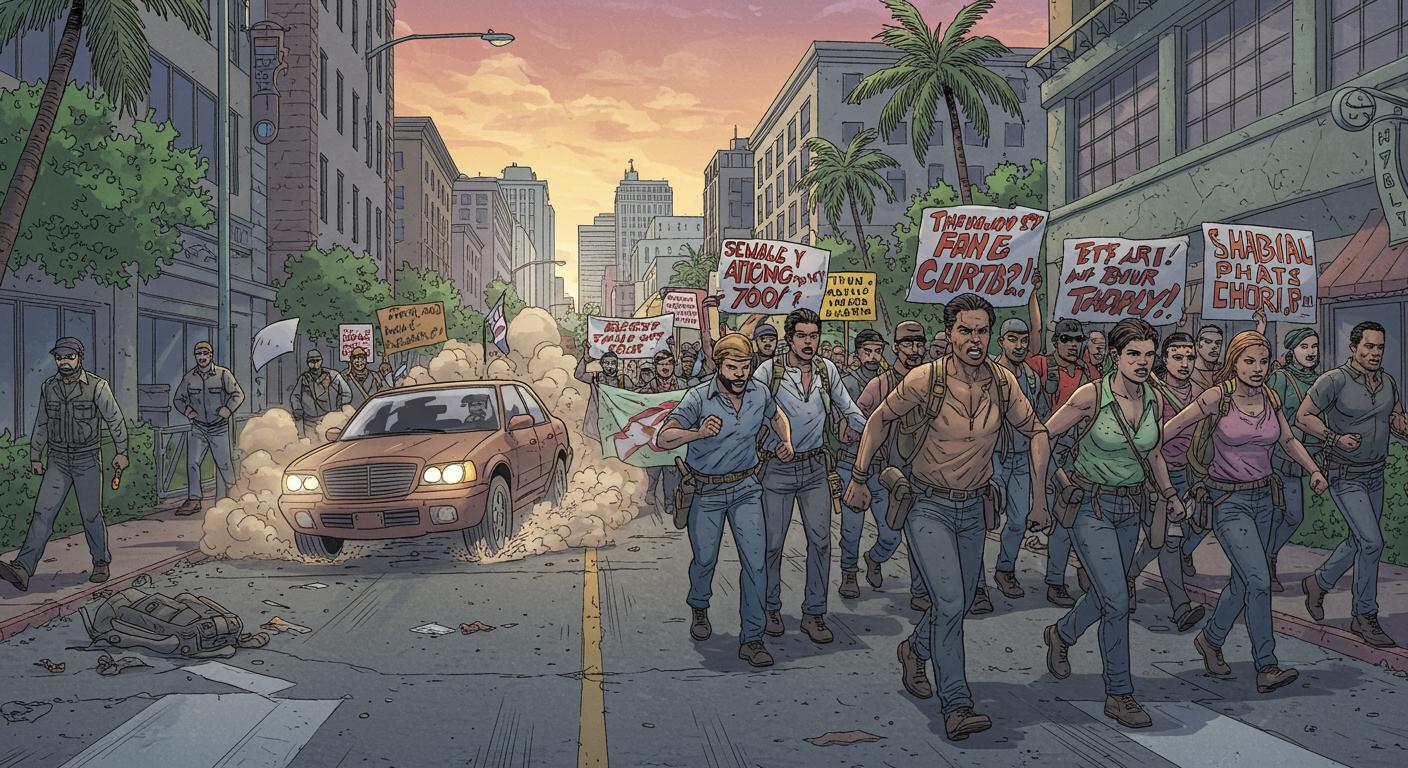
Well, the “Sunshine State” never disappoints when it comes to serving up policies that feel plucked from a fever dream—or at least, the less whimsical chapters of American history. In a recent appearance on The Rubin Report, Florida Governor Ron DeSantis appeared to casually one-up “stand your ground” laws by delivering a message that vehicular escape—potentially involving running over protesters—has the governor’s stamp of approval, provided drivers feel endangered. Why stop at castles, apparently, when you can defend your Honda Civic against “a mob”?
Protect and Swerve?
During his Rubin Report interview, DeSantis told host Dave Rubin, “If you’re driving on one of those streets and a mob comes and surrounds your vehicle, and threatens you, you have a right to flee for your safety. And so if you drive off and you hit one of these people, that’s their fault for impinging on you. You don’t have to just sit there and be a sitting duck and let the mob grab you out of your car and drag you through the streets,” as reported by Newsweek.
A.G. Gancarski of Florida Politics recounts that DeSantis referred to this as a kind of “zero-tolerance policy,” underscoring that, if people in Florida feel threatened by a group while driving, they have the right to run them over in order to get to safety. The governor positioned this as a sharp contrast to the approach in other states, remarking that unlike “Portland, you ain’t just getting a slap on the wrist… you’re going to end up in the inside of a jail cell, and you will be held accountable.”
As noted by Newsweek, these comments come just before the “No Kings” protest set for June 14, with organizers emphasizing their non-violent approach and de-escalation training for participants. Whether de-escalation now includes practical instructions for pedestrian agility remains to be seen.
What Could Possibly Go Wrong?
DeSantis’s stance is apparently a statement against the type of civil disobedience recently seen elsewhere, referencing “riots in Los Angeles” as described in Florida Politics. The governor made it clear that state resources are on alert and will be “deployed as needed” in case protests in Florida get out of hand.
Newsweek also ties DeSantis’s comments to unsettling precedent by recalling the 2017 tragedy in Charlottesville, where Heather Heyer was killed after James Alex Fields Jr. drove into a group of counter-protesters, unsuccessfully claiming self-defense. The argument: under Florida’s rules—as presented by DeSantis and repeated by sources—drivers need not hesitate to respond forcefully if their safety feels compromised in the context of a protest.
There’s a certain tension in inviting people to use their cars as exit strategies—with the heat of a moment and the definition of “mob” left largely to personal interpretation.
The Price of Passing Through
It’s not hard to imagine how such rhetoric could play out: a group of sign-wavers clog a crosswalk, a driver feels a spike of anxiety, and—according to the governor’s framing—the resulting collision is the fault of “impinging” protesters. The calculus seems to hinge less on proportionality, and more on a situational sense of threat. Is this the “life, liberty, and pursuit of happiness” the Founders envisioned, or just another modern spin on that old American pastime: redefining the boundaries between civil liberty and the right-of-way?
It’s an unusual moment when official guidance for contentious street encounters becomes: hit the gas if you’re scared. Does fear now trump judgment? Or are we simply handing over the rules of engagement to whoever has the keys and a convincing story?
Reflection
So we find ourselves with a state policy suggestion that, in effect, labels the open road as a possible free, if not bumpy, escape route from protest. With demonstrations looming and officials framing the situation in terms of “mobs” versus drivers, one can’t help but wonder—are the intersections of American life about to get even dicier? Or is the real subtext that, in Florida, any sense of danger while driving sidesteps ordinary caution and brings policy into very strange territory?
Questions about the traffic code rarely make for dramatic protest signs—but in Florida, they may just decide whose story gets the right of way.