
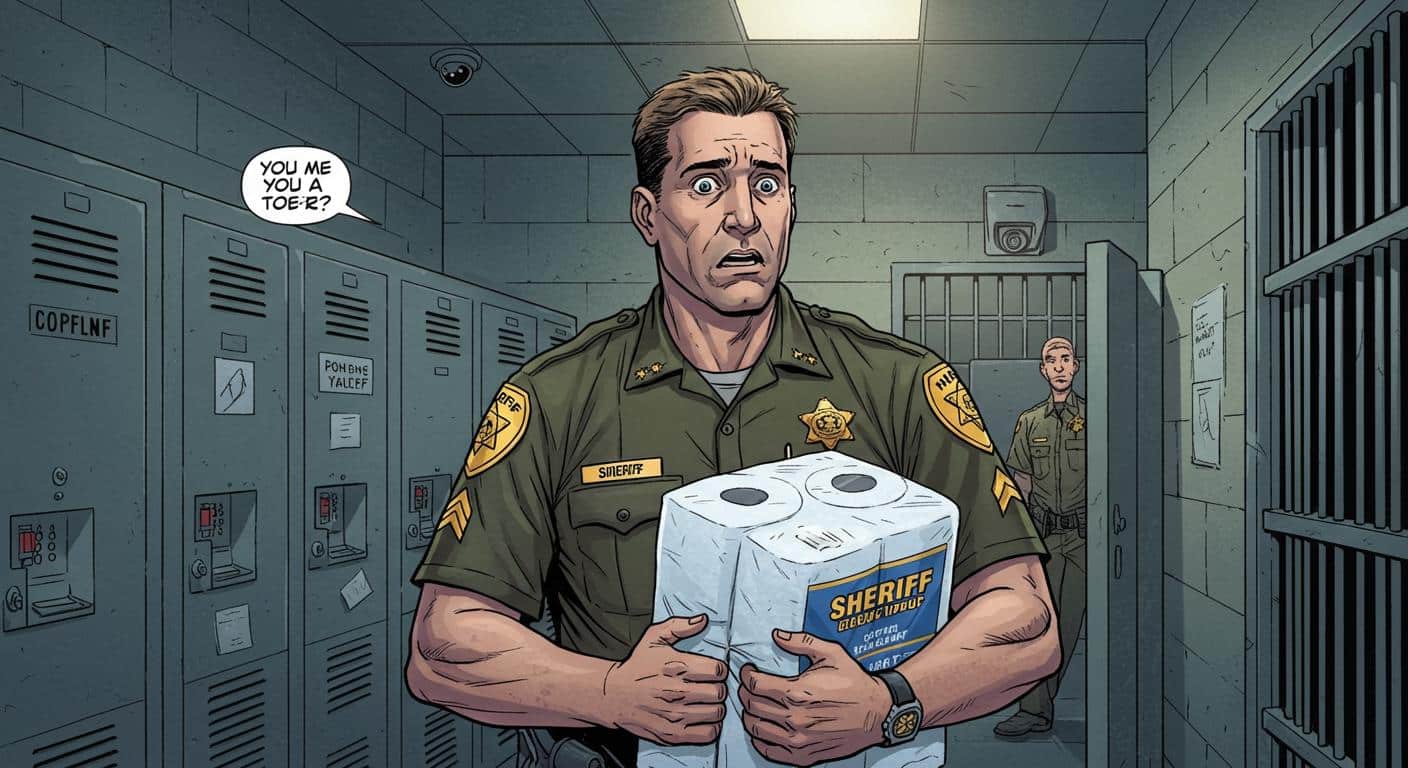
Sometimes the details tucked away in police records are stranger than fiction. According to The Badger Project, a Fond du Lac County sheriff’s deputy landed in the headlines for a feat rarely seen in law enforcement circles: the unauthorized extraction of five rolls of jailhouse toilet paper.
Five-Finger Discount, Restroom Edition
In a scenario that might have made more sense during the Great Toilet Paper Panic of 2020, Coty Hazelett, then a correctional sergeant in Vilas County Jail, found himself resigning after he admitted to taking five rolls of the facility’s supply. The Badger Project, referencing records requests, reveals Hazelett’s contrition came in the form of an apology letter in which he stated he returned four of the rolls and offered to reimburse Vilas County for the fifth. His written mea culpa included the kind of supervisory self-reflection rarely seen outside HR training manuals: “As a supervisor, I should have known better than to do this, and should be making the example to my shift that this is not acceptable.” One wonders—did a similar letter circulate internally the first time someone swiped a pen?
For those who appreciate odd statistics, Hazelett also claimed, “This is the first time I have intentionally taken property from the jail, and it will not happen again.” An accidental roll here or there, perhaps, but the record is clear: this one was deliberate.
Negative Separations and Not-So-Sticky Endings
What happened next straddles the line between institutional pragmatism and the peculiar churn of local government employment. Sheriff Ryan Waldschmidt of Fond du Lac County confirmed in an email to The Badger Project that Hazelett’s initial resignation was flagged as a “negative separation” in the Wisconsin Department of Justice’s database. Despite this somewhat inauspicious marker, Hazelett soon found his way back to Vilas County’s payroll, albeit at a lower-level correctional officer position. The outlet also notes that, following his eventual departure in 2023, this second stint was officially logged as “resigned in good standing.” It’s a fascinating study in the flexibility of redemption, especially where staffing shortages come into play.
Hazelett, for his part, declined to offer any statement for the record (a wise move from a public relations perspective, if perhaps a missed opportunity for product placement by local tissue manufacturers).
When the Talent Pool Drains Dry
If you find yourself surprised that someone could leave a job over pilfered paper products and land another position in a neighboring county, you’re not alone. As The Badger Project points out, Wisconsin’s law enforcement agencies are currently grappling with “near record lows” in staff levels, especially in entry-level corrections roles, which also tend to be the least financially rewarding in the field. Officials told the outlet that the Fond du Lac County Jail, for instance, is budgeted for 65 jail officer positions and currently has 63 filled—a statistic that underscores just how thin the ranks are.
This context puts Hazelett’s revolving door career not just in sharper relief, but almost in the realm of inevitability. As described in the article, the shrinking applicant pool means many departments, faced with choices between unfilled shifts and perhaps a slightly soiled employment record, are opting for the latter. Is this a symptom of lax standards, desperate times, or just evidence that few infractions are truly disqualifying? The lines get blurrier the farther one ventures from the command staff’s office.
Tidy Endings or More Paperwork?
It’s tempting to treat this as bureaucratic slapstick—a cautionary tale about what happens when you take “employee benefits” a bit too literally. Yet, as noted by The Badger Project, Hazelett’s story isn’t unique; Wisconsin’s jails have rehired dozens of officers previously fired or forced out elsewhere, a quirk of the market that raises questions about oversight and the meaning of a “fresh start.”
Does a minor theft permanently stain a career, or is it just a footnote in an already challenging staffing climate? And if the system is designed to eventually let you back in—minus one roll, maybe—what does that say about the dynamics of accountability or forgiveness in public service?
Strange as it sounds, this saga of soft contraband captures something quintessentially human about the machinery of local institutions: even in places devoted to rigid order, the line between lapse and leniency sometimes proves surprisingly, even comfortingly, flexible. Next time you find yourself debating government waste, remember—sometimes it’s measured one square at a time.