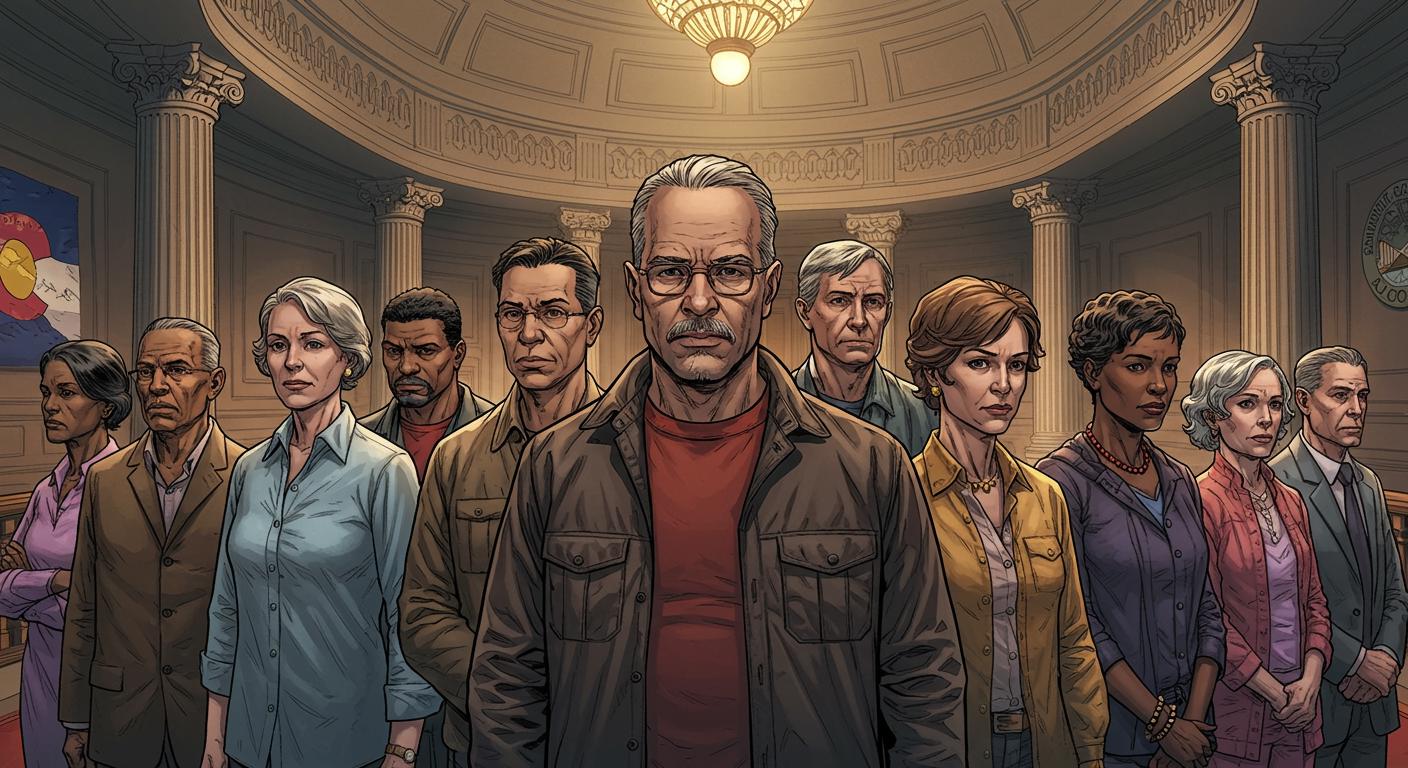
In the world of legal oddities, sometimes a single, heartbreaking event forces the whole system to ask, “Wait—what exactly counts as a grandparent?” That’s precisely what unfolded in Colorado, where, as CPR News details, a devastating murder-suicide didn’t just shatter a family, but nudged the state’s Supreme Court into redrawing family lines—on paper, at least.
From Grief to the Courtroom: When Family Gets Technical
According to CPR News, in 2020, Delta County was rocked by the deaths of Brandon and Amanda Sullivan—a tragedy that left behind a two-year-old and newborn twins. Amanda’s parents, Suzanne and August Nicolas, soon took custody and later formally adopted the children, solidifying their status not just in the family photos but also, crucially, in the legal records.
It didn’t take long for the paternal grandparents—Jayne and Daniel Sullivan—to step forward. They sought visitation rights, which, at first, the court allowed. But the matter grew knottier when the Nicolases contested the Sullivans’ standing after the adoption, pointing to a peculiarity in Colorado law: the statute’s present-tense description of grandparents as the current parent of a child’s father or mother. Once Amanda and Brandon were no longer the legal parents, could the Sullivans still claim the legal grandparent badge? If you sense the delayed headache that comes with parsing statutory grammar, you’re not alone.
“Legal” Family vs. “Actual” Family: The Court Splits
The Supreme Court’s decision, landing at 4-3, hinged on precisely this tense issue. CPR News reports that Justice Brian Boatright, writing for the majority, acknowledged that the court’s role was more about following legislative language than sculpting satisfying endings. He noted the painful reality: no tidy resolution would truly address the loss and complexities facing this family. In his opinion, after an adoption, the birth grandparents lose the legal right to seek visitation; family, at least in the eyes of the law, comes with an expiration date if the paperwork says so.
But not all the justices were convinced. In her dissent, Justice Maria Berkenkotter, as quoted by CPR News, argued that the law misses the enduring nature of biological relationships: “A biological parent is a parent in life and in death. The biological relationship does not change if a young child loses both parents and is later adopted.” She took the legal framework to task for failing to insert an explicit adoption exclusion, suggesting that unless lawmakers specifically cut the cord, those familial bonds should still mean something. CPR News highlights that Berkenkotter saw the key issue as whether the Sullivans had the standing to even ask for visitation—not whether they ought to get it. Considering all this, you begin to wonder: is the law trying to keep up with family dynamics, or just quietly hoping the genealogical chart will stop multiplying?
The Limits of Language—and Logic
This legal saga, as CPR News underscores, boils down to grammatical nuance. The statute’s present-tense phrasing placed the Sullivans on shaky legal ground, ultimately pulling the rug out from under their visitation rights after the adoption. The majority decision rested on a straightforward, if quietly exasperated, reading: unless or until lawmakers step in to add clarity, the law is what it says—even if what it says feels a little off.
Of course, in practice, family structures rarely cooperate with tidy statutory categories. Grandparents can become primary caregivers, confidants, holiday hosts, or, just as easily, people the law decides no longer officially exist as “family” to their grandchildren. Is there an expiration date on kinship, stamped somewhere between a notary public and a changing table? Or is this just another reminder that legal systems are always one step behind the emotional reality of family?
So far, the Sullivans’ next steps remain uncertain. CPR News notes that it’s unclear if they’ll pursue their case in a lower court, though the precedent is not on their side. Meanwhile, any other Coloradan hoping to play the long game as a grandparent might want to keep a close eye on their family tree—and their legislative updates.
Reflections: Bureaucratic Roots and Human Branches
If nothing else, Colorado’s definition-of-grandparent debate is the sort of story that makes you appreciate both the strengths and quirks of written law. On one hand, it’s admirably consistent; on the other, there’s something almost comical about legal kinship being edited by an awkward verb tense. Grandparents, those stalwarts of family gatherings and bearers of unrivaled candy stashes, may now find themselves downgraded to mere “former relatives” if the law swings the gavel their way.
Would a single legislative tweak have spared everyone a lot of confusion and heartache? Possibly. Or maybe the real lesson is that families are messy, laws are messier, and sometimes, the only certainty in life is that the two will collide in ways you could never quite predict.
For three children in Colorado, this strange intersection of tragedy and statutory interpretation is more than just a legal curiosity; it’s a reminder that sometimes, the deepest questions about “who is family?” aren’t answered in the living room—they’re decided in the courtroom, with a dictionary close at hand.