
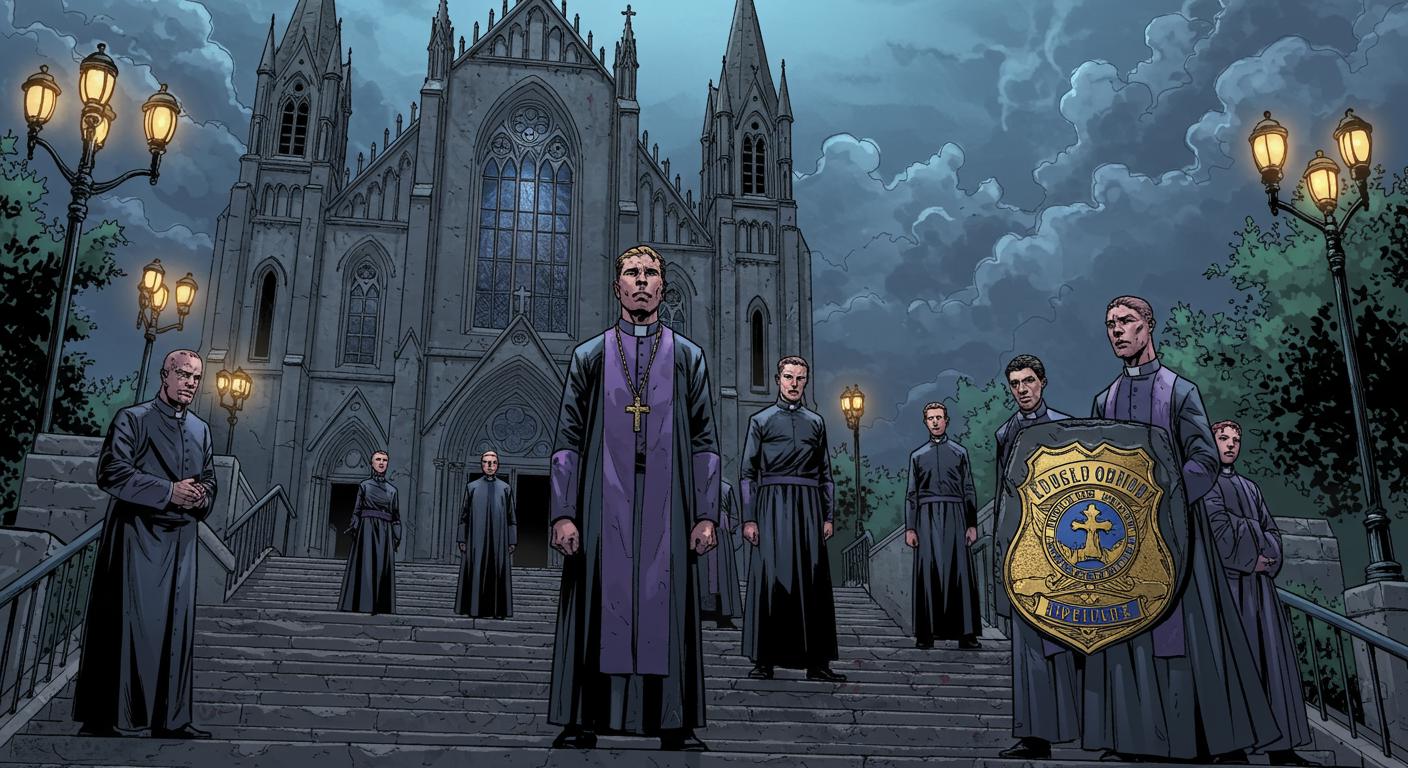
The mental image of a priest quietly weighing excommunication versus jail time over a whispered confession isn’t typical fodder for a weekday news roundup. Yet, here we are—Washington’s latest mandatory reporting law has positioned the Catholic Church at loggerheads with both state law and, for good measure, the federal government. Add in the election of the first American pope, and the script veers close to the surreal.
Confession vs. Compliance
Washington’s new law, signed by Governor Bob Ferguson, disrupts what was for centuries a straightforward rule for priests: what’s said in the confessional stays in the confessional. Now, clergy who hear of child abuse while administering the sacrament are legally required to take it straight to law enforcement—privilege revoked, clerical collar or not. As detailed by KPTV, the Archdiocese of Seattle was quick to stake out its boundary, warning, “Catholic clergy may not violate the seal of confession—or they will be excommunicated from the Church.” In the Catholic universe, excommunication is not just a stern memo; it’s expulsion from the sacramental life of the Church, essentially professional and spiritual exile.
This isn’t theoretical grandstanding. Bishops Thomas Daly of Spokane and Paul Etienne of Seattle have each made public statements promising that, if forced to choose, they’ll opt for jail rather than violate the seal of confession. Daly summed it up with remarkable candor, stating that “shepherds, bishops and priests, are committed to keeping the seal of confession—even to the point of going to jail.” As for Archbishop Etienne, he reinforced that confession “remains sacred, secure, confidential, and protected by the law of the Church,” according to a statement highlighted in Newsweek.
Behind the Statute
So how did we end up with this oddly binary standoff? At its core, neither side disputes the importance of reporting child abuse. The debate really turns on whether there should ever be a carve-out for conversations carried out in the mystery of confession. The new law is the brainchild of State Senator Noel Frame, whose efforts were motivated, in part, by patterns of secrecy not only within Catholic contexts but also among groups like Jehovah’s Witnesses. In a detail described by Newsweek, Frame pointed to how internal hush-hush review processes can allow abuse to persist under the radar. She explained to lawmakers, “This is about making sure we, the state, have the information we need to go make sure that kid is OK.”
Jean Hill, executive director of the Washington State Catholic Conference, remarked that priests in all three of Washington’s dioceses are already bound to report suspected abuse—just not when it’s disclosed under the sacramental seal. As she shared in comments to Newsweek, “They are required to report reasonable suspicions of abuse at all times with the limited exception of the time they are in the confessional—which is typically a couple of hours per week.”
The new statute operates without regard to faith tradition: all clergy are mandated reporters, regardless of religious affiliation. Still, confession has grabbed the legal limelight due to its particular, time-honored secrecy.
Church, State, and Uncomfortable Choices
If this feels like a collision between ancient doctrine and modern legislative impulse, that’s not far off. The Department of Justice has launched a civil rights investigation into the law’s constitutionality, with Assistant Attorney General Harmeet Dhillon labeling the statute “anti-Catholic,” as CBS News reports. Church leaders call the measure a direct intrusion into religious practice; archdiocesan statements, noted in multiple outlets, describe the law as “specifically targeting religious conduct by inserting the government into the Catholic tradition, namely, the highly defined ritual of the Sacrament of Reconciliation.”
The DOJ’s ongoing review comes at a moment notable even by Vatican standards: the first American pope, Pope Leo XIV (formerly Cardinal Robert Prevost of Chicago), has just stepped into the global leadership role. While the Vatican has previously spoken out against similar legislative attempts—like California’s failed 2019 bill—so far, no papal intervention appears to be on the immediate horizon, as documented by Newsweek.
There’s a layer of unintended consequences here. Thomas Plante, a psychologist and longtime consultant to the Church on abuse issues, told CBS News that the “absolute” confidentiality of confession has, at times, enabled priests to convince abusers to seek therapy outside confession—where the obligation to report is clear-cut. In his view, removing the seal might simply send penitents fleeing to states where confession still guarantees secrecy, or give priests reason to stop hearing confessions altogether. A strangely modern take: will cross-border penance become a thing?
Survivors and advocates, on the other hand, argue that any loophole—confessional or otherwise—potentially puts lives at risk. Former Jehovah’s Witness Marino Hardin, interviewed by Newsweek, offered a caution: “Leaving an exception in for the confessional when it comes to mandatory reporting would allow any religious group that had a mandate for secrecy to say, ‘We don’t have to report anything.’” It’s a hidden-in-plain-sight paradox: measures meant to heal can, if poorly designed, protect abusers before victims.
Awaiting the Next Chapter
The law takes effect July 27 unless blocked in the courts. Catholic leaders are already bracing for open defiance. Whether priests will actually find themselves facing arrest or whether the civil rights investigation will upend the law remains to be seen. In practice, the affected moment boils down to a handful of hours per week, in a closed booth, under the constraint of two—now competing—absolutes.
Perhaps the most fascinating question is whether this truly marks the edge of what government can—or should—ask of religious practice. “The state is now intruding into the practice of religion, and if they’re allowed to get away with that, where do we draw the line?” asked Archbishop Etienne, quoted by Newsweek. Is this a rare legal crossroads, or a sign that the old walls between confession and compliance are wearing thin?
It’s hard not to appreciate the oddity here: a ritual that predates most secular law is suddenly a litmus test for American religious boundaries. Will Washington become an outlier, a blueprint, or just a cautionary tale for faith and state navigating the same confession booth? One gets the feeling that archivists of the future—maybe even a few quirky blog writers—will be puzzling over this for years to come.