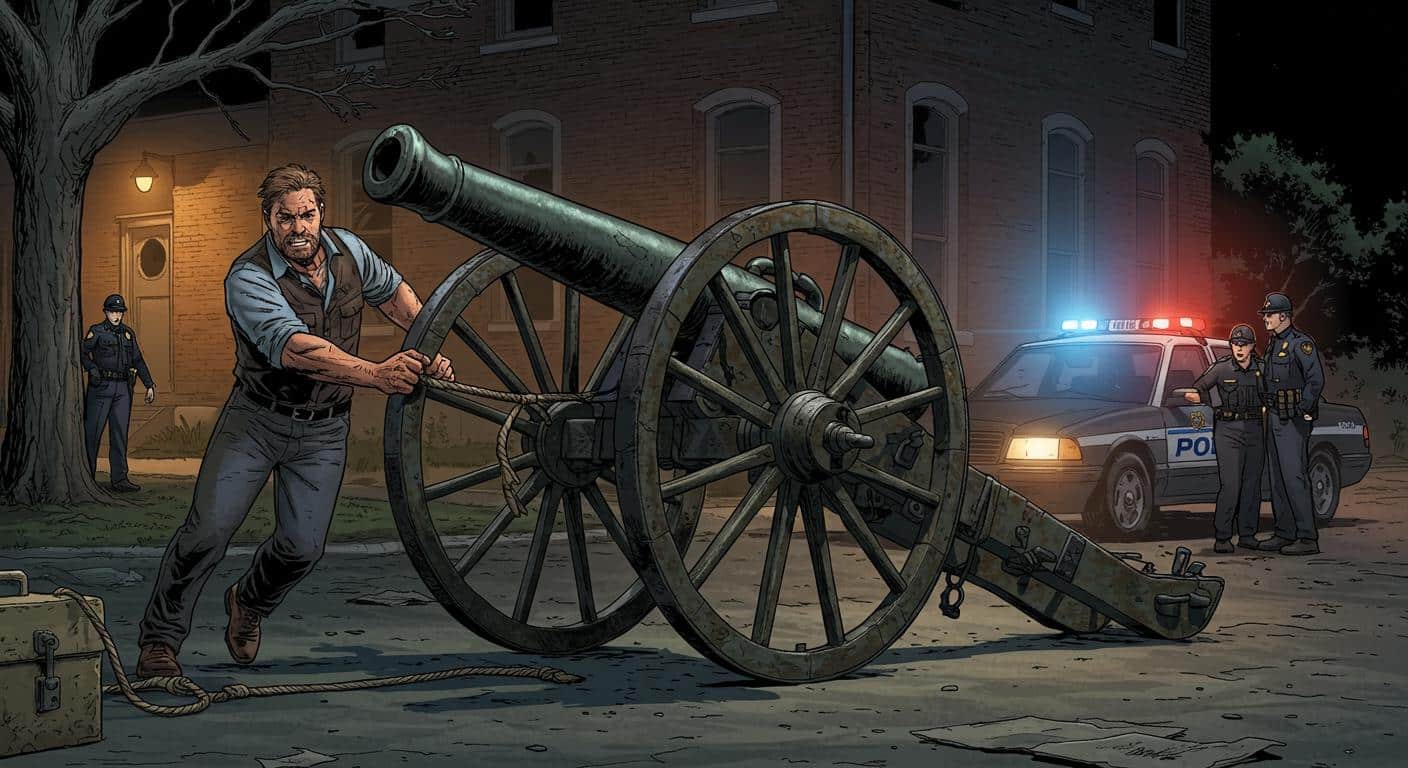
If you’ve ever passed by a somber old war memorial in a city park and thought, “That seems perfectly safe where it is,” congratulations: You possess more optimism than the city of Wichita. Over the past week, onlookers and archivists alike have been digesting the details of a theft so head-scratchingly audacious that even the local meth trade was reportedly unimpressed.
Historic Artillery vs. Drug Debt: Score One for Desperation
Gordon Pierce III—a name that sounds like he should be preserving antiques, not pulverizing them—now finds himself in the Sedgwick County Jail, accused of swiping an 800-pound Spanish-American War cannon from Wichita’s Central Riverside Park in early April. Why steal a one-of-a-kind cannon? The answer, as revealed by People, is as bleak as it is bizarre: a spiraling $20,000 meth debt and a drug dealer threatening to “shoot him and his family” over a missing pound of product.
According to details outlined in affidavits reviewed by KAKE, Pierce—a meth user for two decades—set out to find copper statues to turn into cash. But around 4 a.m., he encountered the neglected relic, a cannon gifted to Wichita in 1900. At the time, its position in a dimly lit park made it, for reasons only desperate logic could explain, the target of choice.
Not Exactly a Smash-and-Grab
The logistics of liberating an 800-pound antique are, perhaps reassuringly, not straightforward. As noted by KAKE and described in the NY Post, Pierce enlisted a homeless man’s help, sweetening the offer with meth and a pipe. The two smoked together in the park, but that camaraderie apparently did not confer superhuman strength. Multiple reports detail their repeated failures to hoist the cannon into a Chevrolet Tahoe, resorting instead to dragging it with a chain attached to the vehicle.
The chain snapped several times, with one break occurring in front of an automotive shop, as detailed by both KAKE and the NY Post. Forced to improvise, Pierce ditched the cannon temporarily, fetched a new chain from a friend (who, as KAKE recounts, wanted no part in the scheme), and finally dragged the relic to the friend’s garage after a display of persistence rarely seen outside slapstick comedy routines.
Unfortunately for Wichita’s historical record—and perhaps the friend’s garage floor—the next step involved a sawzall. KAKE and People both note that Pierce spent hours cutting the cannon into four or five pieces. The plan, if this even qualifies, was to present the pieces to his increasingly impatient dealer as tangible evidence of his desire to repay his debt.
Not the Preferred Ransom Payment
The outcome? About as successful as the rest of the plan. According to Inside News Hub, Pierce brought several pieces of the cannon to the dealer, who was not just unimpressed but irate, telling Pierce he was “stupid” and threatening to “bring heat to his house.” In affidavits cited by KAKE, the dealer purportedly threatened to shoot Pierce in the head during their next encounter. The thought of dragging the pieces down to a scrap yard never quite materialized—a minor complication: Pierce lacked the ID needed to sell scrap, a fact included in both KAKE and the NY Post accounts.
Feeling out of options, and still fearing for his safety, Pierce confessed to his mother. It was, as covered by KAKE and echoed by People, the police who arrived next—thanks in part to a friend pointing investigators in Pierce’s direction and a sequence of clues. Among these, police said they followed indentations in the street left by dragging the cannon, a detail highlighted by Inside News Hub and confirmed in multiple reports.
Fallout: Damage Done, Lessons Learned?
The consequences, officials told People and KAKE, included $100,000 worth of history chopped into pieces and a granite base left $10,000 poorer. The city, in updates celebrated by Inside News Hub and People, called the cannon “irreplaceable”—making its misadventure from national artifact to crime scene especially bitter. The swift arrest earned praise from the Wichita Police Department, with statements underscoring their commitment to safeguarding the community’s heritage.
Pierce is now jailed, bond set at $200,000, with charges ranging from theft of property to aggravated criminal damage and drug possession. His court date is scheduled for later this month.
Objects in Mirror Are Closer Than They Appear
There’s a rueful irony here: two centuries ago, this cannon likely symbolized national might and collective memory. This spring, it became a pawn (literally) in a desperately improvised scheme, its journey from town square to sawzall marking a strange, circular commentary on value, neglect, and the perils of short-term thinking.
If nothing else, this episode may prompt park officials to reevaluate the security of historical memorabilia—and perhaps add a few more lights. For everyone else, maybe it’s another reminder that even the largest, least-mobile fixtures in life can still be swept up in the currents of modern-day strangeness. Who knew the next cannonball run would involve a Tahoe, a homeless accomplice, and a heap of bad planning?
Is anything still safe on its pedestal these days? Or—like so much in life—does everything, eventually, get dragged down 18th Street in the middle of the night?