
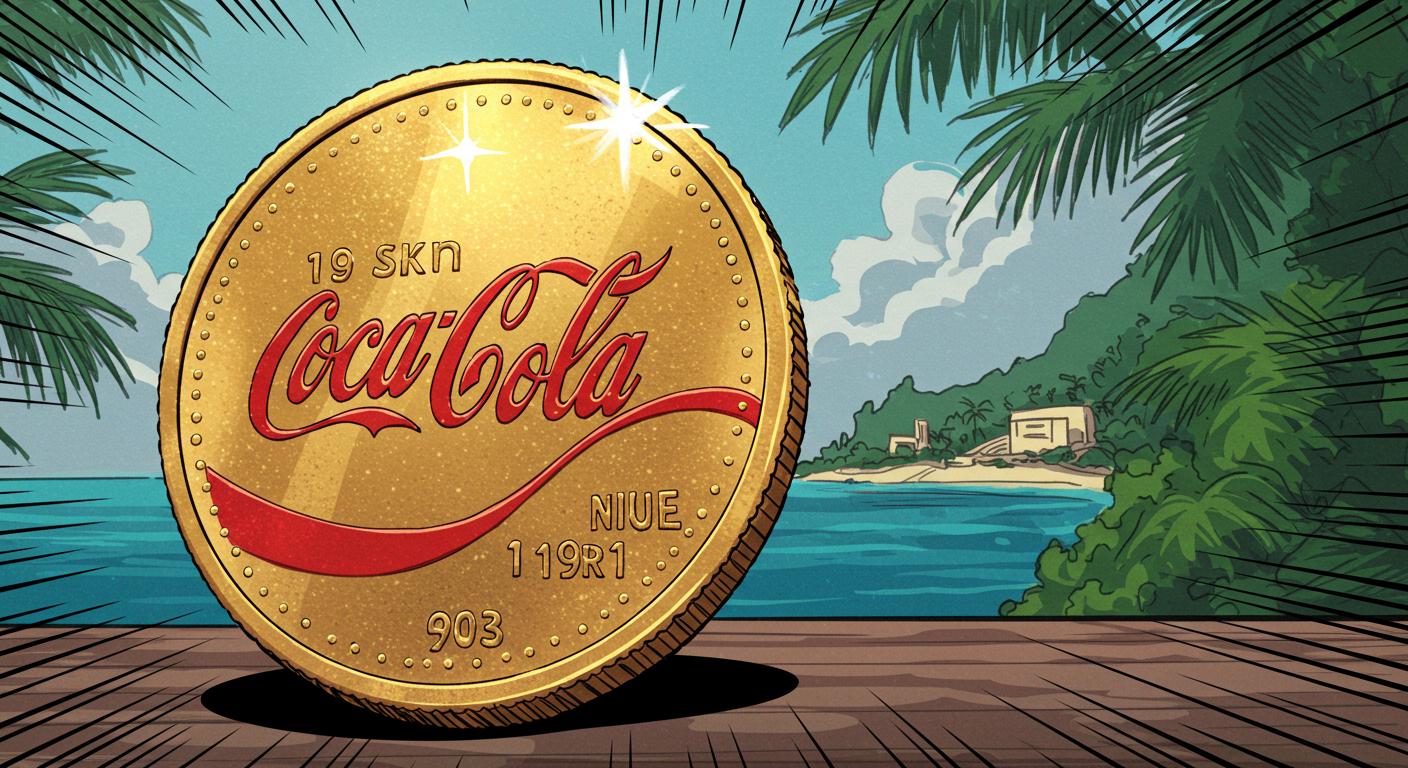
If you thought the enduring tussle between Coke and Pepsi had reached every conceivable point of competition, think again. As outlined in a recent post on ecency.com, 2025 will introduce something no marketing brainstorm—or fever dream—of the Cola Wars ever quite conjured: a Coca-Cola-branded, legal tender, micro gold coin. And no, this isn’t a collector’s edition bottlecap rescued from a vault in Atlanta. In an unexpected twist, the island nation of Niue is minting 2,025 of these 1.2-gram gold coins, complete with Coca-Cola branding and an official price tag expected—somewhat predictably—to surpass the actual worth of the gold within.
The result: a scenario where the world of numismatics merges with the nostalgia-soaked fizz of pop culture, each tiny coin paired with a familiar swirl of red, white, and presumably not a trace of syrup.
A Coin, a Brand, and the Lure of Micro Gold
Behind the curtain, there’s basic economics at play. As thebighigg discusses, citing gold price charts from Kitco, the yellow metal is currently fetching over $4,000 per troy ounce—more than enough to put a full ounce out of reach for many would-be collectors. This price surge has prompted both governments and dealers to mint smaller, more accessible chunks for the enthusiast market. The 1.2-gram Coca-Cola coin offers a scaled-down entry point, though with a hefty premium thanks to production costs and collectible hype.
Specific details about this coin—its weight, limited mintage, and legal tender status—are catalogued on Numista and showcased with product images and descriptions from APMEX. It’s a marriage of novelty and nostalgia that taps into the brand’s remarkable endurance. Thebighigg notes that Coca-Cola collectibles, especially those fashioned from precious metals, often fare well in terms of appreciation—especially when supply is tightly controlled. That claim certainly fits with the well-trodden pattern of popular brands finding their way into investors’ portfolios, one limited edition trinket at a time. Does this purchase decision come down to investment, or is it more about owning a piece of pop-culture-tinged micro-bling?
Betting on Bubbles, Metal, and Marketing
Zooming out, there’s a larger story here about the pursuit of value and the stories we tell ourselves about what’s worth collecting. Drawing on price histories from Kitco, thebighigg underscores gold’s dramatic leap—over $1,000 gained per troy ounce in the past year alone. When tempted by parallel possibilities, thebighigg references historical bitcoin prices on CoinGecko, noting that timing the market just right last summer could have doubled one’s investment to $4,800. Of course, bitcoin’s swings are legendary, and thebighigg wryly observes that gold’s steady-if-unexciting reliability has its own appeal.
All of this positions the Coca-Cola coin less as a rational investment and more as a kind of collectible performance art. Whether these 2,025 coins will be snapped up as soon as they hit the digital shelves is anyone’s guess—scarcity and nostalgia have their own illogical gravitational pull. Is this investing, or just a particularly shiny way of playing “gotta catch ’em all?”
A Toast to the Absurd
This fusion of worlds—global soda branding, precious metal minting by a Pacific microstate, and the everyday human drive to own what’s rare—borders on the delightfully absurd. In a detail highlighted by Numista, the coin really is legal tender, even if you’d be hard-pressed to spend it on a vending machine soda. As thebighigg notes, the logic of brands stretches further and stranger than some might expect.
The post even finds space for a quick comparison—the evergreen “Coke vs. Pepsi” debate—prompting readers to revisit their own flavor preferences. Thebighigg’s palette tips towards Coke, reporting that Pepsi carried a faint aftertaste reminiscent of freshly sanitized CPR dummy. Perhaps not the endorsement Pepsi envisions in its commercials.
Yet behind this gentle rivalry and the heady swirl of novelty coins lies something more universal: our constant search for comfort, value, and just a dash of surprise. When nostalgia, economic turbulence, and the playful human appetite for oddity come together, the result is something as strangely comforting as it is inexplicable. What does it say about us that we crave investments with a side of pop culture? Is our appetite for these glittering oddities ever really sated?
Next time you’re weighing the merits of a Coke, a Pepsi, or a legally sanctioned gold soda cap, consider—perhaps the strangest treasures are the ones that make us laugh and scratch our heads in equal measure. Sometimes, certainty just doesn’t taste as sweet as a little risk and a whole lot of weird.