There are moments when reality briefly outpaces even the most dedicated archivist of eccentric tech artifacts. It’s one thing to find your local library still sorting microfiche; it’s quite another to realize your flight’s safe passage relied on the same kind of Windows 95 machine you might spot in a historical computing exhibit, and storage media last mass-produced during the Obama administration. As both TechSpot and reporting by WESA (via NPR) document, the FAA is finally moving to retire floppy disks and Windows 95 from the nation’s air traffic control infrastructure.
If you’re having déjà vu, you’re not alone—retro hardware has always clung to relevance in odd corners of public life, but this might be its most dramatic encore yet.
The Sky’s Not the Limit—It’s the Year
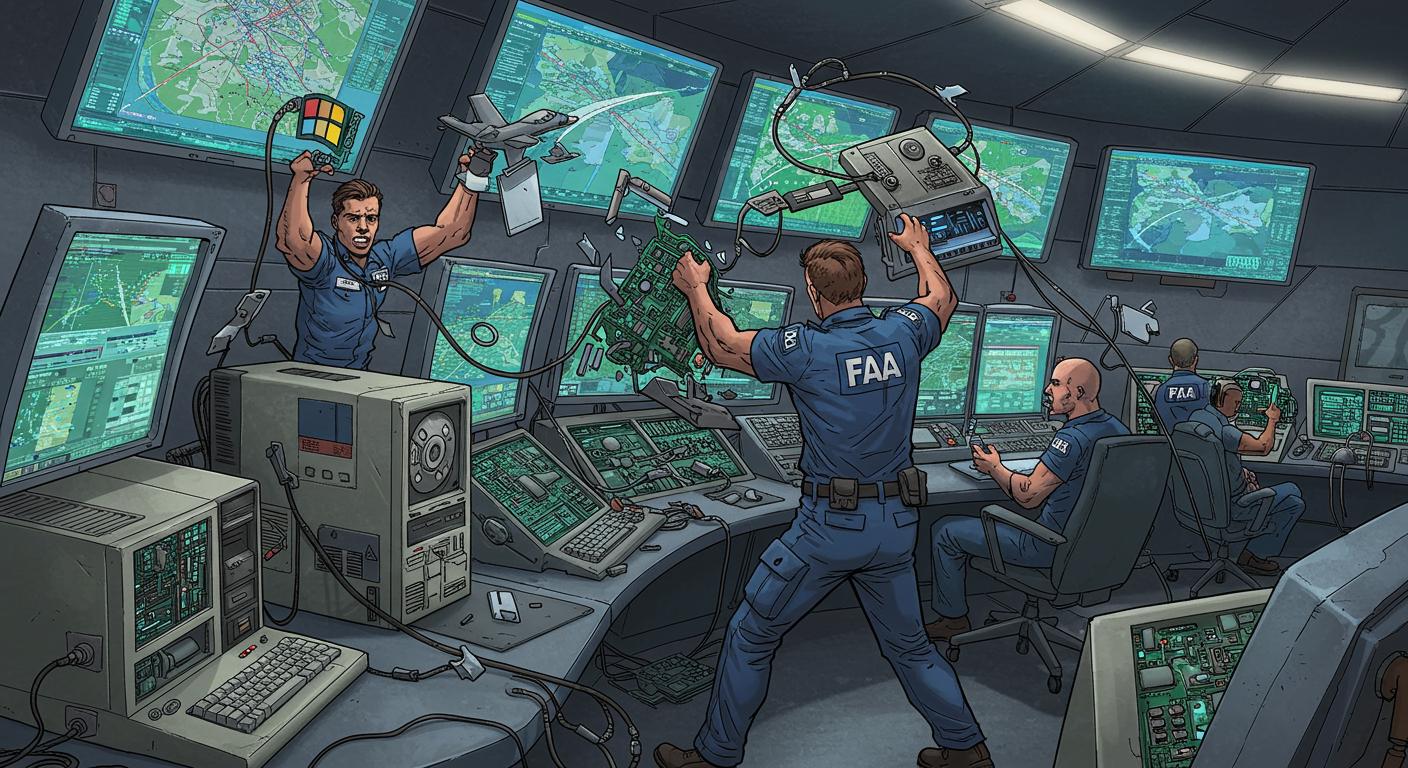
Wandering into many U.S. air traffic control towers is less like glimpsing the future than stepping directly onto the set of a ’90s procedural. During a recent hearing before the House Appropriations Committee, acting FAA administrator Chris Rocheleau didn’t mince words, stating (as detailed in TechSpot and further described by WESA), “No more floppy disks or paper strips.” These aren’t mere figure-of-speech—much of the backbone of American sky-keeping runs through gear and processes more familiar to someone reshelving AOL trial CDs than tracking commercial flights.
Industry officials and reviewers interviewed by WESA confirm that, even now, some computers in these towers boot up to the unmistakable teal-and-clouds logo of Windows 95, and key flight details are still managed by printing or handwriting on bits of cardstock. If you’re picturing a robust digital system, court records reviewed by the outlet illustrate just how strongly the FAA’s operational manuals are tethered to last-century tools. No wonder nostalgia is easy—scrapping these museum pieces proves the real challenge.
How Did We Get Here? Blame the Reliability of Relics
The root of this high-flying time capsule comes down to more than just sentimentality. As noted by WESA, a 2023 FAA assessment concluded that over a third of the country’s air traffic control systems are unsustainable, and evidence of crumbling infrastructure is hardly hypothetical. Footage reviewed after recent outages at Newark Liberty International Airport showed radar and communications failures that led to hundreds of delays and cancellations. TechSpot elaborates: aging subsystems, designed, built, and safety-certified in the 1990s, have been clung to precisely because they work—until they don’t.
Former FAA administrator Michael Huerta, whose comments are cited in WESA’s reporting, explained that the FAA “has been asked to do more with less, essentially,” with a persistent funding shortfall handcuffing any bold moves toward modernization. According to David Grizzle, another former FAA executive quoted by the outlet, regulation adds a further obstacle. “The FAA has not been allowed to shut down old ancient equipment,” he notes, leading to the oddity where more than 90% of equipment budgets are spent maintaining the very antiques in desperate need of replacement. In effect, regulators face their own version of the archivist’s paradox: preserve the past at the risk of undermining the future.
Planes, Politics, and The Price of Progress
Replacing this sprawling labyrinth of legacy hardware is, in the words of Transportation Secretary Sean Duffy (as quoted by TechSpot and highlighted at a Newark press conference described in WESA), “the most important infrastructure project that we’ve had in this country for decades.” Here’s the rarest sort of air traffic: consensus. Unions, airline trade groups, manufacturers, and government agencies alike have come together under the “Modern Skies” coalition, producing ads heavy on 1980s and 1990s nostalgia—walkmans, leg warmers, and, yes, the omnipresent floppy disk still spinning behind the nation’s flight plans forty years on.
Duffy estimates, cited in both TechSpot and WESA, suggest finishing the upgrade in four years, at a cost of tens of billions. Yet, skepticism hovers at a higher altitude. Many interviewed for WESA’s report, including Grizzle, doubt such an optimistic timeline. “There’s no way that they can complete all of that within four years,” he remarks, though even partial progress would count as a triumph after decades of inaction. Meanwhile, the Department of Transportation is actively requesting pitches from private companies for new technologies in a bid to break the logjam—details outlined in TechSpot’s feature and expanded upon by WESA’s review of the agency’s Requests for Information documents.
But even with this momentum, challenges persist. WESA observes that the planned consolidation of older control facilities will spark political feuds as members of Congress aim to shield jobs and local assets. Huerta acknowledges this reality, advocating for consolidation while conceding that the battles ahead won’t be easy.
Catalogued for Posterity—Or Final Boarding Call?
There’s a certain odd satisfaction in knowing that obsolete formats—Sony’s last floppy disk rolled off the line in 2011, as TechSpot reminds us—got to extend their working lives shuffling data critical to millions of travelers. It’s archivally poetic, if existentially a tad nerve-racking. Both outlets point out that these relics aren’t just a quirk of the sky; Windows 95 still underpins systems in trains, ATMs, elevators, and more, due as much to the prohibitive cost of rewriting custom platforms as actual affection for retro software. You have to wonder: is there an award for the world’s largest, most tenacious digital backlog?
For those who’ve spent time cataloguing retired formats or, perhaps, marveling at century-old indexes in a library basement, it’s both amusing and a touch alarming to see the same impulses play out at high altitude. When does collecting for history’s sake give way to making history more secure? At what point do we stop embracing the heartwarming buzz of a floppy drive and admit it’s time for the metaphorical card catalog to yield to the database?
The Modern Skies ad, as described in WESA, drives the point home: “That was then… But four decades later, floppy disks are still being used.” It’s a punchline, but it’s also a prompt. Is there another public system out there, humming along on hardware you’d expect to accession rather than operate? And just how long until registry edits are performed with the same reverence as preserving a rare book?
The answers, as any librarian or flight controller could attest, are filed somewhere between backlog and the ever-expanding “pending upgrade.”