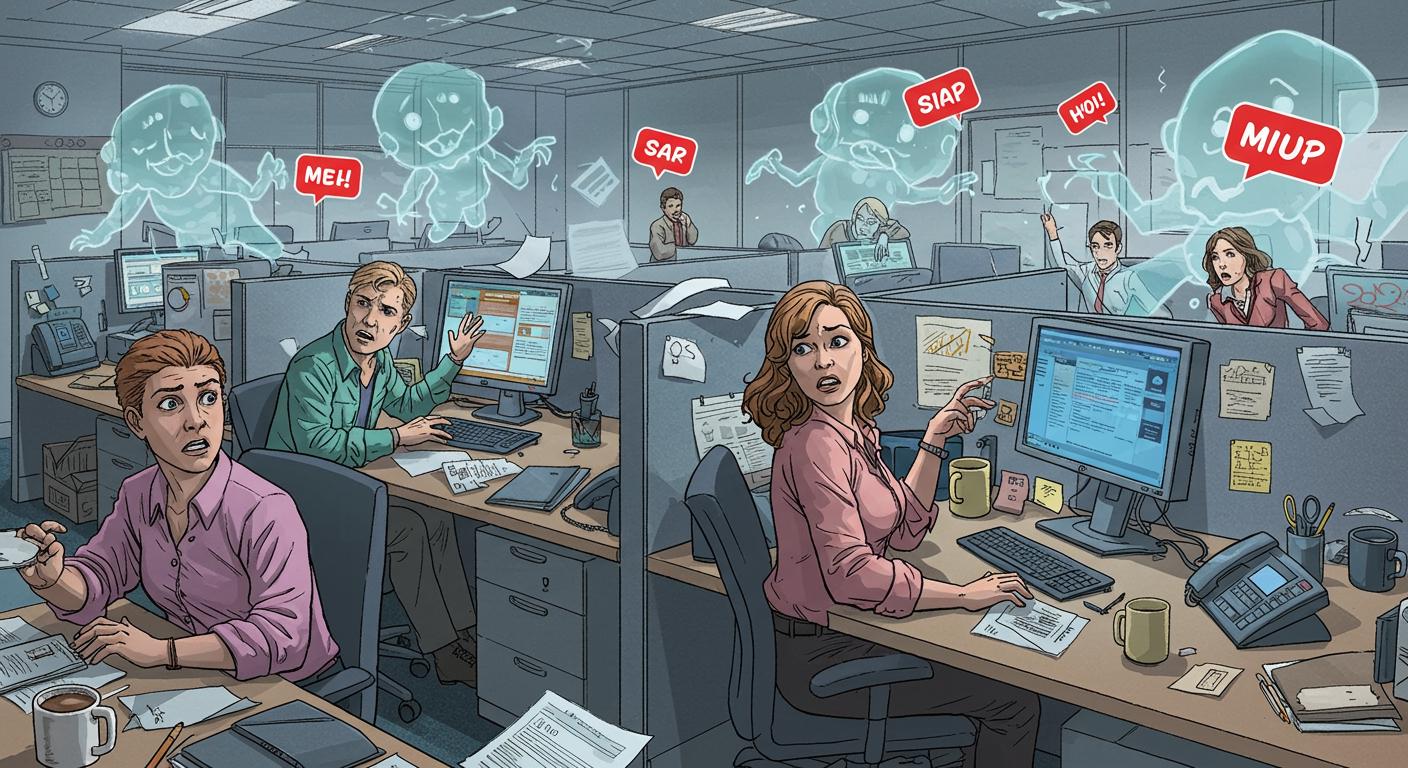
Any seasoned observer of workplace rituals—open office veterans, home-office holdouts, and even those chosen few who still tote lunch pails to brick-and-mortar marvels—has likely suspected that meetings are multiplying like dust bunnies behind the water cooler. Turns out, according to Microsoft’s latest findings, it’s not your imagination: modern office employees are being interrupted by meetings (and a fleet of other digital pings) every two minutes. Yes, every two minutes—a metric that feels less like reasonable business pacing and more like the scheduling equivalent of trying to sneeze with your eyes open: technically possible, rarely voluntary, and, frankly, not recommended.
As captured by CNBC, Microsoft’s 2025: The Year the Frontier Firm Is Born report paints a picture that should be familiar to anyone who’s ever tried—nay, dared—to focus on actual work. Not only do employees face this steady drumbeat of meetings, emails, and other digital notifications, but these stats don’t even consider the additional distractions from messaging apps or open browser tabs. Alexia Cambon, one of Microsoft’s senior research directors, pointedly notes that if you’ve got WhatsApp, Spotify, or YouTube humming along in the background, you’re likely stacking interruptions like the world’s least satisfying sandwich.
Meetings By Ambush
Digging a little further, Mix96.5 Houston flags that most of these meetings aren’t regular, pre-scheduled affairs. Instead, a majority are dubbed “ad hoc”—the professional term for “spur-of-the-moment fire drills.” At this pace, the modern office calendar resembles less of a finely tuned schedule and more a game of Whac-A-Mole, with meetings popping up just as you’ve managed to get your bearings from the last one.
No surprise, then, that all these mid-work mini-summits kick off a chain reaction. Since focus time gets chewed up by pop-in meetings, the inevitable result is that employees fling out emails and chats after hours, turning the mythical “work-life balance” into more of a balancing act on a tightrope, with one end anchored to your inbox.
Focus: The New Office Grail
Somewhere between one Zoom to another Teams notification, there’s a task—likely, the one you were hired to do—begging for attention. If you’re wondering how anyone is supposed to get meaningful work done amidst the onslaught, you’re not alone. The experts quoted in CNBC’s report offer a kind of tactical retreat: block off focus time on your calendar and defend it as you would your last piece of office cake. Vicki Salemi, a career expert, suggests actually scheduling these windows as if they were meet-and-greet moments with a dignitary—ideally, yourself.
Interestingly enough, the advice jingles with a nostalgic ring: turn off your notifications, corral your phone, maybe even alert your household that you’re embarking on a mission of importance (or, at the very least, a 20-minute stretch without interruption). For those inclined to multitask, beware: you may remember the myth of multitasking’s effectiveness, but, as noted in the Microsoft report, the path to workplace enlightenment likely starts with picking a single task and holding onto it like a librarian gripping the last unwatered fern in a sunless staff room.
Which leads to another intriguing point—focus time doesn’t have to mean face-to-screen monotony. Salemi notes the creative power of a well-placed walk, and Cambon herself carves out a 45-minute daily run expressly for mental clarity (and, presumably, the occasional “a-ha!” idea that escapes its digital leash). Such practices are reportedly endorsed from the top, which hints at a new sort of status symbol: not the endlessly busy calendar, but the rare, gleaming block of “unavailable for meetings.”
The Peculiar Erosion of Work Time
But how exactly did we arrive at a professional environment where a focused hour is as elusive as the Loch Ness Monster? If “ad hoc” meetings and perpetual notifications are the digital descendants of ancient memo slips and pop-by boss visits, has technology streamlined our workflow, or simply given us more opportunities to interrupt each other? Microsoft’s findings, echoed by both CNBC and Mix96.5 Houston, suggest it might be the latter.
One has to wonder what records future workplace archaeologists will unearth: fragments of abandoned presentation slides, half-typed sentences, and a fossilized Slack channel titled #quick-question. Will they speculate about the strange rituals that required group alignment every eight minutes, overseen by a pantheon of rescheduling tools?
At the end of the day—assuming you can recognize when that actually is—the question lingers: Are all these impromptu meetings a sign of hyper-collaboration or low-grade chaos? Either way, if you manage to hit “focus mode” for more than five minutes, it might qualify as a minor miracle. Or, to put it another way: if your biggest accomplishment before lunch isn’t escaping the world’s shortest meeting cycle, you’re probably doing better than you think.