Government, with its elaborate rituals and winding corridors, doesn’t often provide moments of accidental comedy. Yet every now and then, even the most procedural environments are prone to a good, old-fashioned slip-up. North Dakota’s recent brush with an unintended housing budget veto fits squarely in this delightfully awkward category.
A Housing Budget Disappears—Almost
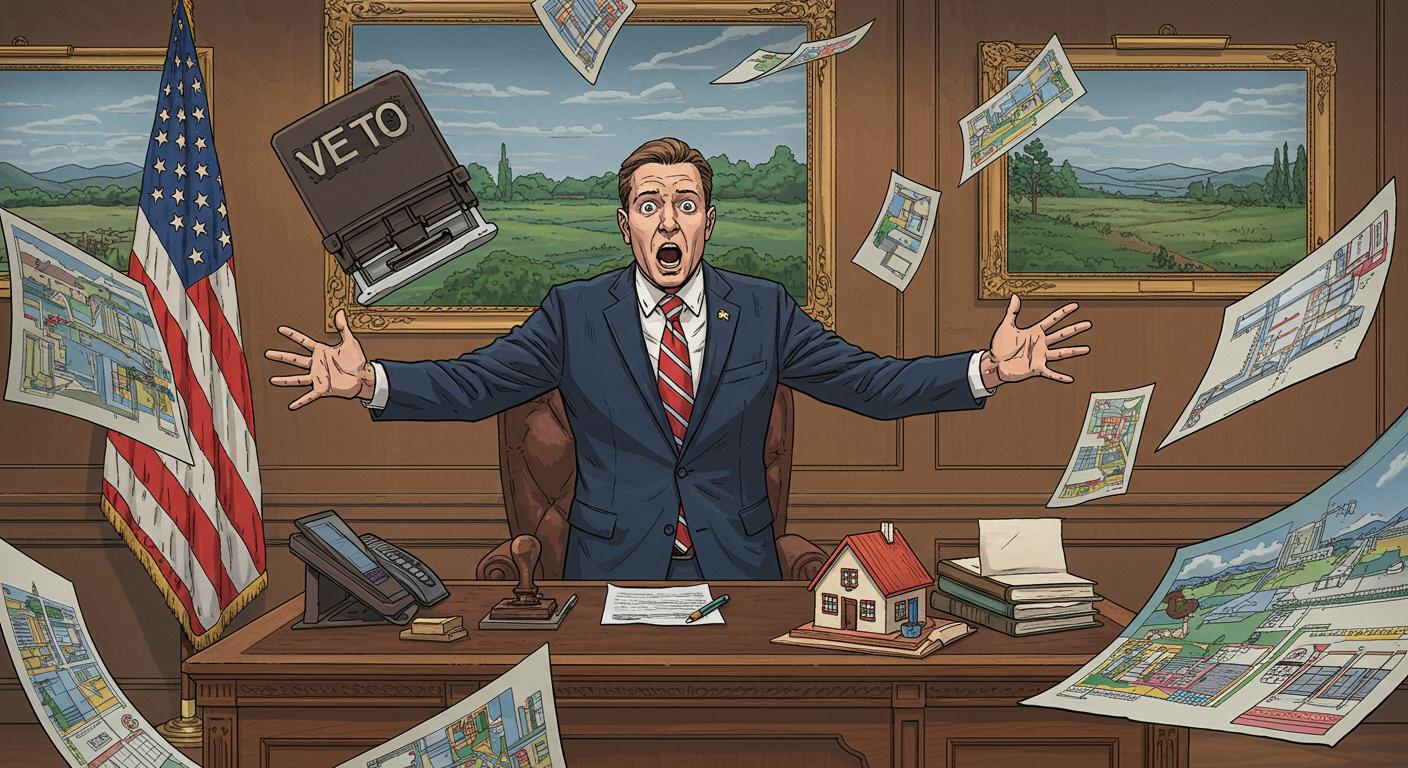
As spotlighted in Associated Press coverage, Governor Kelly Armstrong, just months into his tenure, aimed to neatly excise select line items from a state agency budget. What he actually managed, with an errant stroke (or perhaps overzealous mark-up), was to strike the entire $35 million housing budget from existence. For those tracking legislative history, this lands in rare company; legislative council director John Bjornson reflected to the AP that nothing quite like it had cropped up in his nearly four decades in Bismarck.
Staff in Armstrong’s office later described the gaffe as a “markup error,” clarifying that his intention had been far more modest: the removal of a $150,000 grant intended for a Native American homelessness liaison position. Instead, the misapplied veto now threatens to leave the state’s housing efforts in limbo, with everyone scrambling to tidy up the bureaucratic spill before the change takes effect on July 1.
Unraveling the Process, One Red Pen Stroke at a Time
Armstrong’s team, as outlined in the AP’s report, met promptly with the legislative council to explore fixes. Their statement owned up to the error in straightforward fashion: “This was an honest mistake, and we will fix it.” That admission lands somewhere between comforting and wince-inducing, particularly as it now raises the possibility of needing a special legislative session—an option Armstrong’s office has mentioned it would prefer to avoid due to both logistical headaches and expense.
There’s a certain unintended theater here. If, as discussed by legislative council director Bjornson, lawmakers act to override the governor’s entire veto, they’d inadvertently restore not just the $35 million for housing, but also the specific $150,000 item Armstrong had meant to remove. The alternative—passing an entirely new bill to fund only the $35 million housing budget—could require several extra days of legislative maneuvering. As previously documented in AP coverage, the Legislature still has six unused days from its 80-day session limit, leaving enough time to act. But the process now resembles a game of procedural whack-a-mole: fix one thing, and another pops up anew.
Interestingly, North Dakota isn’t an island of bureaucratic blunders this week. Also described in the article, Nebraska found itself in its own tangle, with Governor Jim Pillen’s attempted budget cuts running afoul of a missed filing deadline. The Nebraska Legislature now maintains that the contested budget items are law, with the Pillen administration consulting the state attorney general. Legal textbooks rarely feature such plot twists.
Mistakes Happen—But They’re Not Invisible
For Armstrong, who wrapped up his first legislative session as governor only weeks ago (having previously served three terms in Congress), this episode will likely stick in the memory banks for a while. To their credit, his staff hasn’t tried to recast this as some stealth reform—it’s admitted the mistake and pursued a fix, as the outlet also notes.
Still, the optics are unavoidably awkward. A whole housing budget—gone with what amounts to an accidental swipe. It’s unlikely to set off fireworks, but it may nudge future governors to double-check their markups (and perhaps swap coffee for herbal tea before final review).
There’s also an intriguing procedural butterfly effect at play: a potential special session not only opens a window to repair this gaffe but could, as legislative council director Bjornson suggests, enable legislators to revisit other vetoes from Armstrong’s fledgling term. Sometimes a small bureaucratic stumble kicks loose a whole slew of dominoes.
The Human Element of Governance
Governance, at every level, remains a very human endeavor—penned in shorthand, annotated in margin, and subject to the occasional “whoops.” If there’s any lesson in this, perhaps it’s a reminder that no system, however formal, is immune to the quirks of human error.
Will North Dakota’s legislative fix be quick and straightforward, or will the mistaken veto earn a chapter in statehouse lore? And just how many future governors will check, double-check, and triple-check the fine print? The answers, as so often in politics, are a little uncertain—though you can bet there’s at least one new anecdote in the “rookie mistakes” section of the governor’s handbook.