
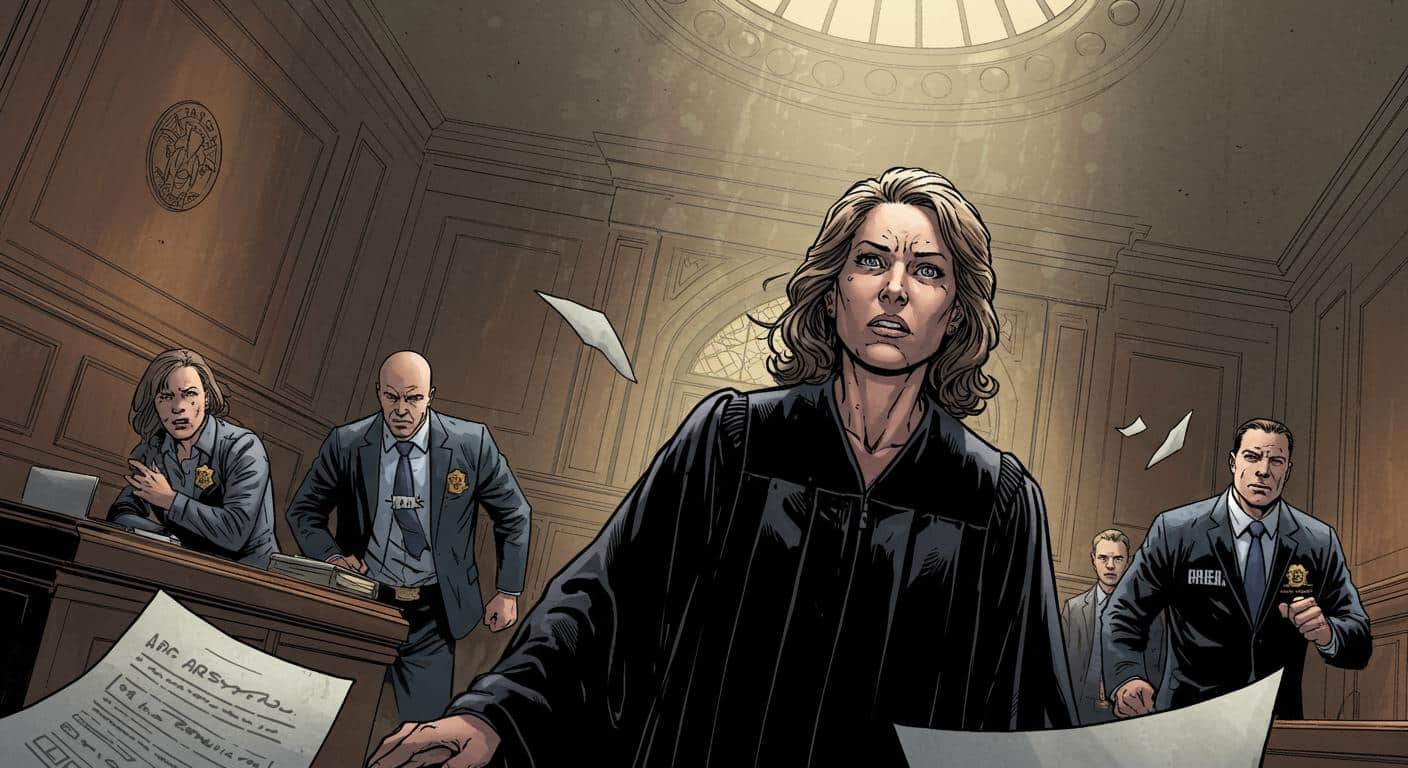
What happens when the keeper of the rules is accused of quietly rewriting the playbook in real time? The recent federal indictment of Milwaukee County Circuit Court Judge Hannah Dugan is a study in unexpected turns—the courtroom equivalent of spotting your librarian leading a jailbreak out the fire exit (and yes, that’s almost as rare as the phrase “judge indicted” itself).
Behind the Gavel: Allegations and Arrest
This winding legal drama began on April 18th, when, according to Wisconsin Public Radio, Judge Dugan was informed by her clerk that Immigration and Customs Enforcement (ICE) agents were present in the courthouse. The target of their search: Eduardo Flores-Ruiz, who faced multiple misdemeanor charges in state court and, federal documents allege, had re-entered the United States after being deported in 2013.
The FBI affidavit reviewed by WPR states Judge Dugan reacted with visible anger to the agents’ presence, requesting to see a judicial warrant—which the agents did not have. Instead, the agents presented an administrative warrant for Flores-Ruiz’s arrest. The court documents indicate Dugan directed the agents to the chief judge’s office for a discussion about courthouse policies, and, taking advantage of their absence, escorted Flores-Ruiz and his attorney through a jury door reserved for staff and in-custody defendants. Witnesses told authorities that Dugan explained Flores-Ruiz could participate in his legal proceedings via Zoom at a later date. Flores-Ruiz was apprehended by federal agents outside the courthouse following a brief foot chase, according to statements from federal authorities cited by WPR.
The Legal Fallout: A Bench on Hold
Subsequent to these events, the FBI arrested Judge Dugan at the Milwaukee County courthouse—a development detailed by The Guardian—and she was suspended from hearing cases in Milwaukee County by order of the Wisconsin Supreme Court, a move intended to safeguard public confidence in the judiciary.
A federal grand jury indicted Dugan on two counts: obstruction of a federal proceeding, a felony, and concealing an individual to prevent discovery and arrest, a misdemeanor. Law360 further confirms that Dugan, if convicted, faces up to six years in prison on both charges combined. Her defense team has publicly maintained her innocence, expressing confidence in her eventual vindication in court.
An incident described in the New York Post provides an extra visual layer: Dugan was reportedly led away in handcuffs while still dressed in her black judicial robe, an image that neatly encapsulates the crossover from authority to accused.
Law, Order, and the Limits of Discretion
Local pushback against courthouse ICE enforcement has been vocal and ongoing—a point emphasized by WPR, which quotes Milwaukee County Board Chair Marcelia Nicholson expressing concern that “federal immigration enforcement… deters survivors of violence from seeking protection and discourages tenants from asserting their rights.” On April 24, the county’s Board of Supervisors passed a resolution opposing ICE operations that operate “outside the limits of the law” at the courthouse.
Meanwhile, prosecutors maintain Flores-Ruiz was facing three misdemeanor domestic violence charges, including accusations of punching and choking another man and hitting a woman—details reported by the New York Post from the police report. Court records reviewed by The Guardian specify Flores-Ruiz was in the country unlawfully following a 2013 deportation, with no indication in federal documents that he had permission to return.
The Guardian also places this episode in a wider context, noting Dugan’s arrest has drawn national attention, with some officials calling it an attack on judicial independence and others insisting it shows no one is above the law. During congressional debate, Senator Bernie Sanders was quoted condemning the arrest as a sign of authoritarian tendencies, highlighting how judicial interventions in immigration enforcement are becoming political flashpoints.
A similar case during Trump’s first term, involving a Massachusetts state judge accused of aiding a defendant’s escape from ICE agents, ultimately resulted in dismissal. That precedent, outlined by The Guardian, lingers in the background as Dugan’s own prosecution moves forward.
The Bench, the Law, and the Gray Areas
What’s most intriguing (and faintly surreal) about this episode isn’t just the rarity of a judge facing federal indictment—it’s the network of legal, political, and ethical tensions it exposes. Is Judge Dugan’s alleged act a principled stand against federal intrusion, or a breach illustrating that all must answer to the law, regardless of position? The layers of policy, conscience, and civic responsibility are dense—and, as is so often the case, not entirely untangled by shifting the action out a back door.
Dugan is scheduled to enter her plea this week. However the legal outcome, the episode lingers as a bizarre reminder that the lines between duty, discretion, and the law are rarely as straight as the marble hallways they’re practiced in—especially when unexpected detours crop up right at the threshold.