In the tome of “stranger than fiction” stories, the Canadian moose collision—already a genre unto itself—has gained a bewildering new chapter. Details reported by CTV News reveal that a routine incident on Highway 69 uncovered more than just dented sheet metal and startled wildlife: a vehicle full of Scarborough teens, significant quantities of drugs, and a loaded handgun with an extended magazine.
Driving While Endangered
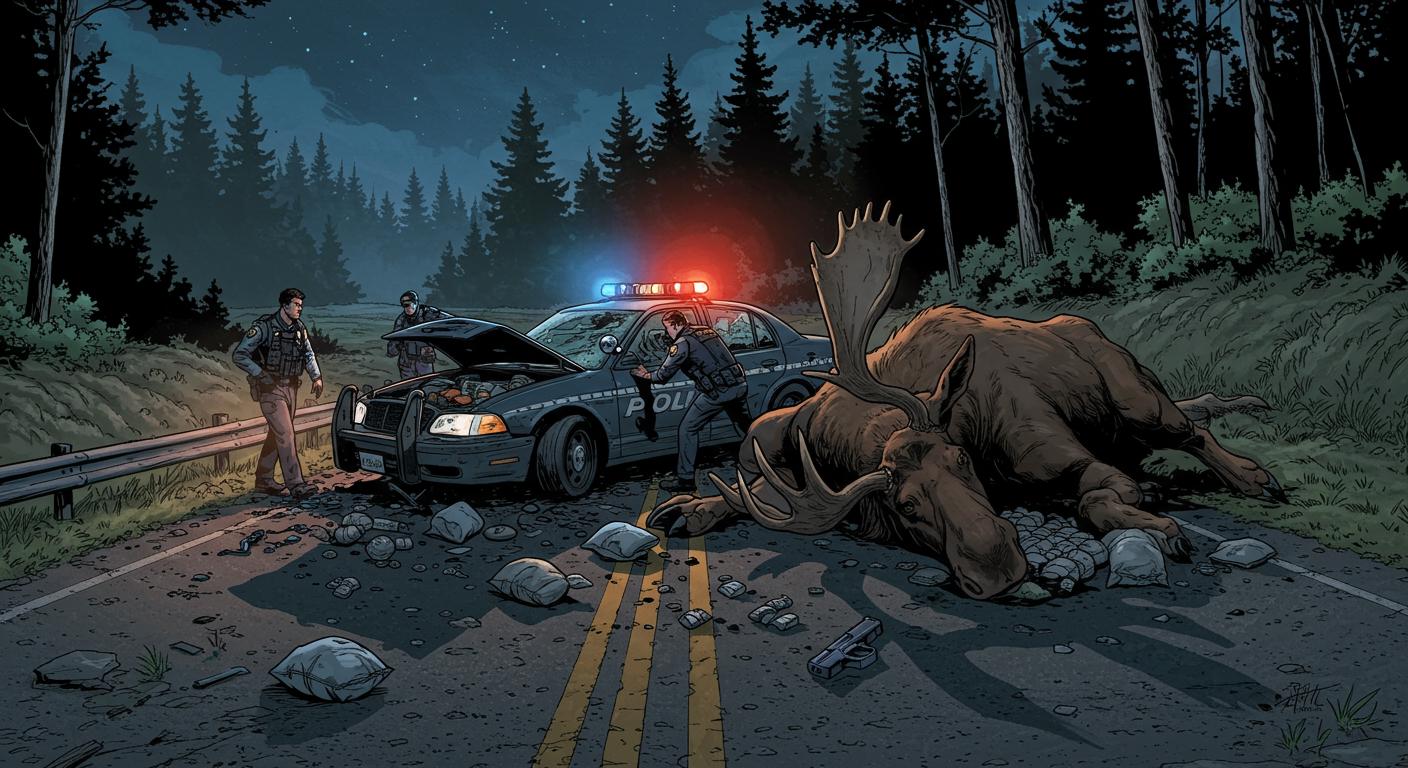
Let’s set the scene: Wallbridge Township, Ontario, where the moose crossings apparently function as both wildlife corridors and, on this particular Saturday, inadvertent checkpoints. According to Anishinabek Police, two 16-year-olds from Scarborough collided with a moose on Highway 69. Miraculously, as noted in the report, all human occupants were uninjured. The fate of the moose, left unaddressed in the CTV account, lingers as one of those peculiar gaps in police reporting. You’d expect a footnote at least—a gesture to the local ungulate census, perhaps.
First responders, including provincial police and the Britt & Area Fire Department, arrived to manage what they likely imagined to be a typical roadside emergency. Instead, police immediately detected what they described as “a strong odour of fresh burnt cannabis emanating from the vehicle,” a detail seemingly at odds with the aftereffects of a moose-induced adrenaline spike.
The Moose Was Just the Beginning
Here’s where the roadside narrative veers sharply from accident report to criminal investigation. CTV News, citing police, explains that under the Cannabis Control Act, officers searched the vehicle and its occupants. The findings read less like the aftermath of a camping trip and more like an appendix to Ontario’s ongoing opioid problem: 250 grams of suspected fentanyl, 33 grams of cannabis in less-than-legal packaging, a handgun with an extended magazine, and sixteen rounds of ammunition. In a moment that feels both cinematic and ill-advised, one teen reportedly concealed the firearm in his waistband—this, according to police, was a weapon lacking any manual safety or safeguard against unintentional firing.
No surprise, then, that the teens (whose names are protected by the Youth Criminal Justice Act, as clarified in the report) now face a variety of drug and firearm charges. Chief among them: possession of a Schedule 1 substance for the purpose of trafficking. The charges are, as CTV News reminds us, as yet untested in court. Still, even before the machinery of justice whirs into action, there’s something quietly methodical—almost archival—about law enforcement’s efficiency, with a wild moose improbably cast as the catalyst for their biggest break of the shift.
Sober Afterthoughts (and Archival Oddities)
Quoting Deputy Chief Julie Craddock, the outlet highlights her gratitude that the arrests concluded without injury and underscores “the dangers faced by first responders on a daily basis.” One suspects “moose collision turns into fentanyl seizure” is the sort of entry that doesn’t often appear in the official training manual.
Oddly enough, this event raises questions beyond the reach of a standard incident report. For instance, does the Ontario police database allow staff to tag cases as “wildlife-assisted apprehension”? Are there cross-referenced entries for “illicit substances recovered after animal collision”? The archivist in me aches to know: just how often do criminal investigations begin with an unexpected hoofed participant bounding into the script?
And circling back—what of the moose, the unwitting protagonist in this Keystone Cops tableau? Its status is a mystery, stubbornly unilluminated in the official account. Perhaps it’s fitting: like so many archival curiosities, there are moments that demand more than the facts provide.
In a world where chaos occasionally comes wrapped in antlers and chance encounters, perhaps the most remarkable thing isn’t the wildness of teenagers—or even the drugs and guns they attempt to smuggle—but how the randomness of a single animal crossing can topple the best-laid (or not-so-best-laid) plans. Is this a statistical aberration, or just another day in the Canadian archives waiting to be catalogued?