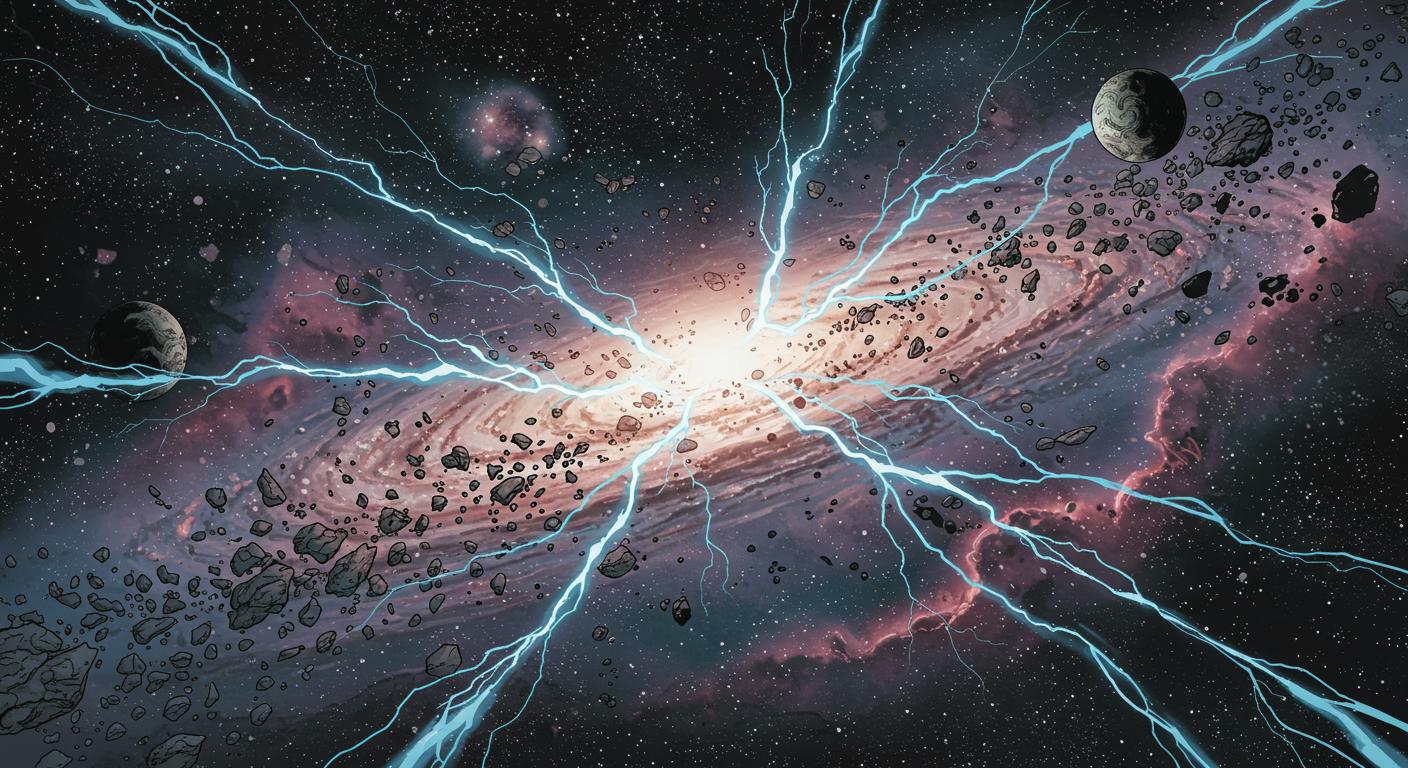
If you’re the type to lose sleep over cosmic timelines, prepare to reschedule your existential anxieties: a group of Dutch scientists has recalculated the universe’s expiration date, and apparently it’s “sooner” than the previous heat-death estimate—if one can call 10⁷⁸ years “soon” with a straight face. According to new calculations reported by Phys.org, the universe is set to wink out of recognizable existence in a mere ten duovigintillion years, as opposed to the once-reassuring figure of 10¹¹⁰⁰ years. Mark your (immortal) calendars.
A Shorter Goodbye (In Universal Terms)
This news comes courtesy of Heino Falcke, Michael Wondrak, and Walter van Suijlekom of Radboud University. In their recently published work, these researchers took another look at the much-debated phenomenon of Hawking radiation—first proposed by Stephen Hawking, who famously punctured our hopes of everlasting black hole monoliths back in the 1970s. Phys.org explains that the Dutch team’s calculations suggest that not just black holes, but a host of objects with significant gravity (neutron stars, white dwarfs, and presumably anything sufficiently dense) are also destined to gradually “evaporate” in this way. This will eventually leave us with not a bang or a whimper, but more of a timeless cosmic sigh, as even the most persistent white dwarfs vanish in 10⁷⁸ years.
If that’s hard to visualize, you’re not alone. It’s like being told your lease is ending 100 trillion trillion trillion years sooner than you previously thought. As reported by Phys.org, previous models didn’t include this updated mechanism for Hawking-like radiation, which is why the old predictions stretched out so leisurely.
How to Evaporate with Grace
There’s a particular elegance to the logic here: the rate at which a celestial object evaporates via quantum means, according to the researchers, comes down purely to its density. Neutron stars and black holes, for all their differences, apparently take about 10⁶⁷ years each to disassemble themselves particle by particle. The twist? Despite black holes’ ferocious gravity, their lack of a surface means they can reabsorb some of their own outgoing radiation. As postdoctoral researcher Michael Wondrak explained to Phys.org, this self-absorption effectively slows down their evaporation—a cosmic quirk in what’s otherwise a universal cleanup.
The trio also ventured into more relatable territory: if left purely to Hawking-like evaporation, the moon (and, for the sake of calculated completeness, the human body) would vanish after about 10⁹⁰ years. Of course, as the article gently notes, there are far more pressing processes that will deal with us and our lunar companion long before those particular quantum shenanigans have a chance.
Hawking Radiation’s Expanding Resume
It’s notable that this revisionist take on Hawking radiation isn’t a bid for cosmic panic or even a jab at our cosmic insignificance (not overtly, at least). Phys.org relays that the research was carried out “dead-seriously and with a wink,” a phrase that suggests these physicists know their audience: a blend of keen cosmologists and regular folk who quietly wish their household appliances would last half as long as the sun.
The underlying message is less about the exact numbers than about the process: as mentioned in the outlet, the more angles we find to approach Hawking’s mysterious radiation, the closer we may get to understanding one of the universe’s strangest disappearing acts. Even if we’re stuck watching from the cheap seats, 10⁷⁸ years is still a fairly comfortable buffer.
So… Should We Worry?
Let’s be honest: this is the astrophysical equivalent of learning that, with current inflation trends, your great-great-grandchildren’s hypothetical Mars timeshare might not be as secure as once imagined. If the revised cosmic timeline leaves you feeling a little hurried, take comfort in the final, math-proclaimed absurdity—by these rules, even a human body will theoretically vaporize from its own gravitational field given enough time. Who knew the universe was such an equal-opportunity disassembler?
On balance, the universe’s adjustment from “practically forever” to “less than practically forever” feels more like an academic tidying-up than a cause for existential alarm. But as the team’s cross-disciplinary approach demonstrates, poking at the edges of what we think we know can yield unexpected and delightful results, even if those results are as timely as a note on the fridge reminding you of a heat death you’ll never witness.
One can’t help but wonder—what other supposedly far-off destinations are barreling toward us slightly faster than expected, and will science keep finding these cosmic time-saving tricks? Or will we reach a point where the universe’s expiration date becomes less a matter of years and more a question of perspective? As always, the weirdness is in the details.