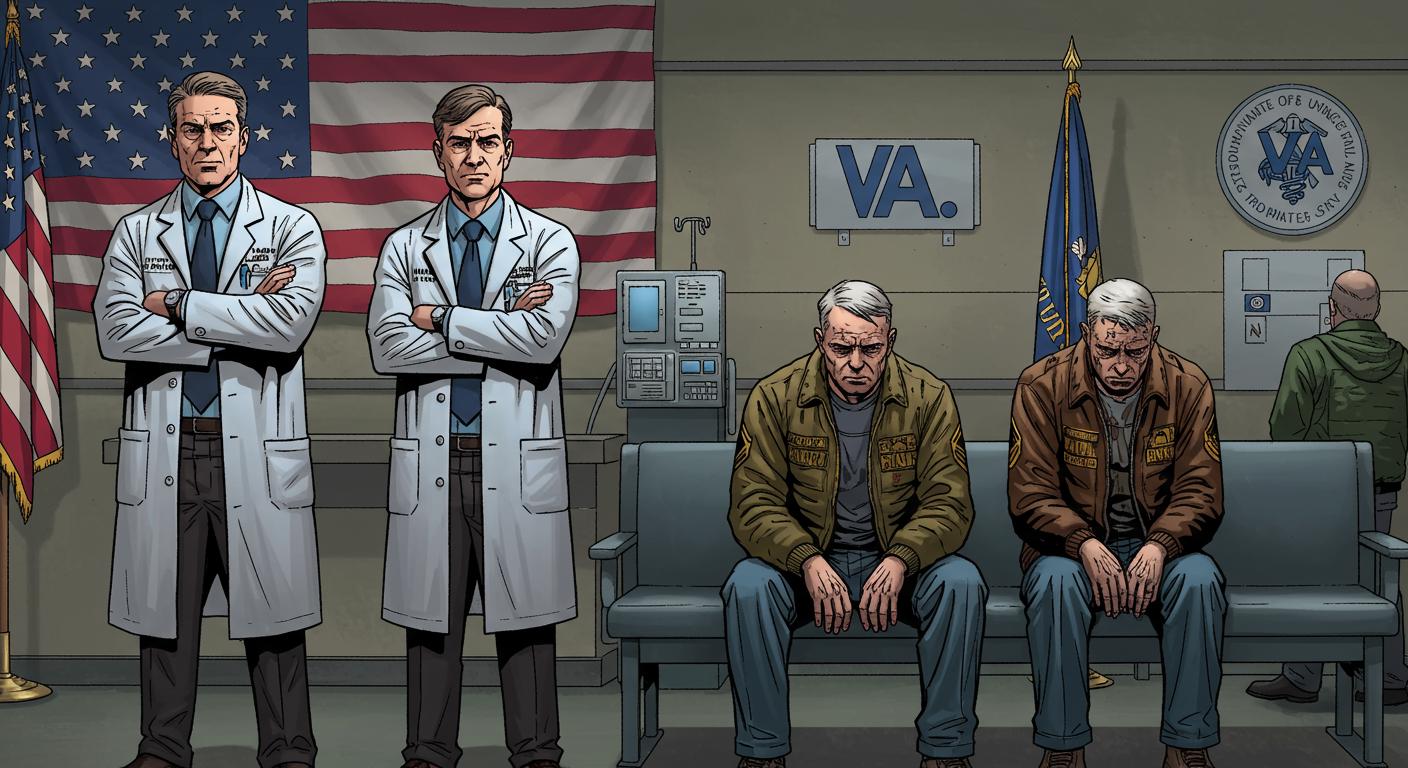
Well, here’s a fresh plot twist for anyone who assumed healthcare discrimination was a relic best left to the footnotes of American history. As detailed by Common Dreams and reported in the Irish Star, the Department of Veterans Affairs has adopted new rules that—brace yourself—let VA doctors and other medical staff refuse to treat patients based on their political beliefs or marital status. If you’re wondering what year it is, you’re not the only one.
From Executive Order to Doctor’s Office
Both outlets tie the origin of this recent policy shift to President Trump’s January 30 executive order, “Defending Women from Gender Ideology Extremism and Restoring Biological Truth to the Federal Government.” Billed as a rollback of federal protections for transgender individuals, the order—according to Common Dreams—also quietly removed anti-discrimination provisions from VA policy bylaws, including protections for “politics” and “marital status.” In a detail highlighted by the Irish Star, the ripple effects are immediate: staff can now lawfully refuse treatment to Democratic veterans or those who are unmarried, so long as the characteristic in question isn’t a category shielded by federal law. Apparently, “for better or for worse” only applies with a ring.
Internal VA documents discussed by both outlets—relying on reporting from The Guardian—indicate these changes aren’t merely theoretical. The new policies are already being applied in at least some VA medical centers, extending not just to doctors but to professionals ranging from chiropractors to social workers.
The Ethical Gymnastics of the New Rules
Predictably, medical ethicists and officials from both the veteran community and Congress have weighed in with some well-chosen adjectives. Dr. Kenneth Kizer, the VA’s top healthcare official during the Clinton administration, remarked to The Guardian (as cited in Common Dreams) that the policy “seems to open the door to discrimination on the basis of anything that is not legally protected.”
Meanwhile, the Irish Star features insights from Dr. Arthur Caplan, founding head of the Division of Medical Ethics at NYU’s Grossman School of Medicine, who described the new rules as “extremely disturbing and unethical.” He questioned whether basic patient intake will soon include inquiries about rally attendance or political leanings. Are questions like “Did you vote for the President?” about to join “Do you smoke?” The scenario is so absurd you could almost imagine it sandwiched between the allergy list and the emergency contact form.
VoteVets, a progressive veterans group, took to Bluesky—according to Common Dreams—to call the guidelines “political purity tests for people who risked their lives for this country.” As for VA Press Secretary Peter Kasperowicz, he told reporters the revisions are a mere “formality” to comply with the executive order, assuring that all “eligible veterans” would still receive legally mandated benefits, even as specifics on the law in question remained as fuzzy as a barely tuned radio.
Political Purity at the VA?
Senator Patty Murray, a senior member and former chair of the Senate Veterans Affairs Committee, responded with visible frustration, labeling the policy “disgusting” and “unethical,” according to Common Dreams. She asserted that veterans’ healthcare should not be doled out to loyalists, especially when the individuals in question have already fulfilled some of the nation’s most demanding obligations. You do have to wonder what internal logic produced a system where a veteran’s care could depend as much on their last voting record as their last blood test.
The policy revision does not just affect patients. As earlier mentioned, Common Dreams notes that internal documents reveal staff themselves—doctors, certified nurse practitioners, and others—may now be barred from working at the VA based on their own marital status, political party, or union membership. It’s like a club within a club, with the bouncer brandishing both a stethoscope and a voter registration form.
The Irish Star puts this in context, referencing further criticism from Dr. Caplan, who sees these rules as symptomatic of a broader campaign against the independence of medicine and science during the Trump administration. Previous years have seen similar restrictions and intervention at agencies like the NIH and the CDC.
The Devil’s in the Details
Look at the numbers: the Veterans Health Administration, as reported by Common Dreams, is the largest integrated healthcare system in the nation—over 9.1 million veterans enrolled, more than 1,300 facilities. Add the possibility of staff making treatment decisions based less on a person’s medical record and more on their choice of political lawn decor or Facebook relationship status, and you have a situation that lands somewhere between a bad prank and a sociological experiment.
If you were hoping for clarity about whether these rules are subject to change or even intended as a placeholder, the answer (so far) is no. The policy is, according to both outlets, already in force at select VA centers. As for which “federal law” necessitated the removals, as VA officials claim? That, at least for now, remains unaddressed.
The Eternal Question: Why?
It’s impossible not to puzzle over the logistics. Will veterans face a pop quiz on political views in the waiting room? Will single veterans need to produce evidence of courtship, just in case? Given the diversity within the military—politically, culturally, and otherwise—it’s hard to see how this doesn’t turn straightforward care into bureaucratic theater.
Besides the immediate threat to veterans’ access, there’s a growing sense that the VA’s mission—serving those who have already made significant contributions—is being subtly, yet fundamentally, altered. Maybe “favorite ice cream flavor” isn’t on the list yet, but it’s anyone’s guess how long that will last.
Conclusion: The Unintended Absurdity
If all this reads more like farce than bureaucracy, you’re not alone. The new guidelines seem, at best, to be a bureaucratic curiosity—one that flirts with ethical sketch comedy. At worst, they risk significant harm for those who, by any measure, have already paid the price of admission.
Is this what innovation in healthcare policy looks like? Or is it a peculiar workaround chasing a problem that never existed? For now, it seems, American veterans—over nine million of them—will have to wait for the next twist in an unfolding policy saga where a ring, a party card, or just being in the wrong club could decide whether you get patched up, or just patched through.
And if you find any of this straightforward, be sure to share your organizational secrets—because the rest of us are still trying to catch up with reality’s latest rewrite.