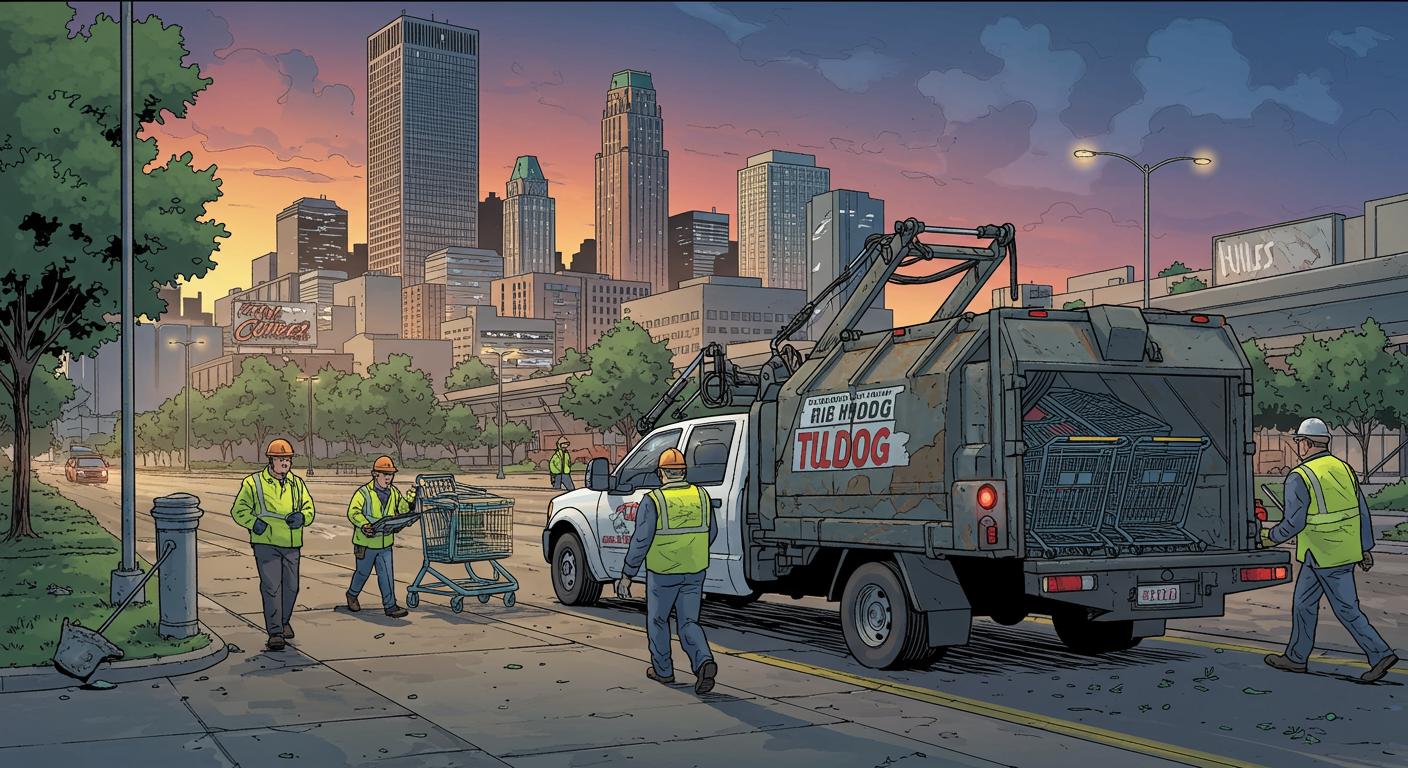
In the ever-expanding catalogue of municipal curiosities, Tulsa’s $100,000 adventure in shopping cart retrieval has rolled itself straight into local lore. News On 6 reports that, since December, a company aptly named Cart Repo has been contracted by the city to round up abandoned shopping carts littering parking lots, ditches, and likely a few places one wouldn’t expect. So far, they’ve managed to track down an impressive 1,917 fugitives of the grocery world.
Carts on the Lam: Scope and Science
Described in News On 6, Cart Repo has been searching high and low, responding to citizen tips and sweeping 40 different store properties in the hopes of corralling stray carts. The majority, perhaps unsurprisingly, have hailed from Walmart—a testament to both the store’s ubiquity and the migratory habits of its hardware. The premise is simple enough: each cart recovered costs Tulsa $15, billed monthly, with the hope that the city can recoup some of that money by reselling the carts to the stores that lost them.
The Buyback Dilemma
But here’s where Tulsa’s salvage operation hits a very modern snag. Cart Repo’s solution is to offer carts back to retailers at $15–$20 apiece—a steep discount compared to the $150 or so price tag for a new one. It sounds almost pragmatic, but as the outlet documents, most major chains aren’t interested in buying back what was, technically, stolen from them in the first place. Shantelle Muhammad from Cart Repo put it rather succinctly: many retailers reason that, since the carts were swiped from their property, they shouldn’t have to pay to recover them.
A local chain, Reasor’s, has reportedly agreed to take some carts back, but for the bulk of Tulsa’s big box stores, the math of principle outweighs the spreadsheet. Earlier in the report, it’s mentioned that this has left the city in a strange logistical limbo—amassing a growing pile of unclaimed carts at a holding facility in Mohawk Park.
Money In, (Not Much) Money Out
Tulsa’s financial gamble isn’t exactly breaking even. Authorities confirmed to News On 6 that Cart Repo sends monthly invoices based on the number of carts collected—$15 a pop—but with minimal retailer buy-in, the reimbursement side is looking thin. “We’re not getting any,” admitted Terry Ball, the Streets Department director, in assessing income from cart buybacks. Long-term viability? Let’s call it a conversation for another day. For now, Tulsa finds itself with a rising cart tab and little to offset the expense.
The Recycling Riddle
There’s also the physical reality to consider. Metal carts, at least, can be shunted into the recycling stream. But as the outlet also notes, plastic carts pose more of a puzzle—languishing in limbo, as the infrastructure for recycling them isn’t reliably in place. Is this the birth of Tulsa’s first plastic-cart sculpture garden, or just another entry in the annals of logistical headaches?
The Strange Arithmetic of Urban Order
Sometimes you have to wonder: what is the true cost of keeping our shared spaces tidy? Tulsa’s cart roundup exposes the background choreography required to manage even the most everyday urban elements. It’s an oddly poetic tangle—a city spends thousands retrieving relics of consumer life, only for stores to balk at the bargain price of reacquiring their own goods. Meanwhile, somewhere in Mohawk Park, nearly 2,000 carts are patiently awaiting their fate, a silent testament to the unintended afterlife of objects we rarely give a second thought.
Perhaps next time you pass a shopping cart sunning itself in the wild, you’ll wonder how many more miles it has to go before finding its way home—or, failing that, the recycling yard. In a world filled with unexpected detours, maybe even a shopping cart has a right to wander.