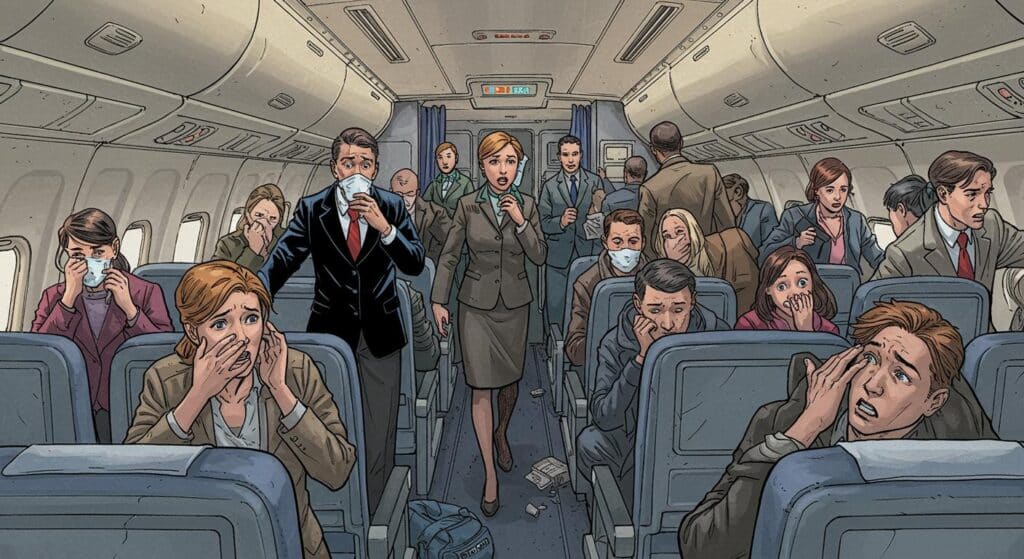

There’s an art to making the ordinary extraordinary. Then there’s just—well, the extraordinary making itself known in the most pungent way possible. Over the weekend, the San Jose Topgolf became the stage for a scenario that reads less like a hospitality mishap and more like a cautionary urban folk tale: “The Day the Water Hazard Was Real.”
The Day the Ceiling Dripped More Than Just Golf Balls
As detailed in the initial local reporting, anonymous employees described wading through actual raw sewage, “complete with fecal matter and toilet paper,” while keeping the brunch service afloat. Remarkably, the leak made its grand entrance via ceiling light fixtures—not just pooling on restroom floors but spreading into active work and dining areas.
The image drawn by a Reddit whistleblower, whose claims were reviewed by KRON4, paints a picture of food runners trekking through contaminated water, each step distributing the problem further to tables and chairs. Meanwhile, bartenders reportedly tried to avoid contaminated floors while still needing to enter the “actively seeping” zones to access supplies and mix drinks. The culinary world is used to messy kitchens, but this is usually a metaphor.
The kitchen staff, according to the same account, prepared and served food within 15 feet of the ongoing leak, all while the air above was thick with the smell of sewage—something described in detail by food service workers on-site. That aroma, from all accounts, didn’t respect floors or boundaries, with the stench reportedly reaching the building’s third level. Employees, understandably alarmed, flooded internal chats to raise health concerns. Yet, as employees allege in KRON4’s reporting, it took management more than three hours to halt food service, with repeated assurances that it was “fine,” even as the leak intensified.
KRON4 also obtained photographs depicting a kitchen floor streaked with suspicious liquid, visibly dripping from the ceiling into buckets—a tableau not usually associated with premium driving-range fare.
Slow Response, Swift Official Action
The Santa Clara County Department of Environmental Health confirmed to KRON4 that it received reports of active sewage at the business and sent out inspectors. According to the Hoodline summary, subsequent inspection resulted in an immediate permit suspension for affected areas. NBC Bay Area, as cited by Hoodline, described how operations in kitchen and beverage stations were suspended, after the violation was deemed an “imminent threat to health and safety.” Food and drinks were reportedly being served while sewage intruded on workspaces, the scent of feces refusing to be ignored.
The health department, in statements relayed by KRON4 and Hoodline, stressed the need to discard all contaminated food and conduct a full sanitation—a process that included cleaning or sterilizing equipment, utensils, and every food contact surface. Operations, officials said, would remain restricted until all corrective actions passed a follow-up inspection.
Curiously, the county had allowed Topgolf to operate select unaffected areas. Still, as KRON4 notes, company management opted for a complete shutdown on Monday night, explaining it was “out of an abundance of caution.” Topgolf issued a public acknowledgment, as quoted in both Hoodline and KRON4, mentioning the activation of strict safety protocols and the involvement of a professional, third-party restoration firm using EPA-registered disinfectants.
Health Permits, PR, and the Fine Art of Cleanup
If you’ve ever wondered what it takes for a modern, multi-level entertainment complex to face a partial permit suspension, here’s your answer: turn the water hazard into an indoor attraction. As highlighted in Hoodline’s reporting, the health department made it clear that full operations would remain shuttered until cleanup was documented and an independent inspection gave the all-clear.
The cleanup, according to Santa Clara County’s Public Health Department statements cited by KRON4, wasn’t a matter of simply mopping up. Rather, all contaminated food was to be discarded and all potentially affected equipment and surfaces required chemical sterilization. Topgolf’s management, for its part, has emphasized following rigorous protocols and committing to additional sanitation efforts before reopening.
The situation might prompt an idle mind to muse: in a bustling venue that relies on hundreds of hands and thousands of surfaces, how close are we ever, really, to encountering a hazard that forces a definition of “oversight”? Is this an outlier, or simply the one day the leaks couldn’t be swept—literally or figuratively—under the rug?
Epilogue: The Hazards You Don’t See on the Menu
No venue aspires to join the “Sewage Incident” annals, yet reality tends to possess a stubborn sense of humor. As food service venues nationwide look on with a mix of horror and relief, Topgolf in San Jose finds itself in cleanup limbo, waiting for county inspectors to re-establish a less aromatic baseline.
In the ever-evolving mosaic of indoor recreation, you have to consider: when the next genuinely unforeseen hazard appears, will lessons from this episode remain, or quietly slip away down the nearest drain? It seems, at least for now, that the only “atmosphere” guests must worry about on their next visit will be the intended kind.
So, who among us would have hung around for another round—just for the story?