You know that old saying, “every vote counts”? Most of us tuck it away along with “don’t swim after eating” and “if you keep making that face, it’ll stick.” But, as recent events in Terrebonne, Quebec quietly remind us, sometimes this tired bit of civic encouragement barrels out of abstraction and plants itself center stage, complete with a twist worthy of local theater.
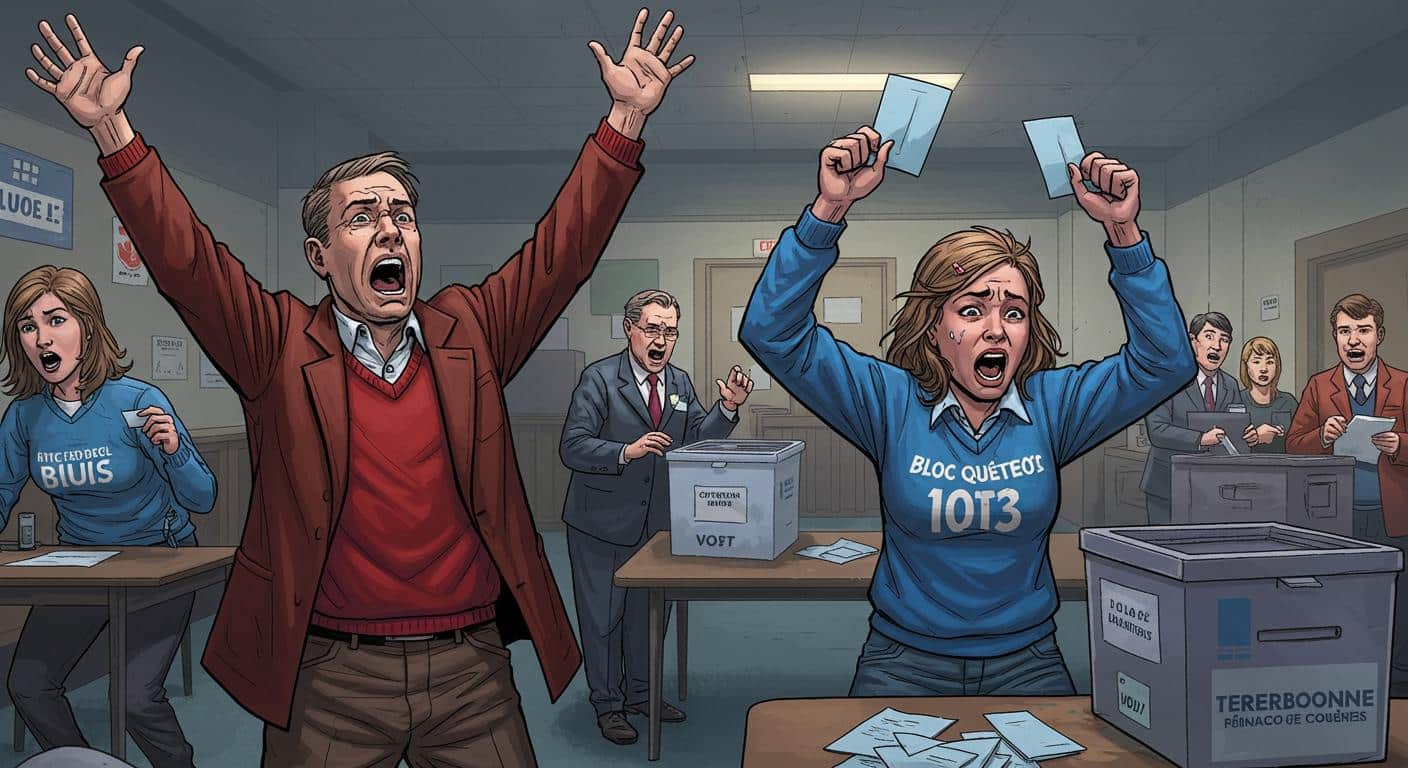
As CBC News reports, the latest federal election in Terrebonne was decided by a single vote. Not forty votes, not a dozen—one. Yet the real kicker? One Bloc Québécois supporter, Emmanuelle Bossé, mailed in her ballot only for it to return itself “to sender” weeks later, disqualified not by lateness or voter error, but by a typo in the address that Elections Canada itself glued onto her return envelope. Bureaucratic slip, meet razor-thin margin.
One Vote, Ripples Across an Election
The sequence of events described by CBC certainly borders on the Kafkaesque: On election night, Liberal candidate Tatiana Auguste led by 35 votes. Following the standard validation process—a by-the-book check where Elections Canada workers comb through results for errors—that lead was overturned in favor of the Bloc, flipping the result to incumbent MP Nathalie Sinclair-Desgagné by 44 votes. That margin was close enough to trigger an automatic judicial recount.
The recount, as explained in detail by political science professor Holly Ann Garnett to CBC, involved a judge, candidate representatives, lawyers, scrutineers, and electoral officials all combing through the ballots yet again, debating the status of disputed or ambiguous votes. After this painstaking process, Auguste was returned to the top—but this time, her edge was a single vote.
Meanwhile, Bossé’s story unfolded quietly on the sidelines. In a detail highlighted by CBC, Bossé says she mailed her ballot on April 5th, well before the April 28 election, relying strictly on Elections Canada’s pre-printed label. She told Radio-Canada, as cited by CBC, that she had nothing to fill out herself—just “put my vote in there.” Nevertheless, her ballot reappeared in her mailbox on May 2, uncounted, courtesy of a misprinted postal code on the envelope supplied by the very institution entrusted with collecting it.
Is there a German word for the specific dismay of watching your civic participation bounce back through the mail, unstamped and unused? Somewhere between “Weltschmerz” and “Bureaukratieblues,” perhaps.
Bureaucratic Mishaps With Real Consequences
The outlet also notes that Elections Canada has acknowledged the postal code error and is launching an investigation to determine how this happened, with a spokesperson stating in a provided statement that they’re still “working to gather all the facts.”
This tangling of ballots and bureaucracy has thrust the riding into an uncommonly bright spotlight. Political commentator Frédéric Bérard remarked to CBC that such a margin is “a first in recent history,” underscoring just how unusual it is for a federal contest to be decided in such a fashion—especially in a seat that had long been expected to remain in Bloc hands.
But the procedural drama may not be over yet. As explained by Ara Karaboghossian, a political science professor cited by CBC, Canadian law allows any candidate—or indeed, any elector—to contest the result if there’s an irregularity that might have affected the outcome. Karaboghossian notes that a misprinted, Elections Canada-supplied envelope certainly checks the “irregularity” box, but the sticking point is always whether it actually changed the result. In this instance, Karaboghossian points out, one uncounted vote is not merely academic: it would have erased Auguste’s one-vote margin.
If Bossé were to launch a legal challenge and a judge agreed that her vote should have been included, the logic—according to Karaboghossian’s reading presented by CBC—points to the possibility of a byelection. But “uncharted waters” is the phrase of the day. You have to wonder if mapmakers of democracy ever pencil in, “Here be returned mail.”
What Counts—And What Doesn’t
It’s hard not to appreciate the understated absurdity of it all. In a contest run through multiple filters—initial hand count, validation, then judicial recount—the entire enterprise still depended on the humble mechanism of a sticker on an envelope. Elections, it turns out, are not decided solely by impassioned speeches or viral photo ops, but sometimes by whether someone in a print room got a postal code exactly right.
For Bossé, the situation is both irksome and clear. As she explained in her interview cited by CBC, the failure wasn’t in her hands or her deadlines, but in the system’s own mix-up. What’s one supposed to feel—bemusement? Exasperation? Or just a deep, archivally-satisfying sigh for the astonishing power of administrative blips?
Tatiana Auguste’s one-vote win already reads like a footnote waiting for a punchline, but that footnote may yet demand more than a parenthetical. If Bossé’s legal challenge moves forward, and the court sides with her, CBC’s interviews with legal analysts suggest a byelection could become reality. The real conclusion? Still unwritten.
Reflections From the Fringe
What exactly are we witnessing here? Beyond any party politics or post-mortem election analysis, there’s an odd kind of beauty in the messiness. Human systems, no matter how carefully codified, are still human. The margins for error—literal and metaphorical—never fully close.
So, yes, a federal election did hinge, for at least a moment, on an envelope’s journey through Canada Post. Bossé’s plainly undelivered ballot is a tiny monument to just how thin the line can get between participation and fate, between a solitary action and a sweeping outcome.
Would you bet on the next “one-vote win” being less dramatic? For all the automated tabulations and legal review, sometimes the smallest details—postal codes included—still have the last laugh.