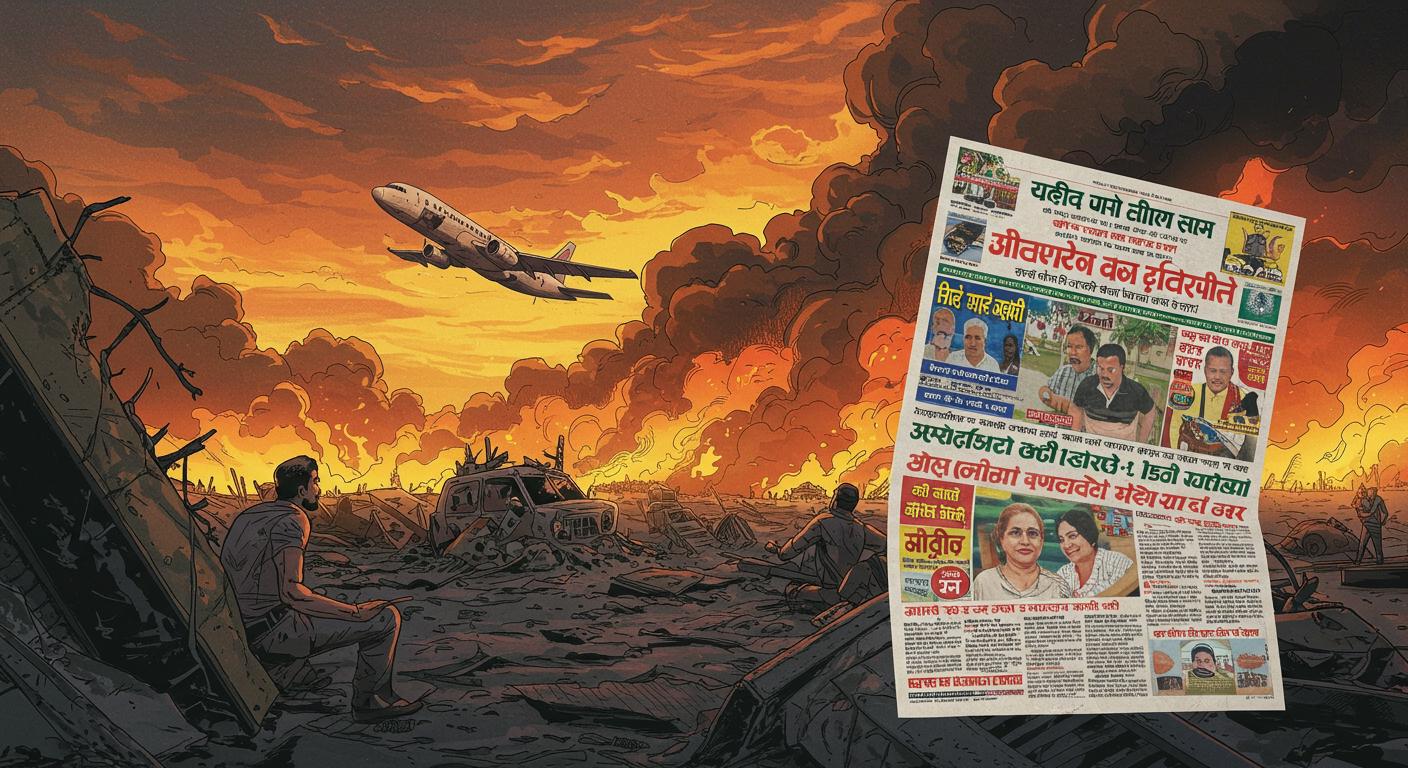
Sometimes the sharpest twists of reality announce themselves not with trumpets, but with an ordinary morning paper and the clink of a coffee spoon. On June 12th, 2025, readers in Gujarat received their usual edition of Mid-Day, likely glancing over a bright KidZania advertisement studded with playful cityscapes and, most notably, a prominently soaring Air India aircraft. Only a few hours later, news broke that Air India Flight AI171—a Boeing 787 bound for London Gatwick—had crashed on takeoff from Ahmedabad, leaving just one survivor out of 242 people. What began as an innocuous, cheerful promo swiftly became, in the cold light of tragedy, something strange and deeply uncanny.
When the Playful Turns Prescient
The vivid KidZania ad was part of a planned Father’s Day campaign, according to The Financial Express. It depicted an Air India-branded aircraft flying out from the right edge of the page, emerging from a miniature cityscape meant to evoke the playful, adventurous atmosphere of the children’s activity center. In this context, the plane symbolized the excitement kids experience at KidZania, where they can role-play as pilots or cabin crew. The intended message was one of friendly fun.
But as The Financial Express also notes, the timing was so tight that when details of the crash emerged, readers couldn’t help but juxtapose the cheerful image of the ad with the devastating real-life tragedy. The ad’s illustration of an Air India plane at low altitude above toy-like buildings came to feel unsettlingly close to reality. This visual similarity was highlighted in multiple news stories and amplified further on social media.
India TV News details how, after the crash, the similarity became disturbing: the AI171 crash left the tail of the Dreamliner wedged in a building on the medical college grounds—a real-life echo of the newspaper illustration, which depicted an Air India aircraft apparently flying right above, or almost into, urban buildings. In both cases, the image shifted from playful to haunting in an instant. Even political analyst Tehseen Poonawala commented on the bizarre overlap, writing on X, “The universe always reflects what we project. This ad was meant as a joyful Father’s Day celebration, and I respect that intent. Yet, it underscores the gravity of what we share. I am not claiming any conspiracy theories, all I am insisting is always put positive things into the universe!” As documented by India TV News, the public focus was on the shocking resemblance, not on blame.
My Pune Pulse recounts how the ad, originally designed to promote June 13-15 Father’s Day events, featured a clearly Air India-branded aircraft soaring above stylized buildings—a nod to KidZania’s aviation experience for children. After the crash, netizens began sharing side-by-side images of the ad and the site, calling it “surreal,” “the height of coincidence,” and “shocking & mysterious.” Multiple posts circulated widely, echoing the recurring sentiment: “Was that a sign?” Yet, even amid the online astonishment, My Pune Pulse reports that public reaction stopped short of outrage or conspiracy theories. The event was universally recognized as an unfortunate, if arresting, coincidence.
Not Prophetic, but Unmistakably Poignant
The feeling of collective unease was evident, but nowhere did the conversation tip into accusation. MENAFN reports that the ad was planned and submitted far in advance, as part of a typical summer campaign; the Air India imagery depicted KidZania’s partnership with the airline in their aviation roleplay activity and appeared in all their centers globally. In the wake of the crash, KidZania paused any further distribution of the visual and issued a statement expressing sorrow for the tragedy and clarifying that no one could have foreseen the unfortunate events.
The outlet also highlights how, even as phrases like “prophetic” started trending online, there was general consensus that the incident was the result of tragic timing rather than any error or misjudgment by the advertisers or the paper.
As technical investigations and the aftermath unfolded, public and media attention fixated for a moment on this eerie visual echo: a toy-like plane over city buildings, printed hours before an almost mirrored disaster in real life. According to The Financial Express, there was neither outrage nor scandal—only a sense of disbelief and an underlying sadness at the grim interplay of reality and representation.
The Oddities of Chance
What strikes me, leafing through the reporting and the parade of screenshots, is how often the weirdest coincidences emerge without malice, plan, or meaning—just a brief alignment that is impossible to ignore. Statistically, odd overlaps like this become inevitable in a world oversaturated with images and narratives flying in all directions. Yet even for those of us who spend our days hunting for eccentricities and patterns, this one stands out for its precision.
It’s worth noting, as India TV News observes, that public reaction was overwhelmingly measured; most readers responded with quiet reflection, not hysteria. The conversation centered on the uncanny timing and the sudden shift in meaning for an otherwise standard-issue print ad. KidZania’s swift move to pause the campaign—reported in MENAFN—and the absence of kneejerk outrage suggest a rare moment of collective recognition that sometimes, coincidence can simply be coincidence.
The Strange Comfort of Coincidence
After all, there’s a humility to accepting that, no matter how carefully we map intentions and stories, reality can still outpace imagination. The playful ad, distributed just hours before disaster, changed its meaning not out of prophecy but out of circumstance. As My Pune Pulse and other outlets illustrate, even the most carefully managed narratives can be upended by fate. Sometimes, all anyone can do is pause, reflect, and try to make sense of what patterns, if any, we’re seeing in the mosaic of the everyday.
So, does this episode say something about fate, randomness, or just the weird way stories intersect? Maybe it’s best left as a snapshot of coincidence: unsettling, poignant, and undeniably memorable. Even in a world used to algorithmic predictions, sometimes the printed page still surprises us—if only just for a morning.