There are some stories that prompt a double-take—not because they’re mysterious, but because the line between the everyday and the utterly bizarre blurs for just a moment. NBC Los Angeles reports that Chapman Hamborg, a Huntington Beach father of four, was recently mistaken for a homeless individual and questioned by police while taking his newborn daughter, Florence, for a walk. The root cause appears almost too relatable: exhaustion, a man bun, baggy paint-speckled clothes, and—incriminatingly—a hole in his slipper.
When Your Morning Walks Trigger a Police Response
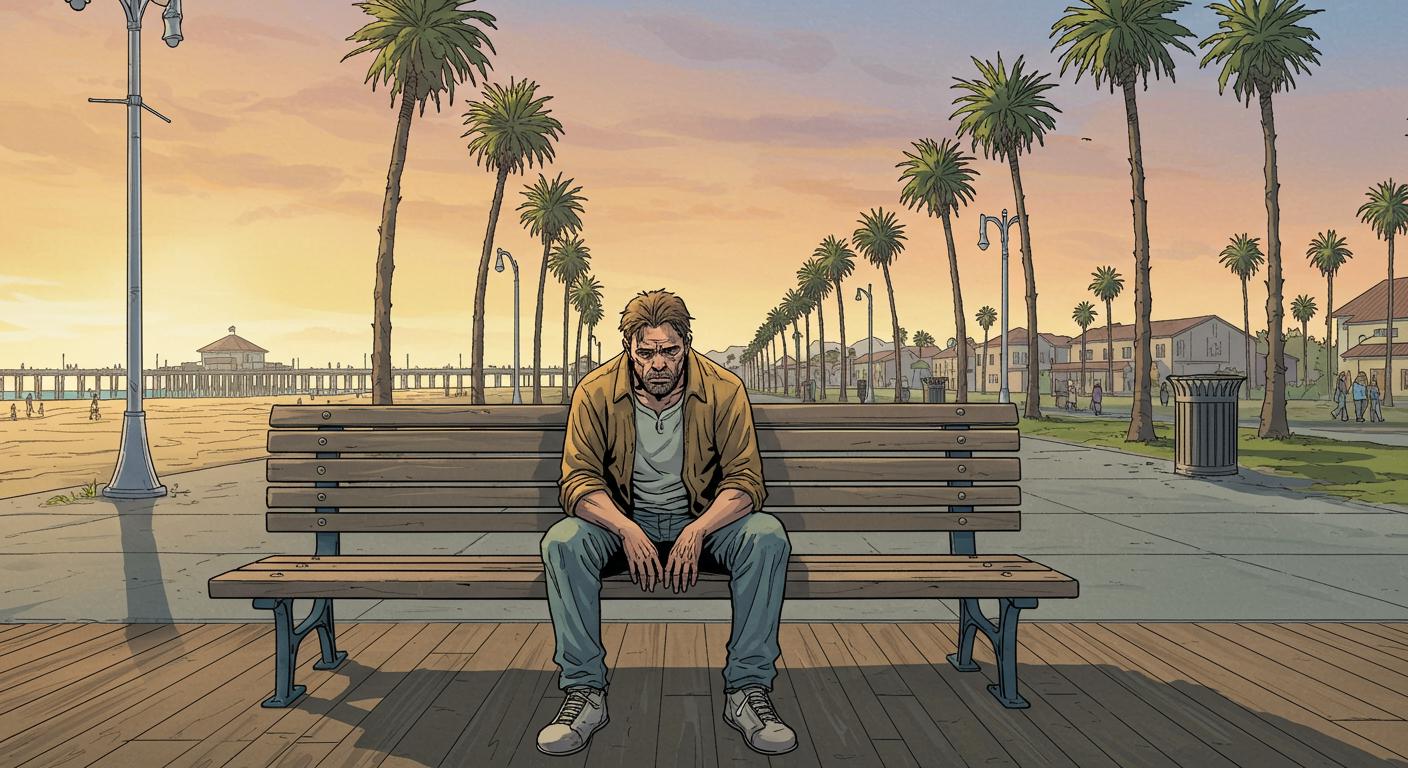
NBC LA documents how Hamborg, an artist by trade, often takes Florence on multiple daily strolls—part parenting, part effort to give his wife a break from fussy-newborn duty. On April 22, after his second walk of the day, he returned home only to be informed by his oldest child that a police car was waiting outside. Police officers soon approached, asking pointedly, as Hamborg later recalled, if he was just out for a walk and if the baby was his. Evidently, a neighbor had followed him and, disconcerted by his attire and general state of “tired dad,” reported their suspicion to authorities, even suggesting the baby might have been stolen.
In a detail described by NBC LA, Hamborg replied to the officers’ questions with, “Nope, not homeless. Just a tired dad.” It’s a response that seems concise enough to fit on a commemorative mug or ironic T-shirt.
NBC LA further outlines how Hamborg was surprised his neighbors didn’t recognize him—especially considering his frequent walks with the baby in tow. He joked that perhaps he needed to “work on [his] appearance,” noting the suspicion stemmed from his status as either an artist or a chronically tired parent. His interaction with the police, captured on video and posted to Instagram, quickly gained viral traction.
Parent Aesthetic: Between “Sleep-Deprived” and “Suspicious”
The Daily Mail provides more specifics about Hamborg’s now-infamous parenting attire: a brown Patagonia jacket, hair in a loose bun, paint-stained clothing, and a slipper with a visible hole. As the outlet documents, these hallmarks of busy-parent fashion were interpreted by at least one watchful neighbor as evidence of homelessness. The neighbor wasn’t convinced even after watching Hamborg enter his own home, instead persisting in calling 911.
After the police encounter, the family and officer reportedly shared a laugh, according to the Daily Mail, once identities were confirmed. Hamborg quipped, “Apparently, I need to work on my appearance,” while also reflecting on the neighbor’s assumption that he had stolen his own baby. Social media responses, noted by the outlet, highlighted the oddity of the situation: is it against the rules to look a little rough around the edges while caring for a child? And would simply being homeless—if that had been the case—be grounds for police intervention on a public walk with a baby?
The Daily Mail points out that several Instagram users debated these very questions, with some marveling at how quickly a tired dad became a suspected kidnapper in the eyes of suburbia.
Mistaken Identity Becomes an Art Project
Rather than venting frustration or igniting neighborly drama, Hamborg redirected the whole experience into something both practical and creative. NBC LA notes that he used this teachable moment to create a painting called “Unseen Path,” depicting himself carrying two of his children—a nod, he says, to the visible and invisible burdens of parenthood. He joined with Orange County United Way to sell a limited run of 80 prints, donating 20 percent of proceeds to support families facing homelessness.
NBC LA features a comment from Becks Heyhoe-Khalil of Orange County United Way, who observed that 371 families reached out to the organization for help in a single month, many reporting that they were at risk of homelessness with children in tow. Hamborg, wanting also to teach his own kids about the realities and human side of homelessness, saw this project as a way to spark both local compassion and conversation.
The Daily Mail also reports on Hamborg’s open-minded response to the neighbor behind the call. He never received an apology and isn’t sure of her identity, but he has said he’d be glad to meet her—not to shame, but to thank her for being vigilant.
The Universal Experience of Being Misunderstood
The entire scenario lands somewhere between comic misunderstanding and social parable. NBC LA describes how the Instagram video racked up nearly 50 million views and spurred a conversation about how quickly suspicions can escalate over something as innocuous as a tired parent with a baby—and, crucially, how we treat people who don’t meet our neighborhood’s sartorial expectations.
In the end, what’s most peculiar may be how universal the experience feels: who hasn’t, at some point, been misread by strangers, particularly during peak disheveled-life phases? Hamborg’s story lingers as a gentle reminder that the real offense is sometimes just being visibly, unmistakably, profoundly tired—so much so that a neighborhood watch mistakes you for someone else entirely. Perhaps the line between “parent” and “public curiosity” is thinner than any of us realize. How many walks, paint stains, or sleepless nights does it take before one’s dad uniform warrants a double-take from the neighbors?
It seems that, for some families, the dividing line isn’t really about being housed or unhoused; it’s simply about surviving the day. And perhaps that’s awkwardly relatable—even if most of us aren’t picking paint-splattered pants for our next undercover adventure.