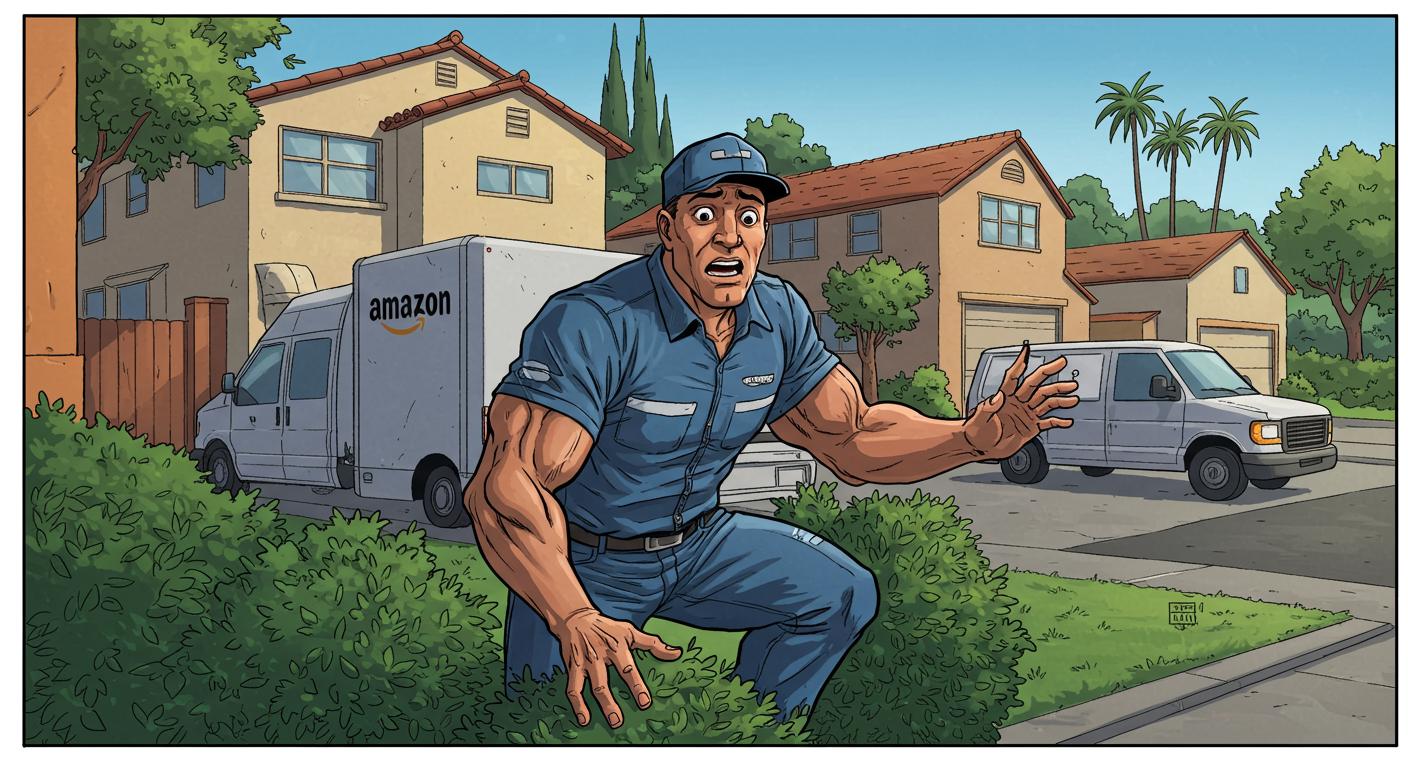
If you thought the hazards of “porch piracy” began and ended with stolen parcels, allow me to politely disabuse you of that notion. In Woodland Hills, Los Angeles, home security footage recently captured a distinctly non-traditional sort of delivery—one decidedly lacking in tracking numbers and awaiting no signature upon receipt. As chronicled by Rock 92.9, an Amazon driver was filmed relieving herself not once but twice, directly on the front porches of local homes. Talk about same-day service no one requested.
It’s worth noting that a Yahoo story was also reviewed, but it contained no additional reporting or unique details—not exactly rare in the age of automated news feeds.
The Perils of Modern Delivery (And Expectation Management)
It’s a scene that reads more like urban myth than actual, doorbell-camera-verified experience: the driver arriving, presumably with a tote of bubble envelopes and Prime-branded cartons, only to leave something, shall we say, considerably less well-packaged. According to Rock 92.9, which references KTLA’s reporting, the incidents occurred at two separate residences in Woodland Hills. Although these are the only confirmed cases, one wonders, uncomfortably, if these were merely the homes with the best surveillance angles.
The fact that the driver made eye contact with the camera—before continuing on with the business at hand (and, well, another sort of business entirely)—adds a dimension of surreal resignation to the whole story. Sometimes the daily grind really does get too literal.
There’s an odd inevitability about all this. Delivery drivers race from house to house with barely a moment for a sandwich, much less a scheduled restroom break. Husbands and wives parse tracking notifications like they’re waiting for the birth of a child, yet we rarely spare a thought for the bodily logistics of someone averaging 200 stops on a Tuesday. Still, as relayed by Rock 92.9 from KTLA’s video review, the prevailing public mood appears less sympathetic and more, well, appalled. Amazon was quick to issue an apology, describing the incident as “deeply disturbing” and confirming that the driver is no longer delivering on Amazon’s behalf. “You gotta go, you gotta go” makes a decent bathroom sign; it doesn’t really hold up in the “notes section” on a delivery app.
Surveillance Society: Blessing, Curse, or the Reason You Now Have to Wash Your Porch?
The whole episode is one for the annals—not just of the Amazon labor force, but of weird digital-age documentation. Imagine a time traveler from 2005 watching Americans voluntarily install motion-capture-equipped doorbells, only to uncover these sorts of unfiltered moments. As detailed in Rock 92.9’s account of the KTLA footage, if there’s a public-facing surface and a wifi signal, someone (or something) is watching.
This isn’t to reduce the magnitude of the, ahem, offense. Public sanitation laws exist for a reason, and nobody wants to start their morning with the kind of “delivery” seen in these videos. Yet, considering the ceaseless pressure placed on gig and contract workers—a situation frequently examined in labor studies and occasionally highlighted in broader reporting on Amazon’s regulatory issues, as Rock 92.9 briefly alludes—there’s a grim logic underlying the whole debacle. How long before these stories shift from outlandish outliers to an expected occupational hazard?
On the List of Life’s Unexpected Prime Deliveries
Amazon’s response, swift and uncharacteristically clear-cut, leaves little room for interpretation: behavior totally out of bounds, driver removed, apologies dispatched to affected households. Presumably, scrubbing brushes and bleach were delivered promptly and without further incident.
This episode, as relayed by Rock 92.9 based on KTLA’s reporting, is destined to bounce around the internet for days. It’s a story that manages to be both disturbing and, on some deep level, darkly comic—if only because there’s no obvious protocol for processing it. Where, exactly, does one leave feedback for this type of “service”—and what sort of star rating should it get?
Is this just one vividly unfortunate anecdote, destined to become a cautionary tale recited over dinner parties, or is it a symptom of a system in need of overhaul? In an era of increased automation, shrink-wrapped convenience, and Next Day Everything, the machines haven’t taken over just yet—but human unpredictability remains alive and well, thriving (if not entirely hygienic) on our doorsteps.