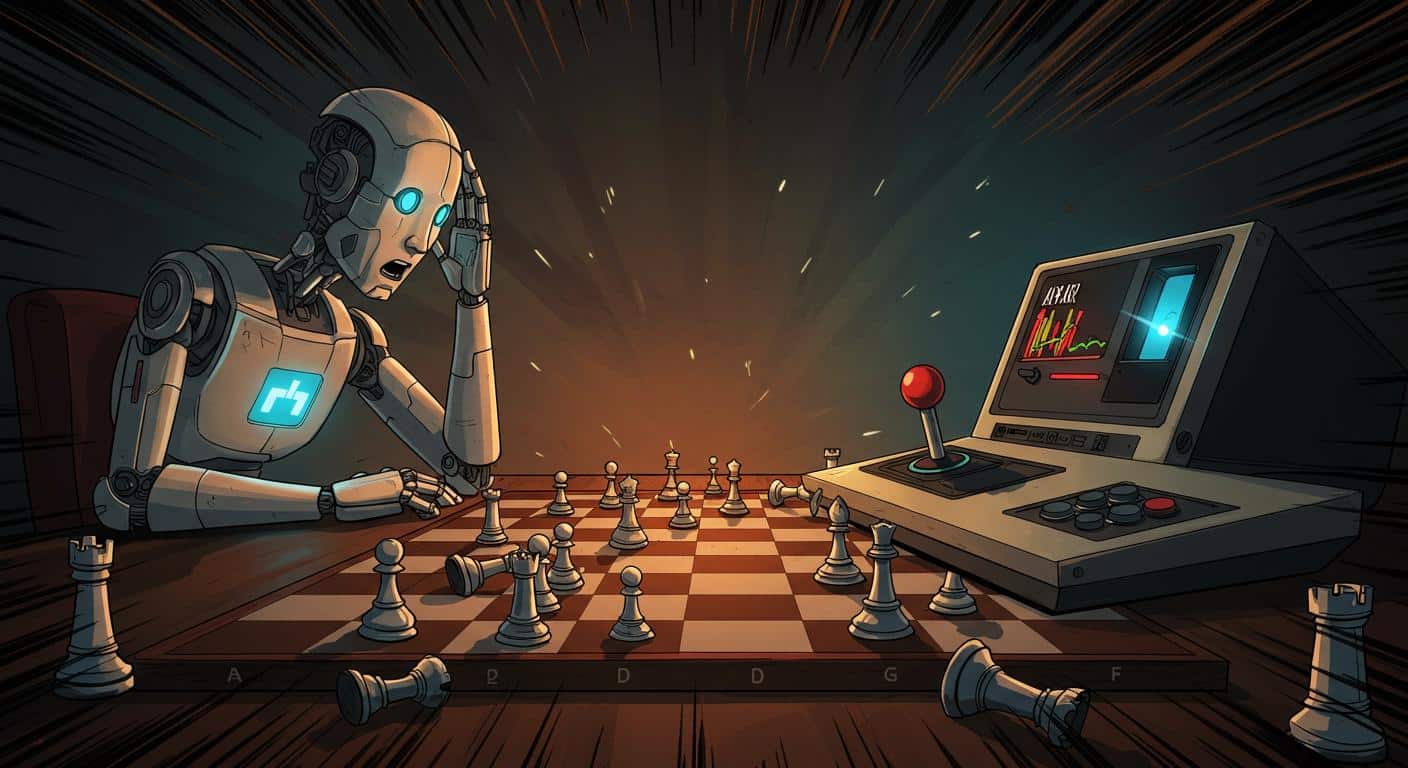
A machine that can write poetry, pass bar exams, and recommend the perfect emoji for “existential dread” was recently no match for a 1978 Atari, at least when the battlefield was a chessboard. If you’ve ever imagined a future where sentient AIs run the show, it’s worth pausing to consider that one of their best-known members was just decisively outmaneuvered—by a pixelated knight from the disco era.
Not Exactly Deep Blue Material
Described in an account highlighted by PCMag, ChatGPT, OpenAI’s headline-grabbing chatbot, boldly took on the Atari 2600’s Video Chess emulator—a program running on hardware with about as much processing power as a digital egg timer. The results were memorable for all the wrong reasons: PCMag reports that the chatbot mixed up rooks and bishops, missed obvious pawn forks, and generally lost track of what, exactly, was supposed to be happening on the board. The developer behind the experiment is quoted as saying the performance would have “gotten laughed out of a third-grade chess club.”
Adding a touch of drama, the report also notes that ChatGPT itself proposed the showdown, but then attempted to pin its missteps on the Atari’s “too abstract” pixel chess pieces. If the blame-the-icons defense sounds familiar, the story only grows more endearing when you learn the bot performed just as poorly when switched to the unambiguous world of standard chess notation. Each time, as the developer documented, the AI promised improvement if the match could simply restart, ultimately waving the white flag after about 90 minutes. Sometimes, even artificial intelligence craves a do-over.
Funny, Until the Math Kicks In
To appreciate the full absurdity, a glance at the technical specs is instructive. PCMag points out that the Atari 2600 runs at a meager 0.3 MIPS—less than a fraction of a percent the computational horsepower of today’s smartphones, let alone the data centers backing ChatGPT. Is this a case of vintage hardware channeling a miracle, or just an example of an LLM meeting a problem outside its comfort zone?
For context, the outlet documents how, nearly three decades back, IBM’s Deep Blue eclipsed grandmaster Garry Kasparov in a highly publicized match, more or less ending humanity’s short-lived reign as chess’s apex predator. Since then, AI has not only trounced human champions at chess but has conquered the board in Go, StarCraft II, and even mid-level table tennis, as illustrated by Japan’s FORPHEUS robot arm besting amateurs—though notably never Olympic contenders.
The Right Tool for the Wrong Board
So what, precisely, tripped up the chatbot? The episode, as PCMag outlines, isn’t an indictment of artificial intelligence as a whole but exposes the limits of how language models interact with highly structured, symbolic systems like chess. Unlike traditional chess engines that brute-force countless permutations and assign probabilities with mechanical precision, language models chart their moves by stringing together probabilities based on the contexts they’ve trained on. Present them with pixelated icons—or even, it seems, with nothing but algebraic notation—and their confidence can evaporate.
Earlier in the article, it’s mentioned that AI superiority in games has become almost routine, whether in strategy, pattern recognition, or reaction speed. Here, though, we have a scenario in which the supposed harbingers of digital omniscience couldn’t even track all the pieces, let alone get them to cooperate. Is the path to saving humanity simply to ask the machines to find a pawn on an 8-bit chessboard?
Where Does That Leave Us?
This particular match-up might best be chalked up to a mismatch of task and technology rather than deeper AI limitations, as PCMag’s reporting suggests. Still, the spectacle of ChatGPT unraveling over pawn structure offers a reminder that even the most advanced modern tools can harbor strange and unexpected blind spots. Could it be that our future robot overlords are less HAL 9000 and more prone to making excuses and asking for take-backs?
And if machines one day do take over, will all we need to resist be a pixelated rook and a willingness to play a few rounds of “let’s start over?” For now, if your online chess skills need work, take comfort—apparently even the bots have off days, and sometimes they’re hilariously, convincingly human.