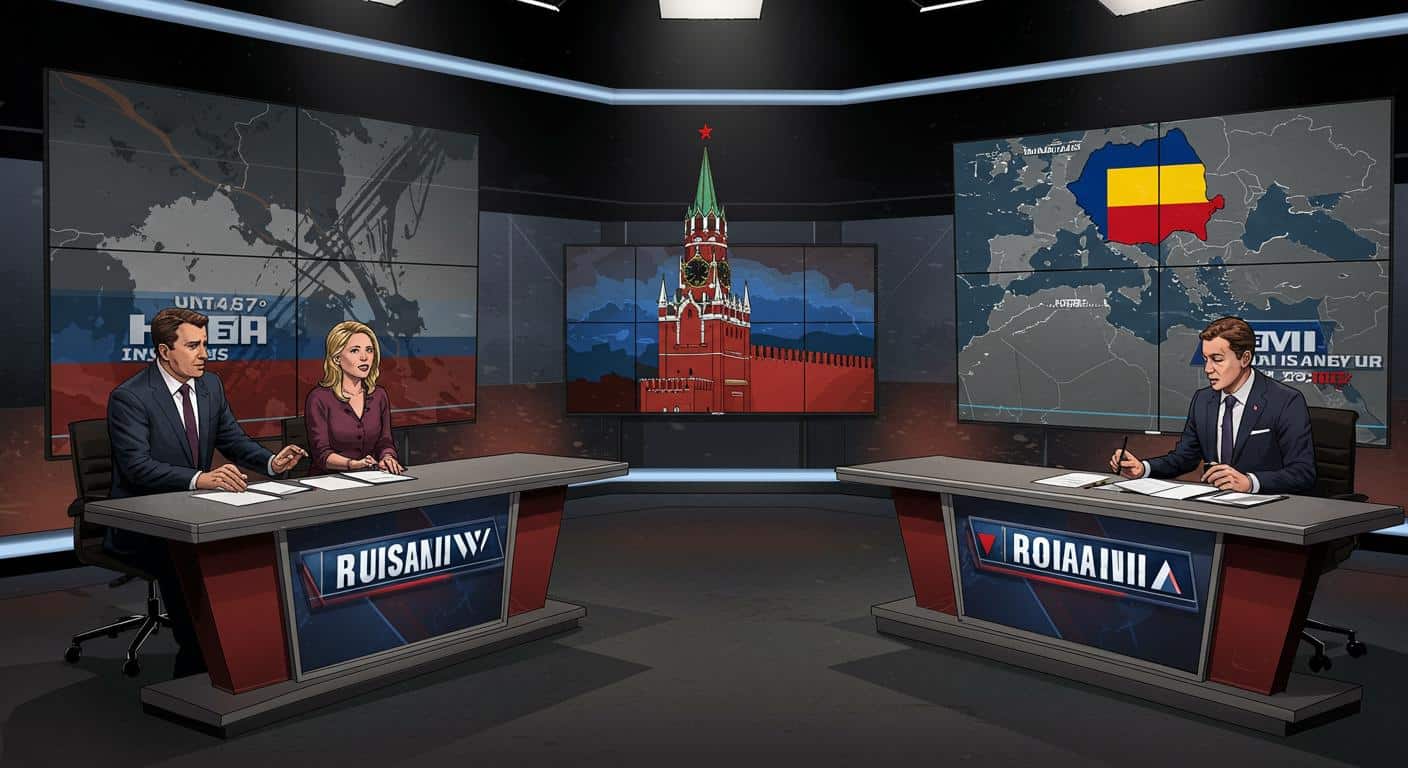
Some stories float into the news cycle already wearing an overcoat of irony. This week’s candidate: prominent Russian propagandists airing regrets on television that, alas, the days of “peacefully” seizing power in Romania are over. As documented by Libertatea, several Kremlin-aligned talking heads responded to Romania’s recent presidential election with the kind of melodramatic sighing usually reserved for missed trains or spilled soup—except here, it’s about not being able to orchestrate a friendly regime change next door, with everyone just agreeing politely.
When “Peaceful Transition” Becomes a Loophole
During a recent panel show on Russian television, a guest lamented that “events in Bucharest showed nothing can be done with them peacefully.” The remark, highlighted in Libertatea’s reporting, wasn’t about the logistics of party planning, but about political influence: specifically, the new roadblocks preventing Russia from shepherding Romania’s government in a more Moscow-approved direction without, well, drama. The guest mused aloud, “What can you do with this kind of European leadership? Unfortunately, the events in Bucharest showed nothing can be achieved with them via peaceful means.” If you catch a whiff of professional disappointment, you’re not alone.
In summarizing the outcome, the commentator suggested that liberal democracy in Romania had now mastered “the techniques for staying in power under any circumstances”—essentially framing the actual exercise of democracy as a kind of unfair advantage. The implication seemed to be: shouldn’t someone step in and give these folks a crash course in proper regime change etiquette?
The Kremlin’s Turn: Bemusement and Suspicion
Not to be left out, the official line from Kremlin spokesman Dmitri Peskov was delivered, as Libertatea records, with all the gravitas of an office worker reading from a coffee-stained manual. Peskov described Nicușor Dan’s presidential win as “at least strange,” pointing to the allegedly abrupt ejection of the presumed frontrunner as evidence that something was off. As the outlet reports, Peskov asserted, “We know the story of a candidate with the greatest chance who, without really being given any clear explanation, was effectively removed by force. And in the absence of a favorite, anyone could win.” There’s an art to sounding cryptic and resigned at the same time, and apparently the Kremlin has it down cold.
What makes the complaints especially eye-catching is the context in which they surfaced. According to details compiled by Libertatea, the weeks before the election saw the exposure of a well-organized effort—spanning Wikipedia edits and AI manipulation—to flood informational channels with pro-Kremlin content. These attempts, ongoing for at least three years, were laid bare just as Romanians headed to the polls, painting a picture of digital meddling attempted with quietly comical persistence. The digital equivalent of sneakily changing the labels on library books, only to have taxpayers cheerfully sign them out anyway.
If You Can’t Win, Change the Narrative
The Kremlin’s analysis and the televised grumbling both share a certain unintentional candor: the “peaceful” route evidently meant swaying the outcome through soft power and influence, techniques that until recently may have felt more promising. There’s an irony in Russian pundits complaining, somewhat openly, about being structurally locked out of someone else’s democracy—almost as if that, in itself, is the greater breach of protocol.
Why this public airing of frustration? It’s a pattern: when direct influence falters, the fallback strategy often becomes raising suspicions about the process itself. As seen in the latest Romanian electoral drama, the ability of a country to run its own election without outside orchestration is now cast as suspicious, even “perfected” to the point of unfairness. It’s a bit like accusing chess opponents of cheating simply for knowing the rules.
The Absurdity Isn’t Lost
For Romania, the spectacle of foreign broadcasters outlining, with wounded sincerity, their missed shot at easy influence, must land somewhere between insult and backhanded compliment. What are the odds this narrative—Romanians outfoxing even Wikipedia warriors—will boost national morale rather than shake it? When the main complaint is that democracy has become too robust to manipulate quietly, maybe you’re doing something right.
Taken altogether, Libertatea’s coverage frames this episode as a unique collision of old-world intrigue and new-world workaround. The traditional tools—media meddling, digital whispers, cryptic skepticism about the legitimacy of rivals—don’t seem to fly as smoothly as they used to.
So, if you find yourself chuckling at the idea that the greatest complaint from Russian state media is that they didn’t get to oversee a polite, paperwork-filled coup d’état in Bucharest, you’re probably not alone. How soon, one wonders, until this flavor of “peaceful” transition becomes just another meme for the digital scrapbook?