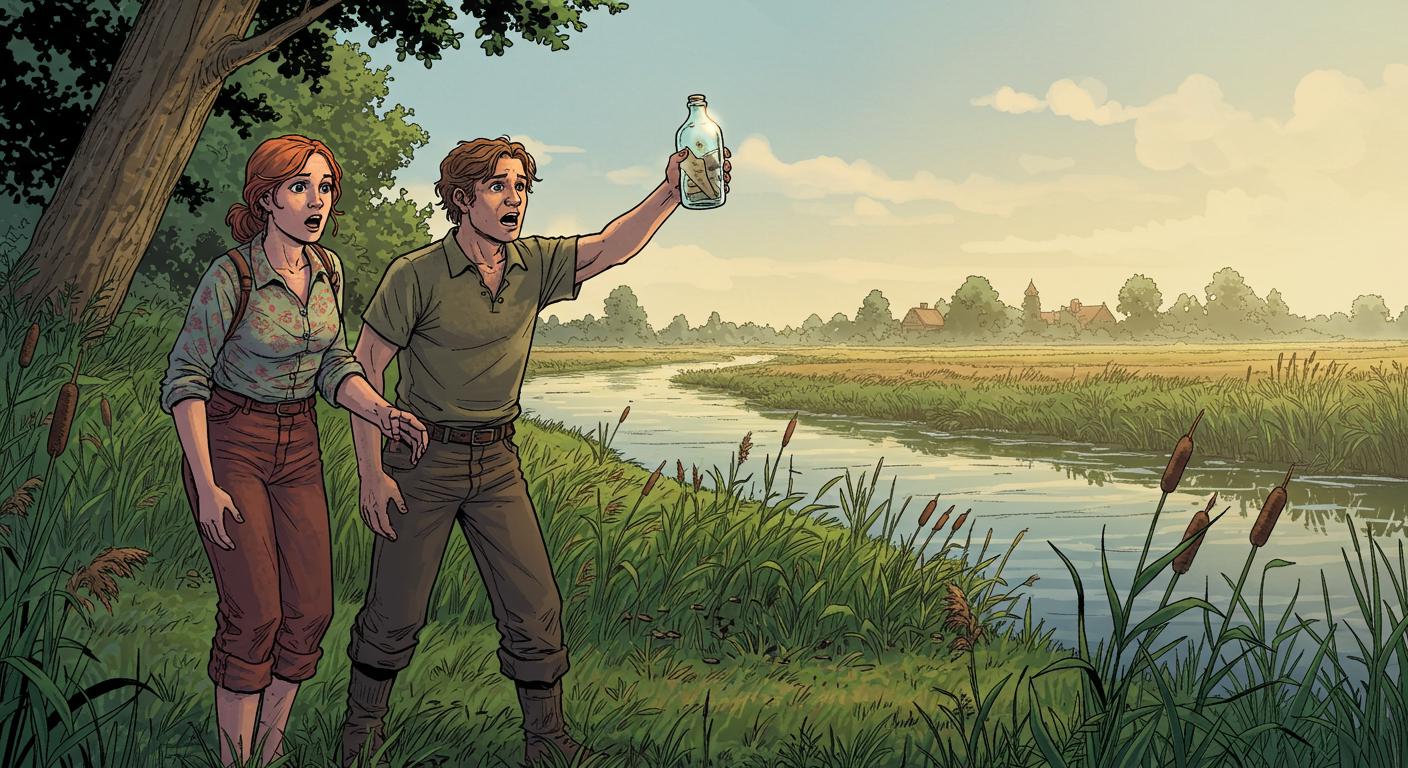
Somewhere between the more peculiar headlines involving capybara chases and snake stowaways, UPI reports on the kind of accidental time capsule that reminds us: the ocean is still the most forgetful archivist. Two 10-year-olds, Eryk and Kuba, took a stroll along Gdansk’s Stogi Beach—which already comes preloaded with the atmospherics of World War II bunkers and brisk Baltic winds. According to UPI, while walking near these beach fortifications, the boys discovered an old glass bottle tucked in the dunes, containing a handwritten letter from 1959. The message was penned by a student named Rysia, who addressed it to “Bunny” and described her loneliness at school in Tarnów, her quiet nature, and a persistent affection for the intended recipient.
UPI details that Rysia wrote, “I assure you that I am quiet and modest, I do not make friends with anyone, I simply avoid men… My dear, I am a terrible egoist, I only write about myself, but I only think about you, I see you at every moment.” Upon finding the bottle and reading its contents, Eryk and Kuba reached out to a museum in Tarnów, hoping they could help trace the letter’s author or the mysterious “Bunny.” The outlet also notes that, at the time of reporting, the search remained ongoing.
Bottled Echoes and Archive Gaps
For denizens of the internet age, where messages self-destruct or get buried beneath endless feeds, the notion that handwritten longing could survive six decades of salt, sand, and storm is moderately astonishing. The odds are stacked high against paper lasting an afternoon on most of our desks, let alone decades at the mercy of the Baltic’s tides.
Yet in this case, as UPI’s account highlights, what survived was not an SOS or a puzzle piece from a pirate’s hoard, but the everyday ache of a distant student, preserved against all odds. The fact that “Bunny” remains unidentified only sharpens the story’s intrigue. Are we looking at a term of endearment, inside joke, or perhaps a code meaningful only to two people in 1959 Poland?
A History Buff’s Delight (and Quandary)
It’s tempting to imagine all the ways this message might have ended up bobbing its way north. Was it lobbed by Rysia herself into the Vistula, consigned to hope on the Gdańsk shoreline during a rare visit? Or is the journey even more circuitous, beachcombed again and again over decades by tides, storms, and curious hands? While UPI does not speculate, bottles like this have taken impressively circuitous routes in the past.
What’s striking is this: of all the messages to persist through wars, regime changes, and the relentless advance of Polish pop music, it’s this fragile, unpretentious memento that turns up in 2025. Could anything so earnest survive if written today—a note about missing someone, finding shy solace in the company of imagined rabbits? Or is our era’s communication, for all its digital permanence, somehow less equipped to endure these slow journeys?
So, Who Was Rysia? And Where’s Bunny Now?
With the boys’ letter now in the hands of a Tarnów museum, and as UPI mentions, their ongoing effort to find the author, the rest of us are left in that deliciously uncertain place historians often inhabit: the borderlands of fact and speculation. Perhaps Rysia and “Bunny” found each other, settled down, and swapped love letters for grocery lists. Maybe the bottle was kept a secret, or its journey never completed as intended. The outlet indicates the search continues, but so far the trail remains tantalizingly cold.
If anyone has ever wanted a practical demonstration of the persistence of small kindnesses or unheralded affection, this is it. Sixty-six years later, a pair of Polish kids fumble open an old bottle and, in doing so, bridge two worlds—one anxious and digital, one handwritten and tentative. Would Rysia be mortified or quietly pleased to know her self-described “egoism” has now lapped up on the wider world’s shore?
To find such a letter is to wonder all the more about what’s washing up unnoticed, what gets missed or misread, and which of our own attempts at reaching out might, unexpectedly, endure. Is there a better metaphor for humanity’s persistent, hopeful noise than a lonely schoolgirl’s note surviving decades at sea? Or, put another way—whose bottle is next?