It’s official: the penny—which, for most of us, is less a currency than the accidental ballast at the bottom of every bag—is finally heading to the great piggy bank in the sky. The Treasury Department has announced it will halt production of the one-cent coin early next year, closing the ledger on a piece of Americana that dates back to 1792. As ABC News reports, the move is billed as a win against governmental waste. Cynics may call it a rounding error, but for the penny faithful, it’s the end of an era—whether you noticed or not.
Costly Change: When Making Money Stops Making Sense
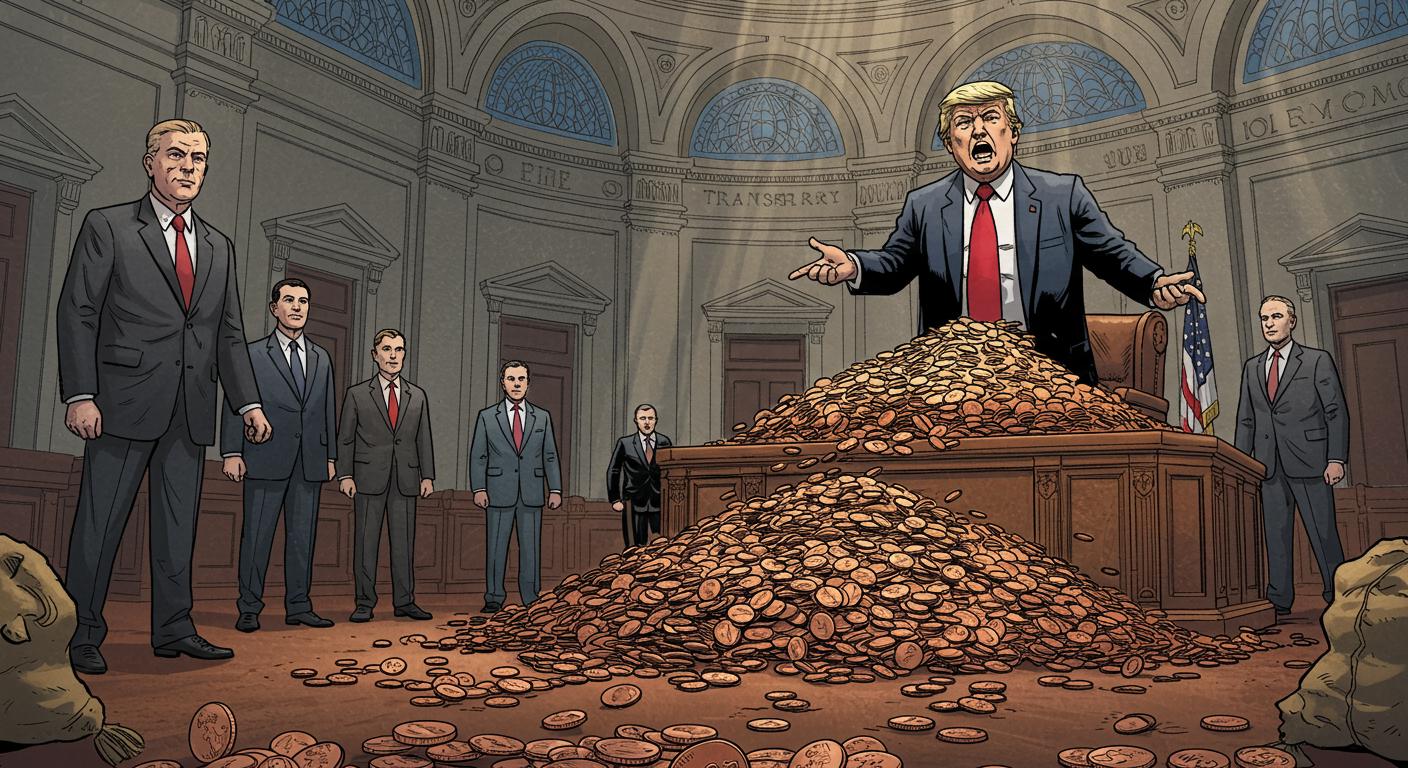
By now, it’s less “a penny saved is a penny earned” and more “a penny minted is three pennies lost.” The Treasury’s own accounting pegs the current cost to create a penny at 3.69 cents, which feels like a warning from an alternate universe where the laws of economics have gone on vacation. Treasury officials project a savings of $56 million every year from the penny’s demise, and additional cost cuts as facilities downsize and streamline without the endless task of stamping tiny Lincolns. The U.S. Mint, according to its latest annual report referenced by ABC News, managed to lose $85.3 million on pennies last fiscal year. That’s a lot of copper (well, mostly zinc) down the drain.
President Trump, showing a rare flair for wordplay, declared the penny “wasteful” back in February via his Truth Social account, and in a flourish of executive urgency, instructed the Treasury to cut production. The final order of penny blanks has already gone through, as confirmed by the Treasury’s statement. The move doesn’t require an act of Congress—a legal wrinkle highlighted by Harvard constitutional law professor Laurence Tribe in conversation with the Associated Press—since federal statutes give the Treasury Secretary authority to make this sort of change.
Heads or Tails: Penny’s Place in the American Imagination
It’s not all bottom lines and melting zinc. For many, the penny’s significance is equal parts practical irrelevance and sentimental coin jar nostalgia. The coin’s been circulating (or at least, languishing in desk drawers) since the earliest days of the republic, with Lincoln’s face pressed onto its diminutive frame for 116 years now. As detailed in a feature by inkl, the U.S. Mint churned out over three billion new pennies last year, and there are currently 114 billion in theoretical circulation—though, considering how many spend decades under car seats, perhaps that number should have an asterisk next to it.
Caroline Turco, assistant curator at the Money Museum in Colorado Springs, points out that the “penny” isn’t even technically American—it’s a British word, smuggled across the Atlantic with other imperial relics like “queue” and “spelling colour with a u.” We call it a cent, but it seems “Take a cent, leave a cent” never quite caught on at gas stations. The coin’s not alone in the retirement club, either. Among its forebears: the trime, half-cent, and 20-cent piece—all now mostly familiar to trivia buffs and very hopeful metal detectorists.
The Rounding Begins: Nickels, Pricing, and Predictable Grumbling
Of course, no extinction event is complete without warnings of unforeseen consequences and the faint aroma of vested interests. Mark Weller, executive director of Americans for Common Cents (yes, that’s real), told ABC News the change “is an absolutely horrible idea.” Weller argued that eliminating the penny would force up production of the nickel, which has production costs edging toward the theatrical—nearly 14 cents for every five-cent coin. Producing more nickels, he contends, will just scale up the monetary leakage.
His reasoning leans into the domino effect: lose the penny, make more nickels, and the losses could balloon; meanwhile, businesses eye the nearest opportunity to round up prices in a classic demonstration of private-sector optimism. “If there’s one thing most economists agree on is that private business has a profit motive,” Weller observed, suggesting nobody should brace for prices to be rounded down. If you’ve ever shopped in a gift store, this doesn’t exactly sound far-fetched.
Another, less obvious fallout: as digital payments quietly take over, those still reliant on cash—particularly the underserved and “under-banked”—may see their purchasing power eroded, cent by cent. The inkl report describes how state and local governments will be left to hash out rules for rounding sales taxes, a logistical headache likely to haunt only accountants and the very dedicated.
An Archipelago of Unloved Coins
It turns out, most of our coins already live in exile. Federal Reserve estimates relayed by inkl claim that about 60% of coins in “circulation” are actually marooned in jars and drawers, while Americans collectively throw away tens of millions in change each year. (It appears the couch cushion is both Fort Knox and landfill.)
Purists and collectors, however, are waxing nostalgic. Turco from the Money Museum dryly suggests that the coin’s value won’t skyrocket overnight, but that phrases like “lucky penny” and “a penny saved…” will persist. If history is a guide—see: Canada, which sent its penny packing in 2012—the impact will be felt mostly in stories, not shopping habits.
Social media, always ready to wring a joke out of demise, has played its part. The inkl coverage highlights comments such as “A bitcoin for your thoughts? future generations prolly,” and the more anxious, “So what happens to the take a penny leave a penny at gas stations?” It’s unclear whether future generations will even know what a gas station is, but the sentiment feels apt.
In Summary: All Change and the Occasional Lucky Find
The penny’s gradual fade from fiscal necessity to cultural footnote didn’t happen overnight—but then, the slow march of obsolete things rarely does. In the great sorting of what society keeps around “just because,” the one-cent coin finds itself finally out of excuses.
Should we be mourning a piece of copper (well, zinc) that’s mostly been a punchline in recent decades? Or are we overdue for a change—literally? Maybe ridding ourselves of the penny is just one more step toward a future where loose change is a thing of the past and the lucky coins are all digital, waiting to be uncovered under the HTML couch cushions of tomorrow.
But who knows—someday, maybe finding an old penny in the wild will feel a bit like spotting a pay phone: an artifact of a stranger, slightly weirder time. When was the last time you got actual pennies with your change? And will you miss them, or just the odd satisfaction of dropping them in a rusty jar no one ever remembers to cash in?