Some adventures begin with a plan; others start and end with the weather making all your decisions for you. Peng Yujiang, a paragliding enthusiast with five years’ experience, set out for nothing more exciting than a cautious equipment check in China’s Qilian Mountains. Somewhere between the ground and, well, what airline passengers would recognize as their cruising altitude, routine turned into high-altitude improvisation. The resulting viral video and regulatory ripple effect are, as the Guardian relays, almost as improbable as Peng’s survival.
When Gravity Takes the Day Off
Peng’s original plan, described in reports compiled by the Gansu Provincial Aviation Sports Association and detailed by both the Guardian and the Global Times, was a low-key “ground parachute shaking” session. Picture an equipment shakedown with minimal lift—nothing involving actual flight or paperwork. Yet, as weather records (and now viral history) will show, a sudden updraft provided an unsolicited upgrade.
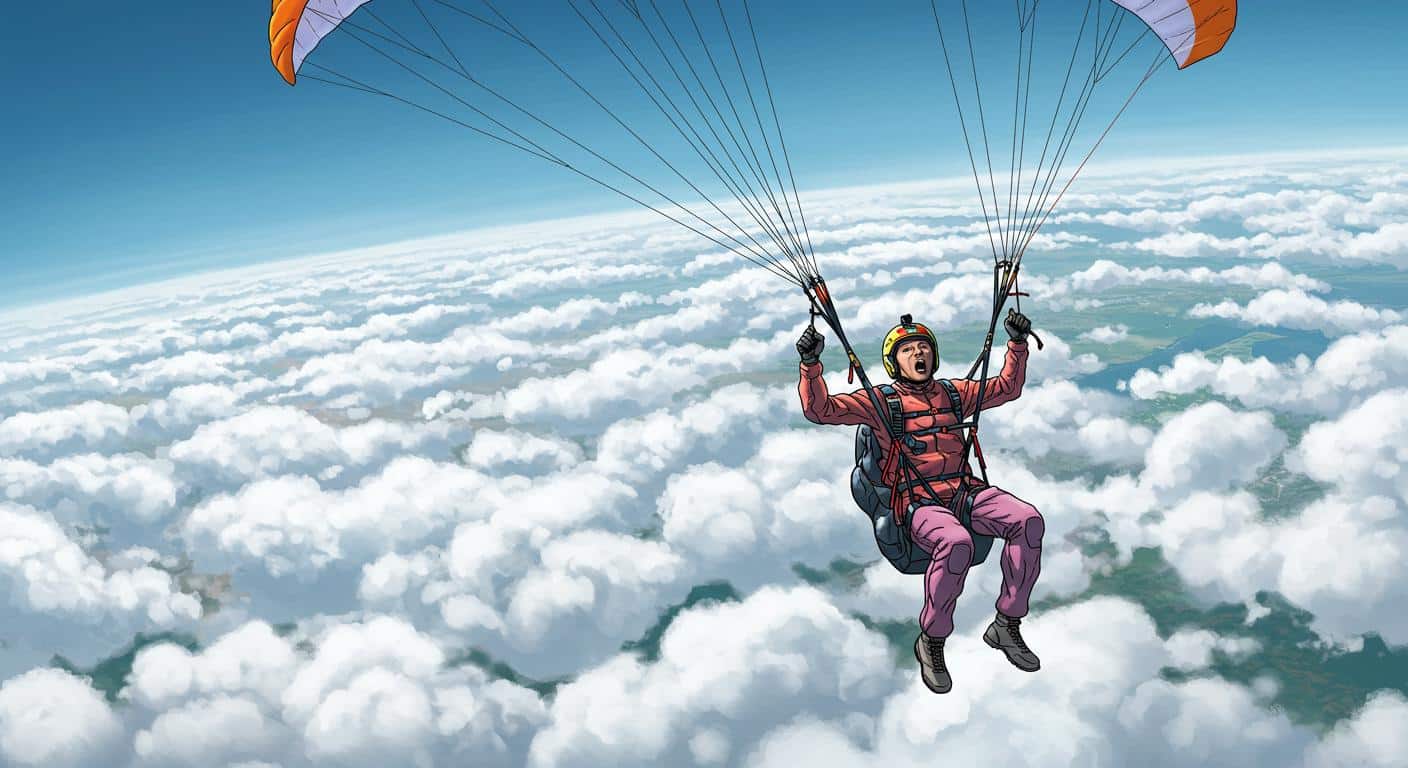
Within about 20 minutes, Peng was yanked skyward by a phenomenon referred to as “cloud suction,” ascending more than 5,000 meters from his launch point at around 3,000 meters. Before long, he found himself above the cloud layer at an altitude not far below Mount Everest’s peak, with temperatures plunging to -35°C and ice quickly accumulating on his gear. The Guardian, drawing on footage from Peng’s helmet camera, reports that his hands froze, attempts at radio contact became increasingly strained, and he experienced disorientation and spells of unconsciousness. It makes you wonder what goes through a person’s mind—besides a lot of very cold air—in those moments.
The Global Times further notes, via the association’s official investigation, that as Peng battled to descend, his attempts to break free from the updraft proved completely ineffective. After entering the cloud, his sense of direction vanished and he endured major collapses of his wing, passing out temporarily before the subzero shock revived him enough to manage a landing near Qifeng town, some 30 kilometers from his unintentional launchpad. It’s the kind of ordeal you expect Swiss climbers to survive, not recreational paragliders out for a patch test.
Viral Flight, Viral Fallout
One would think returning to the ground at all would be accomplishment enough, but the aftermath became a story of its own. Peng’s friend Gu Zhimin, who had been in radio contact throughout, met him at the landing site—and, naturally, posted the whole saga to Douyin (China’s TikTok variant). Reactions ranged from awe to concern, with some commenters suggesting Peng had broken altitude records in the sport.
However, both outlets document that the authorities were less than enthusiastic about star-making accidents. In a finding summarized by the Guardian, officials conceded Peng’s ride into near-stratospheric territory was accidental—and that, medically speaking, “a normal person cannot be exposed at 8,000m without oxygen.” Nonetheless, the mere fact that the flight was unregistered and took place without site or airspace approval triggered official sanctions.
The report, recounted in the Global Times, clarifies that although Peng’s outing shattered the existing world paragliding altitude record (previously held by Ewa Wiśnierska at just below 10,000 meters), the achievement wouldn’t count. Rewarded for his survival with a six-month flying suspension, Peng must also complete a written reflection on the “negative impact” of his behavior. Gu, for posting the viral footage without clearance, faced the same penalty. Flight sites in the area were promptly sealed, with prominent no-fly signage sprouting up—apparently the regulatory equivalent of “Don’t try this at home.”
Ice, Altitude, and Unscheduled Records
There’s dry irony in the fact that Peng’s brush with the extreme followed not bravado, but the meteorological equivalent of tripping into the record books. Footage cited by both sources shows Peng battered by frostbite yet somehow aware enough to operate his canopy on descent, rivaling accounts of Wiśnierska’s similar ordeal in 2007, where she also lost consciousness after being swept up by a storm’s updraft.
As previously reported in Global Times, ground parachute training doesn’t typically need formal approval. Yet when gusts hand you the keys to the sky, bureaucracy is quick to take the wheel back. It raises the question: how many “accidental” records languish unrecognized, simply because no one thought to fill out the right form before being unwillingly launched into the heights?
A Story Best Filed Under “You Had to Be There”
Now, both Peng and Gu have several months to consider what qualifies as “negative impact.” Does it lie in the breaking of rules, the physics-defying ascent, or simply the fact that the most record-breaking thing about their weekend entailed icicles, bureaucracy, and a viral video essay?
After all, some practice runs just lend themselves to legend—the kind of tale you’d expect to hear second-hand and immediately Google in disbelief. What are the odds the most memorable thrill does not come from seeking risk, but simply from an uncooperative cloud and the world’s most ambitious updraft? It’s enough to make even an archiving skeptic smile: once in a while, reality outpaces even the wildest hypothetical.