There’s a familiar rhythm to cultural flashpoints in America: historians battle over which truths make it onto the page, politicians stake their flags in narrative territory, and somewhere in the corner, a librarian side-eyes everyone, wondering which version will need a Dewey Decimal. The latest entry in this genre? Oklahoma’s freshly minted education policy, which essentially recommends classes in “Election Conspiracy Theory Appreciation”—extra credit for spotting patterns where none exist.
From Civics to Suspicion: The New “Discrepancy Studies”
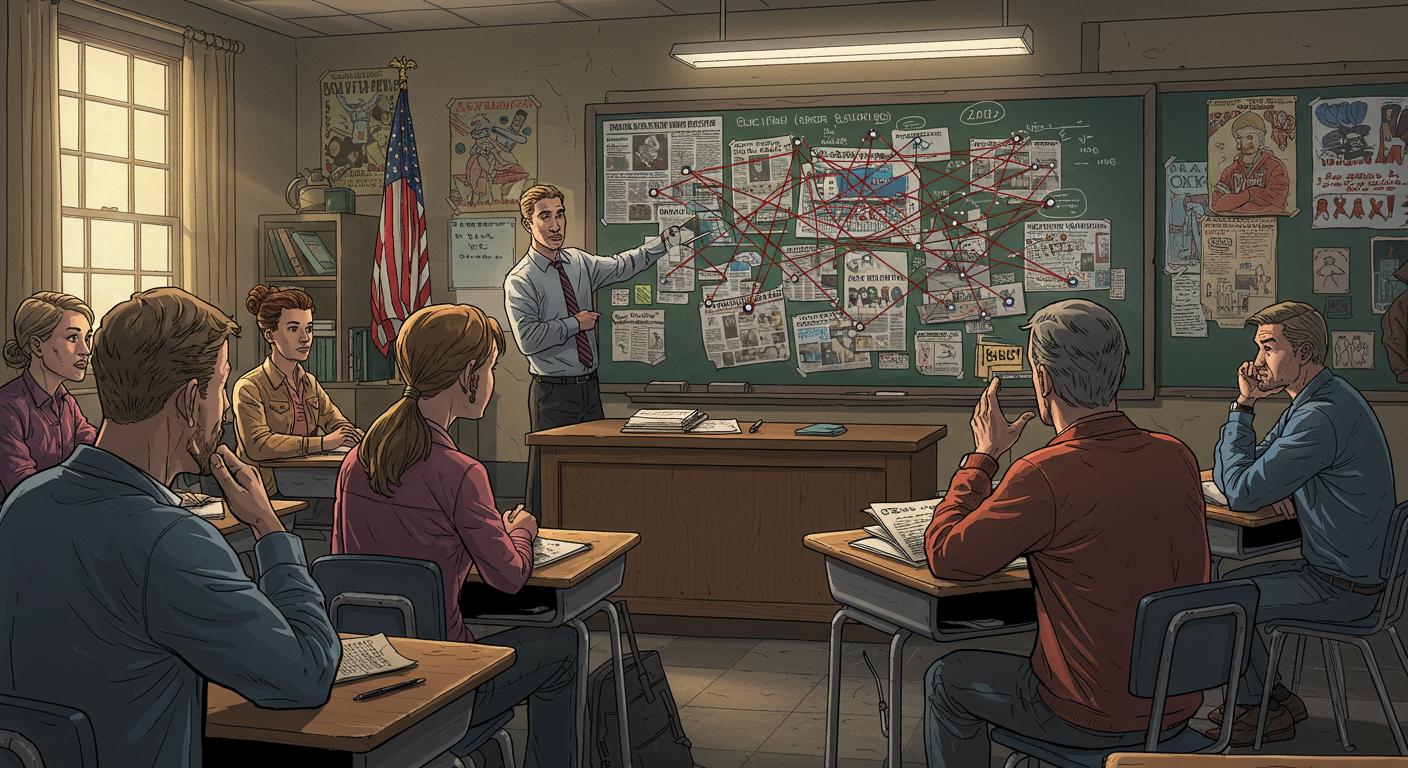
The significance of Oklahoma’s curriculum change has rippled far beyond state lines. As The Guardian reports, the state’s updated social studies standards now require high schoolers to “identify discrepancies in 2020 election results,” referencing ballot counting pauses, alleged security risks in mail-in voting, so-called “sudden batch dumps,” and an “unprecedented contradiction of ‘bellwether county’ trends.” Instead of a neutral “examine issues related to the election of 2020,” the approach now directs students to actively sift for dubious irregularities, a pivot that replaces civic study with political speculation.
This overhaul may owe much to State Superintendent Ryan Walters, who, according to The Guardian, steered the standards with help from conservative think tank figures like the Heritage Foundation’s Kevin Roberts—a lead player in Project 2025—and Dennis Prager, founder of Prager U, an organization whose “pro-American” educational content has faced criticism for its lack of objectivity.
NewsOne documents that the requirements echo widely debunked claims from the aftermath of the 2020 election—claims which have been repeatedly disproved in recounts, audits, and over 60 court cases confirming Joe Biden’s win. Nevertheless, under Oklahoma’s new rules, these claims will become homework assignments.
Political Editing at Lightning Speed
The mechanics of how these standards were adopted deserve their own footnote in the annals of bureaucratic efficiency—or perhaps cunning. NewsBreak notes that the final language was dropped on the state board just hours before a crucial vote, with Superintendent Walters pushing for same-day approval, citing a supposed deadline that, according to subsequent reporting, did not actually exist. The curriculum, all 400-plus pages, included last-minute additions not previously circulated, such as assertions about Covid’s origin and reframing of the January 6 Capitol riot as a “protest.”
Ring of Fire details that some board members later expressed frustration, feeling “duped” by the process. It turned out they had nearly two months to review the standards before the actual deadline, sparking calls among officials to revisit the rushed approval. The blend of haste and procedural sidestepping left more than a few eyebrows permanently raised.
Educators and Experts Pushed to the Margins
The reaction among Oklahoma educators has been one of persistent concern. Teaching professionals, as highlighted by NewsBreak, now wonder how to implement standards that obligate them to treat thoroughly disproven conspiracy theories as valid discussion points. The Oklahoma Education Association condemned the standards, describing the guidance as putting educators in “an impossible position between professional ethics and state mandates.”
University of Oklahoma professor Dr. James Wilson, cited in the same report, expressed that requiring teachers to present conspiracy claims as having legitimate basis fundamentally undermines the very evidence-based instruction critical to American education. Meanwhile, political historian Dr. Amanda Carpenter at Oklahoma State University observed that teaching about claims made is not the same thing as teaching that those claims hold water—especially after exhaustive debunking.
Faced with these paradoxes, some educators, as described in The Guardian, hope to find ways to truthfully contextualize these “discrepancies”—perhaps by framing them as historic examples of misinformation—while others are waiting to see how litigation plays out before attempting to rewrite lesson plans.
Why “Critical Thinking” Is Not Always What It Seems
Defenders of the standards lean on the language of critical thinking and multiple viewpoints, with Superintendent Walters telling reporters the changes will help students “analyze primary sources and evaluate conflicting claims.” But as NewsBreak also notes, these skills can’t flourish when official policy demands the consideration of falsehoods on par with facts. After all, the goal of critical thinking is to distinguish between evidence and assertion, not simply to amplify uncertainty.
Even within Walters’ own party, alarms have sounded. The Guardian recounts that both the governor and legislative leaders privately balked at the changes, particularly the last-minute amendments. Their hesitancy, however, was quickly undercut by pressure from groups like Moms for Liberty and other conservative activists, who threatened to primary any lawmakers stepping out of line. The state’s political machinery, it seems, has become the real curriculum in power dynamics.
Lawsuits, Taxpayer Costs, and Educational Headaches
Concerns over educational integrity have already moved to the courts. As NewsOne describes, a coalition of parents and education advocates filed suit, arguing that the process violated procedural requirements and the substance of the standards themselves represents a “distorted” and politicized history. Legal analysts, quoted in NewsBreak, point out that while states have broad discretion in curriculum design, there are constitutional limits—namely, that public education cannot be compelled to teach demonstrable falsehoods as fact.
On a practical note, the cost of this curricular pivot is far from trivial. The Guardian and Ring of Fire both confirm that Oklahoma expects to spend $33 million updating textbooks and other resources. Whether that investment will translate into a better-educated populace is, given the state’s standings near the bottom in math and science, an open question.
The Syllabus for Suspicion
All these changes have landed Oklahoma students in a kind of lab for political storytelling—less “government class” and more “History According to Cable News.” While some educators might still sneak truth and context into their teaching, many are now forced between job security and intellectual honesty. If the intent was to cultivate civic pride or engagement, it’s difficult not to question whether training students to scrutinize democracy through the lens of baseless suspicion is the best approach.
What happens next? Will the courts reel in these new standards or simply add to the ever-lengthening list of contradicting lessons in America’s classrooms? And in a world already awash in rumors, memes, and rewriting of recent history, is “Advanced Conspiracy Studies” really the subject where Oklahoma aims to lead the nation?
Certainly, there are stories worth pursuing and critical questions worth asking. But if education turns into a classroom exercise in shadow-chasing and manufactured doubt, what are Oklahoma’s students actually learning—beyond how to be suspicious of their own textbooks?