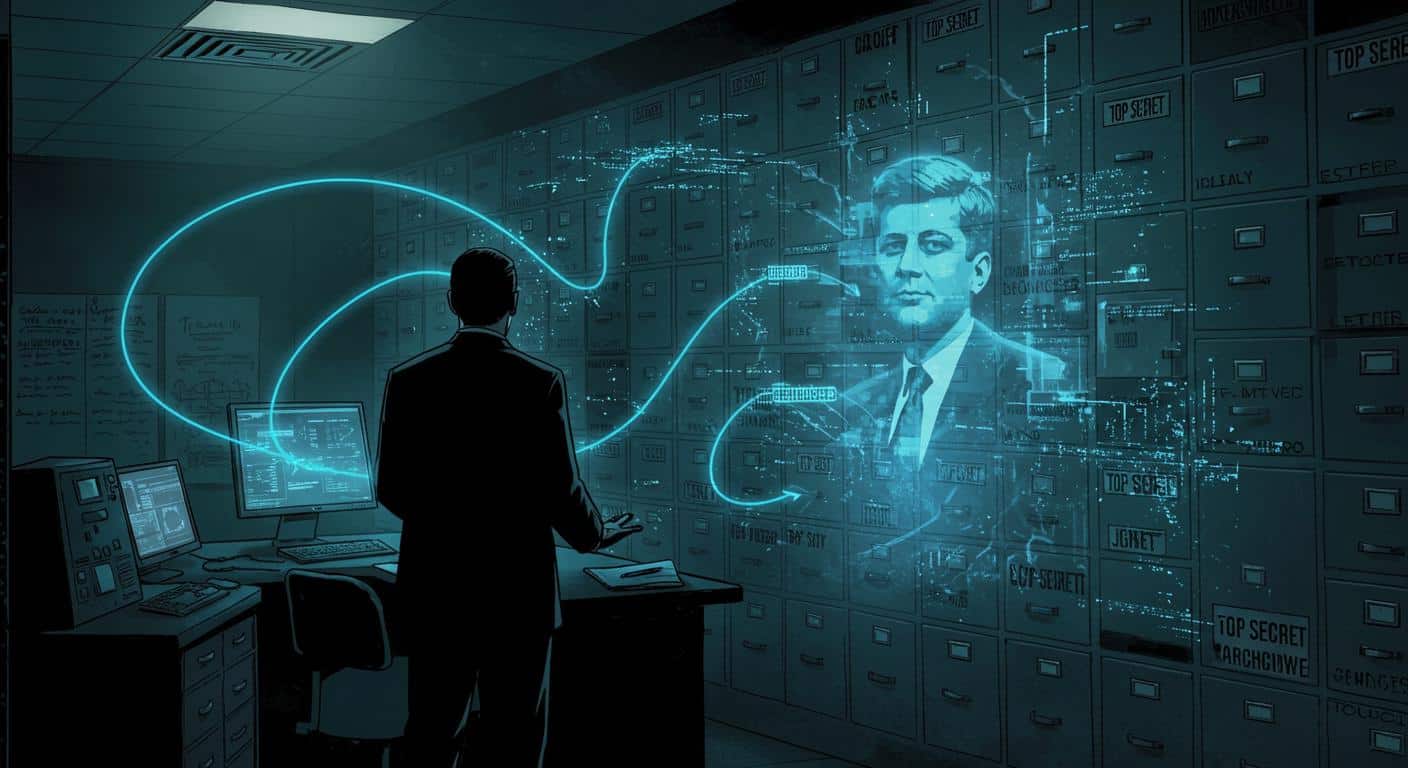
It’s probably safe to assume the mysterious saga of the JFK assassination files wasn’t near the top of anyone’s “AI is coming for your job” worry list. But, as recently revealed by U.S. Director of National Intelligence Tulsi Gabbard and reported in The Hill, the technological ghost in the archives is now picking through boxes long left to the realm of anxious historians and very committed Reddit threads. Yes, according to sources and Gabbard’s remarks at an Amazon Web Services conference, the decision about which secrets we may finally gaze upon from the Kennedy assassination files is, at least in part, being made by artificial intelligence.
Algorithm Over Archivist
Director of National Intelligence Tulsi Gabbard disclosed during her remarks at the AWS Summit, as The Hill documents, that the Trump administration utilized artificial intelligence to review tens of thousands of pages related to JFK’s assassination. The primary reason: speed. Gabbard described the painstaking process of “having humans go through and look at every single one of these pages” as exceedingly slow, sometimes requiring months or even years—a sentiment echoed by experts cited in AP News.
Instead, the agency fed the documents to AI systems capable of rapidly scanning for sensitive information, significantly expediting declassification. Gabbard emphasized that leveraging private-sector technology allows intelligence officers to direct their energy toward work only they can do, rather than acting as, essentially, high-security document sorters. As AP News further notes, this effort aligns with a broader governmental push for modernization, with President Trump having signed an executive order earlier in the year aimed at updating federal technology and software.
The AOL network, summarizing Gabbard’s statements, also reported the use of AI to decide which JFK files to release, confirming the scope and intent of the operation.
Now, those stacks of government secrets that might once have passed through human hands beneath dim fluorescent lights are instead filtered by code—a kind of tireless, indifferent understudy reading faster than any caffeine-powered historian.
Progress, or Just a Shinier Lockbox?
Of course, the juicy question isn’t merely whether AI can chew through classified documents, but how it decides what’s safe for public eyes. Gabbard, at the AWS event referenced in The Hill and AP News, didn’t go into fine detail on the precise decision matrix used by the AI. One can only imagine whether the software is deploying a simple checklist—names, phone numbers, cryptic references to umbrellas—or if there’s a hidden layer of bureaucratic nuance involved. It’s unclear, and the public can only speculate, as the articles don’t elaborate on the inner workings.
As both The Hill and AP News highlight, much of what’s being unsealed are documents that were public before, albeit with key details redacted. AI’s involvement means some of those blacked-out bars may finally disappear—or, depending on the software’s logic, stay blacked out for the foreseeable future. The process promises less personal whim, if perhaps less room for a sticky note reading “maybe let this one through.”
Gabbard’s confidence in technology-driven review arrives alongside an ongoing handoff of sensitive government work to private companies, something she has called for expanding, according to AP News. At least for now, humans remain in the loop for edge cases—but increasingly, the gatekeeping may be more about code than coffee breaks.
AI, Odd Ironies, and the Ongoing Allure of Secrecy
It’s almost quaint to picture computers as disinterested arbiters, sifting history from rumor. Yet, even the most finely tuned AI can only be as precise as the parameters it’s given: does “national security risk” translate into a clever filter setting, or is anything truly ambiguous flagged for the old-fashioned “send to supervisor” pile? If efficiency becomes the main rubric, will thorny issues of context and nuance falter when rendered as algorithmic logic?
Gabbard’s approach, described in both The Hill and AP News, is hardly limited to JFK files: AI is now involved in other routine—and not-so-routine—intelligence chores, from HR flagging to scanning intercepted communications. Perhaps one day, the shadowy vaults of 20th-century history will only ever be glimpsed as a machine-learned “further review needed.” AOL’s coverage underscores how this hands-off sorting may itself become a new mystery for future historians to dissect.
In the end, there’s a certain irony: after decades of speculation about cover-ups and secret-keepers, the gatekeeper for America’s most intriguing assassination files may not be a human at all, but a complex and quietly impartial algorithm. Is this progress, or just bureaucracy with shinier locks? Or is abdication to software simply the next, inevitable twist in a saga already crowded with unexpected turns? For now, the process of revealing the past may be more opaque than the documents themselves.