
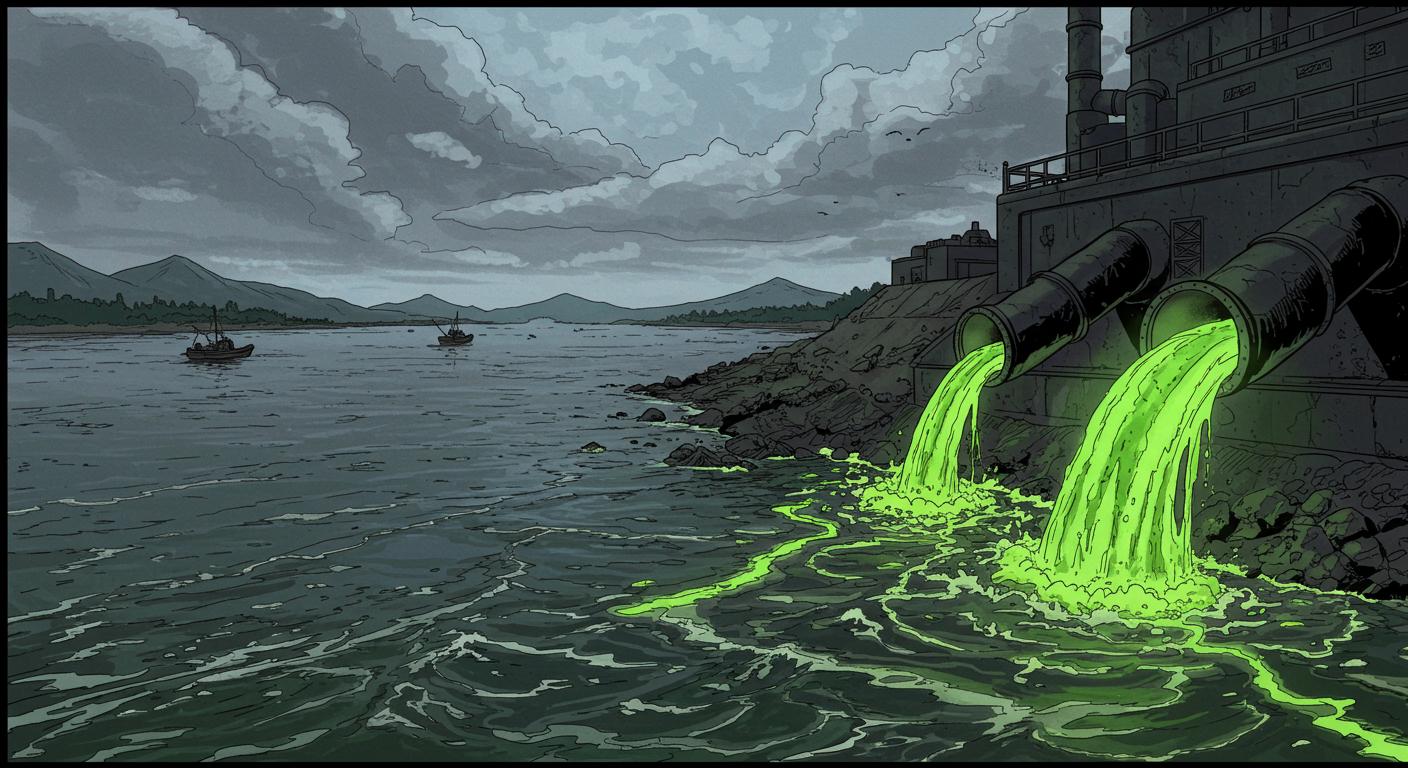
Sometimes, it’s the subtle shifts in a decades-old problem that catch the eye. While international news cycles swirl endlessly around North Korea’s nuclear ambitions—you know, rockets here, missile tests there—less attention is paid to what trickles quietly downstream. Literally. As detailed in Daily NK’s analysis, those longstanding concerns about North Korea’s uranium waste seeping into South Korean waters have quietly advanced from the realm of feared accidents to an almost head-scratching intentionality—thanks not to carelessness or failing infrastructure, but deliberate engineering.
Deliberate Detours: How Waste Finds Water
The Pyongsan uranium facility in North Hwanghae Province may not be a household name, but as described by Bruce Songhak Chung, it’s key to the North’s nuclear chain—in effect, an assembly line for yellowcake, the uranium powder that makes later enrichment possible. Historically, the plant’s waste—including a mix of sludge and contaminated water—landed in a sedimentation reservoir across the river. According to satellite imagery and expert analysis cited in Daily NK, as years passed and uranium-related sludge piled up, the pond became progressively overwhelmed. What began as a 1.9-hectare sludge cover in 2006 gradually swelled to over 16 hectares by October 2024—a growth confirmed by reviewing WorldView-3 images via ESRI’s World Imagery Wayback, as the outlet outlines.
But here’s where things tilt from grimly routine to quietly bizarre: Facing a maxed-out sludge pond, North Korea didn’t simply hope for evaporation or invent a new waste treatment scheme. Instead, satellite evidence and time-lapse imagery collected by both Jacob Bogle (a U.S. civilian satellite imagery specialist who first flagged the tunnel excavations in early 2023) and further confirmed by Chung’s analysis show a purpose-built drainage system quietly being dug between the sedimentation pond and a nearby stream beginning around March 2022. By late October 2024, as confirmed by the high-resolution imagery highlighted in Daily NK, the underground tunnel and external drainage channels were completed, giving waste an unimpeded, human-crafted path toward the Yesong River.
So, in a move both bold and eyebrow-raising, North Korean engineers essentially re-routed the problem—sending untreated uranium waste not just out of sight, but quite literally downstream. The resulting leachate isn’t just a trickle: in satellite images, the drainage channel stands out as a dark vein running two kilometers to the Yesong, after which it continues its cross-border journey, ultimately emptying into the West Sea through Ganghwa and Gyeonggi Bays.
Old Leaks, New Strategies
It wasn’t always this bold. Several years ago, as noted in Daily NK’s report, specialist outlets like 38 North and Radio Free Asia raised alarms about possible leaks from old, failing pipelines. That prompted South Korean officials to collect samples from the Han River and West Sea; as the Ministry of Unification publicly announced in October 2019, no “unusual findings” or dangerous radioactive contamination were detected at the time. Those results, though, referenced the era of accidental leaks, not the era of intentional flow. The outlet also observes that following repairs or replacements, satellite imagery no longer revealed telltale pipeline leakage. For a while, it looked as though the worst was over.
This new approach—tunneling and intentional release—marks a pretty distinct turn. As emphasized in the Daily NK reporting, all of this has unfolded under the lens of regular international satellite surveillance, which makes North Korea’s indifference to being spotted even more peculiar. The guiding logic remains fuzzy: is it resignation to being watched, an outright disregard for environmental costs, or just plain necessity when the pond’s brimming?
The Expanding Footprint—and the Fallout
Daily NK further documents that as waste production ramped up, the sedimentation reservoir’s surface area expanded in tandem with North Korea’s nuclear activities—a notably visual sign of trouble. Satellite imagery doesn’t just indicate increased contamination but reveals green scum, probable algae blooms, and what can only be assumed are off-the-charts odors wafting from the expanding sludge. For those tracking cross-border environmental issues, the full-scale wastewater discharge captured in late 2024 puts to rest any notion that this is still a case of an old leaky faucet; it’s more a deliberate pipeline.
With untreated uranium concentrate waste now on a southward journey, the international community is left to wonder about verification and response. North Korea, for its part, appears to have skipped over neighborly consultation in favor of practical expediency.
Radioactive Exports—And Open Questions
There’s an irony, not lost on Daily NK’s observers, in seeing uranium waste become an unofficial North Korean export. What downstream consequences will play out is still an open question—South Korean authorities are likely to be weighing further testing, but the outlet notes that the contaminated Yesong River water now merges with the Han, filters through Ganghwa Bay, and reaches the West Sea. As a result, verification efforts remain a priority, though, notably, clarity is still lacking on exactly how much contamination is reaching South Korean territory.
All told, the situation reads less like a spy thriller and more like a slow-moving environmental whodunit—except in this case, the culprit is very much on camera, the clues stretch for kilometers, and the neighbors can watch the problem grow in real time from space.
Will this finally trigger a broader response, or will the uranium waste simply become another unusual feature of Peninsula geopolitics—quietly, inexorably winding its way south? Sometimes, the most unnerving news isn’t a sudden explosion, but a slow-rolling plume, visible from orbit, slipping quietly past the headlines.