
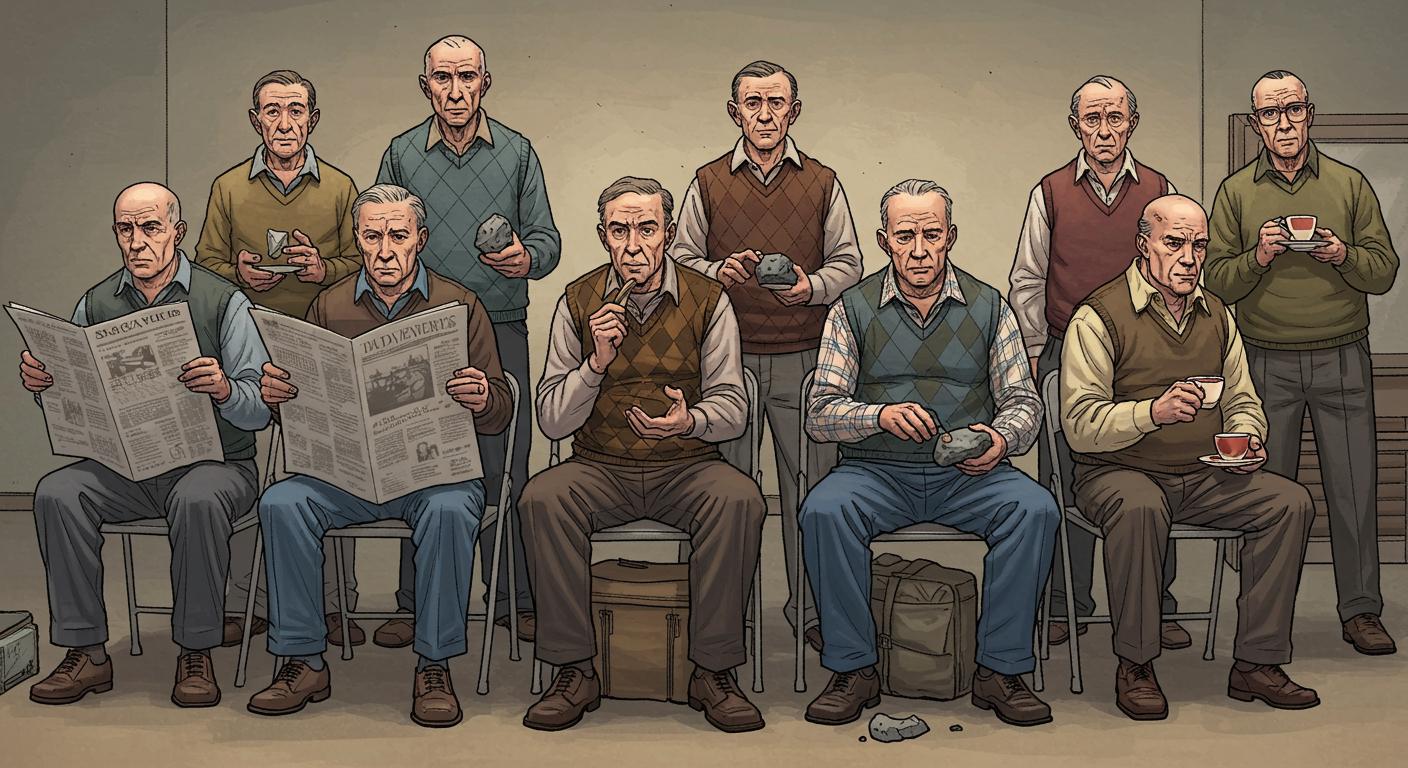
Sometimes you stumble onto a corner of the internet so committed to its bit that you have to double-check it isn’t satire. According to a recent feature in The Guardian, the Dull Men’s Club is one such place—a global collective of self-professed dullards banding together to out-mundane one another. It’s a kind of anti-Fight Club, but the only rule is that you really mustn’t get excited.
A Bastion of the Unremarkable
As narrated in The Guardian, The Dull Men’s Club began in early 1980s New York, when a group of friends, seated at a bar reading about boxing, fencing, and judo, famously admitted, “Dude, we don’t do any of those things”—prompting them to embrace their own dullness. Grover Click (a pseudonym chosen for its intentionally bland resonance), spearheaded the effort, which today encompasses a 1.9 million-strong Facebook group, complete with an annual calendar, a book called Dull Men of Great Britain, dedicated merchandise, and awards like “Anorak of the Year” and “DMC Person of the Year.” There’s even a raft of copycat clubs, with one boasting 1.7 million members, as the outlet documents.
Maintaining the rigorous standards of dullness, however, is a matter of principle. The Guardian highlights how the club’s Australian branch removes posts with bitmoji avatars for being “far too exciting.” Even exclamation marks are frowned upon. Alan Goodwin, a U.K. member, once worriedly confessed that spotting a lesser spotted woodpecker in his garden might be “a bit too exciting” for this crowd. The detection of military jets on a flight tracking map posed a similar problem—one must never bring too much drama.
Club moderator Bt Humble describes it as “competitive dullness,” with members sometimes trying to out-dull one another. There may not be a fixed admissions test, but some, he admits, could “bore the ears off you”—a phrase The Guardian attributes directly to him.
The Artful Irony of the Dull
What distinguishes this community, as portrayed in The Guardian, is the self-aware, tongue-in-cheek humor. The group walks a fine line, poking gentle fun at itself, but always in a way that is endearing rather than demeaning. Ridicule, politics, religion, and swearing are all strictly forbidden by the club’s rules—a demonstration of the principled, almost reverent approach to the mundane.
Members revel in discussing tiny annoyances and overlooked details: five hundred comments amassed under a post dissecting the pros and cons of coat hangers in hotel room rails. The legendary “over or under” toilet paper debate lasted for two and a half weeks (politely, as The Guardian points out). Other hot topics? The dismantling of electronic appliances, photographing post boxes, ranking animated movies for pointlessness, and the oddly mesmerizing contest to fit as many used toilet rolls as possible inside one another. In a detail highlighted by the outlet, there is even a member, Lee Maxwell, who has restored 1,400 antique washing machines—each more domestic than the last.
When the Dull Becomes Poignant
Yet, even in a club designed as a celebration of tedium, there are stories that transcend. The Guardian dedicates attention to Andrew McKean, an 85-year-old electronics engineer from Australia, whose life shifted dramatically after a heart attack left him and his wife moving into a nursing home. Once connected to the Apollo moon mission and a career that roamed from the UK to Malta, West Africa, and Canada, McKean now finds his world reduced to a single room. “Every trace of my existence is contained within these walls,” he writes, observing the changing light from his frayed armchair and listening to the “faint hum of machines and the shuffle of slippers,” as described by The Guardian.
McKean’s regular writings, posted to the club’s Facebook group, chronicle the small dramas of institutional life—watching kangaroos graze on the lawns, savoring rare bus rides into town for KFC (“the sharp tang of it a small rebellion against the home’s bland meals,” as quoted in the article), and sitting on a park bench, quietly “watching the world’s parade, its wealth and hurry.” The poetically dry reports resonate with fellow members, who check in with concern if he misses his daily update—proof, perhaps, that even among millions of self-proclaimed dull people, a sense of connection can quietly bloom.
Ordinary, But Never Irrelevant
In a reflection outlined by The Guardian, founder Grover Click argues that what these “dull men” (and women) do is akin to ikigai—the Japanese concept of purposeful living. He writes in the 2024 club calendar: “It gives a sense of purpose, a motivating force. A reason to jump out of bed in the morning.” Whether that reason is meticulously ranking windshield wiper speeds or simply sharing unremarkable observations with likeminded souls, it appears to suffice.
It’s a curious twist: in an era obsessed with spectacle and viral drama, perhaps it’s radical to stake a claim for the slow, the careful, and the ordinary. As the outlet notes, these are individuals who find beauty in the overlooked, humor in the understated, and companionship in quiet solidarity. Is there, in the end, anything truly dull about that? Or is interest—like excitement—a matter of perspective? In the Dull Men’s Club, it seems, there’s always room for one more uneventful story.