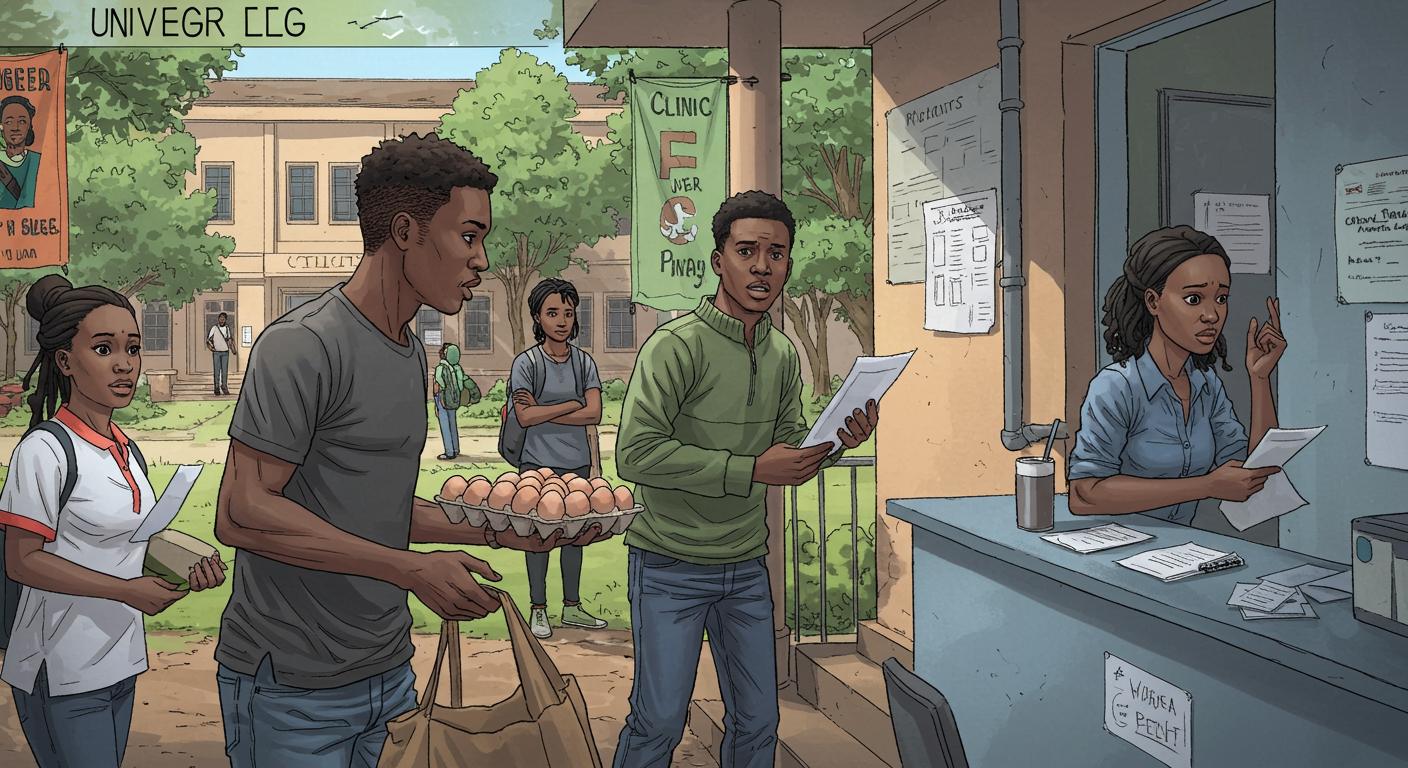
There’s a certain irony in watching the old adage “desperate times call for desperate measures” play out at the molecular level on Nigerian college campuses. In a twist that would make both economists and bioethicists pause, students are increasingly selling their eggs or sperm to fertility clinics, a phenomenon detailed in Live Action News as not so much a bold adventure in science as a reflection of financial necessity.
Cash for Cells: Tuition by Any Means Necessary
For many of these students, the financial calculus is bleak. Live Action News documents that the going rate is around ₦50,000—about $31—per donation, sometimes a touch more, depending on the donor’s characteristics or the facility’s policy. That money, intended as tuition support, can evaporate quickly in the daily grind of university life. Meanwhile, the cost to their wellbeing might not be so easily tallied.
Accounts sourced from the outlet paint a picture that’s less science fiction, more everyday dystopia. Dorothy Nwankwo, a journalist following the story, voices concern about exploitation as destitute students are recruited for their biological assets. Professor Omolade Olomola, with expertise in Family Law and Reproductive and Gender Justice at the University of Ibadan, describes how the lack of oversight lets clinics shuttle students for procedures, sometimes detaining donors and confiscating their phones until the process is over. Olomola’s recounting of a female student from Lagos transported to Abuja, misled about her own “viability” and left traumatized, underscores how these transactions can take more than just cells—sometimes stripping away agency and trust.
As highlighted in the same article, it’s not simply a matter of paperwork and payment; students are often bombarded with injections and pressed into undertaking intrusive procedures, occasionally without a full understanding of the physical or psychological risks. Sometimes, escape from these situations is possible only once the donation is finished, and the profit to the clinic has been secured. Is it any wonder that both donors and outside observers are left uneasy?
Fertility Clinics and the Market for the Self
If the word “marketplace” conjures stalls and shouting vendors, the modern fertility clinic offers a quieter—if no less transactional—scene. The practice, as the outlet explains, is hardly confined to Nigeria, yet there’s a particular edge when students are encouraged to see their DNA as yet another item for sale to make ends meet.
Medical anthropologist Diane Tober, whose studies are summarized by Live Action News, notes a pattern of clinics sidestepping recommended donation limits: instances where one donor cycled through the process nineteen times, and cases where clinics pursued not the standard fifteen to twenty eggs per cycle, but counts closer to eighty. These numbers, Tober argues, make it clear that the drive for profit can far outpace the regard for donor safety. Her findings align with those of Wendi Kramer at the Donor Sibling Registry, who reports that, across multiple studies, a significant chunk of donors experience Ovarian Hyper Stimulation Syndrome or infection—potentially lasting complications from a supposedly routine procedure.
Professional voices included in the story, like that of Dr. Bukumi Kolade, a specialist in IVF, echo the refrain: the needs of patients drive demand, but ignorance or desperation can push students into choices that shouldn’t be considered a “means of livelihood.” Still, so long as a market exists for donor materials, the boundaries between temporary financial relief and bodily risk remain hazy.
From Campus Crisis to Commodity Exchange
This convergence of economic stress and biological entrepreneurship feels oddly predictable. Students, squeezed by tuition hikes and scant job opportunities, navigate a world where the value of an education is balanced against the literal price of a piece of themselves. The outlet records instances where students, motivated by immediate need, sign away their cells without any guarantee of dignity or even truthful disclosure about the process.
What’s unsettling is not just the mechanics—the injections, the contracts, the medical aftermath—but the increasing normalization of these transactions. As described in the reporting, the consequences ripple outward, raising thorny questions about autonomy, consent, and the commodification of human life. When survival strategies involve harvesting one’s own biology, at what point does ingenuity cross into exploitation?
Live Action News takes a strong editorial stance on the broader ethical implications, contending that these practices reduce children to consumer products and entangle young donors in a system where the pursuit of one life may come at the expense of many others, both literally and figuratively. Dr. Lauren Rubal, a board-certified OB/GYN and reproductive endocrinology specialist, is quoted underscoring the inescapable fact that most embryos created in IVF are ultimately discarded or destroyed—a byproduct, she argues, of a commoditized process with far-reaching ethical fallout.
Degrees, Detours, and Dilemmas
So, what does it mean for education when the price tag gets paid in chromosomal installments? The reporting suggests a kind of collective shrug: if loans and scholarships don’t cover the bill, someone will find a workaround—no matter how unconventional. Is this an indictment of the system, a testament to human adaptability, or both?
Of course, the idea of bankrolling your future by bartering away the literal building blocks of life makes for a surreal commencement address. But is the real strangeness in the students’ choices, or in the circumstances that prompt them? Who profits most—those getting degrees, or those collecting the fees?
As stories like these drift from the margins into the mainstream, one has to wonder: are we witnessing innovation, desperation, or just the next awkward chapter in humanity’s ongoing negotiations with its own biology? The answer, like so many things in the age of the bio-economy, is probably yes to all of the above.