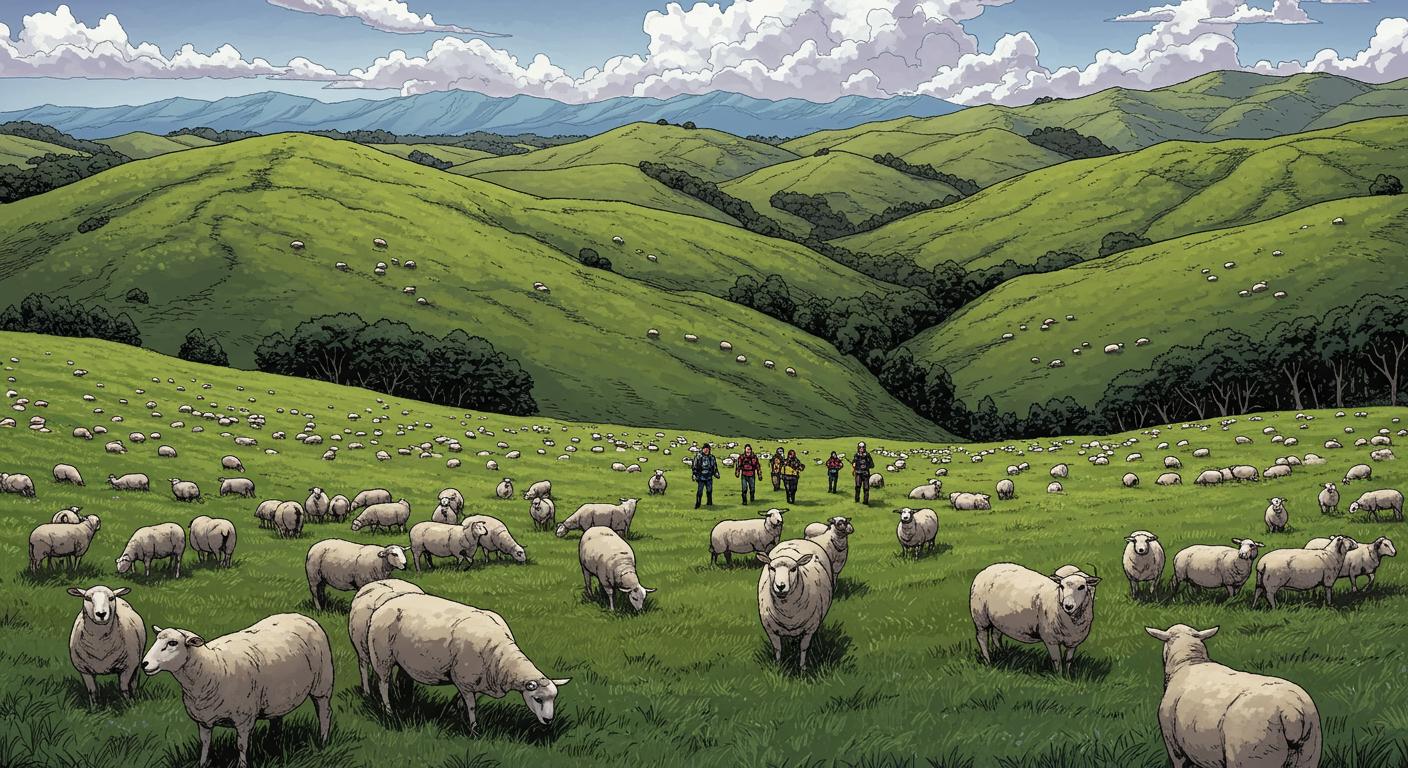
Somewhere between the rolling hills of the Shire and the world’s supply of wool socks, New Zealand has always been quietly engaged in one of the planet’s least competitive competitions: people versus sheep (numerically, not physically—although that would be a spectacle). The popular image practically writes itself: more sheep than humans, every panoramic drone shot filled with enough wool to knit a continent. Yet, recent figures described in an Associated Press report reveal that the age-old ratio is quickly narrowing, and the so-called reign of mutton may not be as eternal as popular myth suggests.
Four-and-a-Half Sheep Per Kiwi, and Getting Cozier
Government statistics cited by the outlet show that New Zealand maintains its quirky distinction of having more sheep than people, tallying 23.6 million sheep and 5.3 million humans—about 4.5 sheep for every resident. Seen in context, that’s a considerable decline from 1982, when farming sheep for meat and wool was New Zealand’s biggest economic driver. At that time, more than 70 million sheep grazed the fields, outnumbering the roughly 3.2 million people by almost 22 to one.
As documented in the AP’s coverage, the intervening decades haven’t been kind to the sheep count. Much of the blame lands on the persistent dip in global wool prices, a trend spurred by a widespread shift toward synthetic fibers. In a detail highlighted by the report, many farmers, eyeing greater profit and stability, have traded in sheep for dairy herds or converted land to pine forestry—sometimes to sell carbon credits, a modern twist befitting the 21st century.
Toby Williams, spokesperson for Federated Farmers, told the outlet that the wool sector teeters on the brink: “If I’m really honest, the wool industry is almost at that tipping point, if not already there, of not having a wool industry anymore.” For a country that played host to more than 150 years of sheep-dominated landscapes, it’s a change that feels both quietly shocking and oddly inevitable.
Pine Trees, Procurement, and the End of a Familiar Punchline?
In 2023, New Zealand’s official statistics agency recorded, for the first time, fewer than five sheep per person. The national flock dropped by another million as of June 2024, according to records referenced by AP. Meanwhile, attempts to hold the line—such as government procurement guidelines launched in April that encourage New Zealand wool products in public construction, and new limits on converting farmland to pine forests—are unlikely to reverse the long slide. The report notes these measures intend only to slow, not stop, the decline.
It’s not just New Zealand that’s watching its iconic herds thin out. Australia, often the source of sheep jokes at New Zealand’s expense (the sibling rivalry is never-ending), faces a similar fate. The outlet also notes Australia’s ratio has contracted to about three sheep per Australian. Apparently, the age of the sheep joke may be approaching its natural conclusion. Is there a formal process for retiring a stereotype, or does it simply fade out, slightly awkward at parties?
Shifting Landscapes and the Curious March of Numbers
When statistics go through wardrobe changes, they drag cultural imagery along with them. As the AP account outlines, New Zealand is about the size of the United Kingdom but with a population just one-thirteenth as large, resulting in the kind of open, bucolic landscape that lent itself to sheep-centric postcards and, eventually, the cinematic exploits of hobbits. Long before “Lord of the Rings” turned the country into a pilgrimage site for fantasy tourists, it was green hills and woolly figures that shaped outsiders’ impressions.
But economies morph, identities shift, and the once-indisputable truths—the kind recited by tour guides and travelers alike—begin to blur. At what point does the famous sheep surplus become more brand than fact, a vestige in the national mythos, cataloged alongside tales of Mounties or Swedish meatballs? With declining numbers, will visitors soon need to make a reservation just to spot a sheep?
Will Humans Win the Race?
So, the statistical footrace continues: people, as ever, multiplying with bureaucratic predictability, while sheep quietly cede ground to cows and carbon offsets. Judging by the latest government figures described in the AP report, the days of “more sheep than people” remain, but the gap is less grand every year. What takes over as New Zealand’s go-to symbol if the sheep one day fall from numerical grace—dairy cows, forests, or something less tangible altogether?
Or perhaps this is how new oddities are born: the moment one number overtakes another, leaving just nostalgia and a faintly sheepish laugh in its place. In the end, isn’t there a certain, soft-spoken intrigue in counting the improbable—and wondering how long the count will last?