
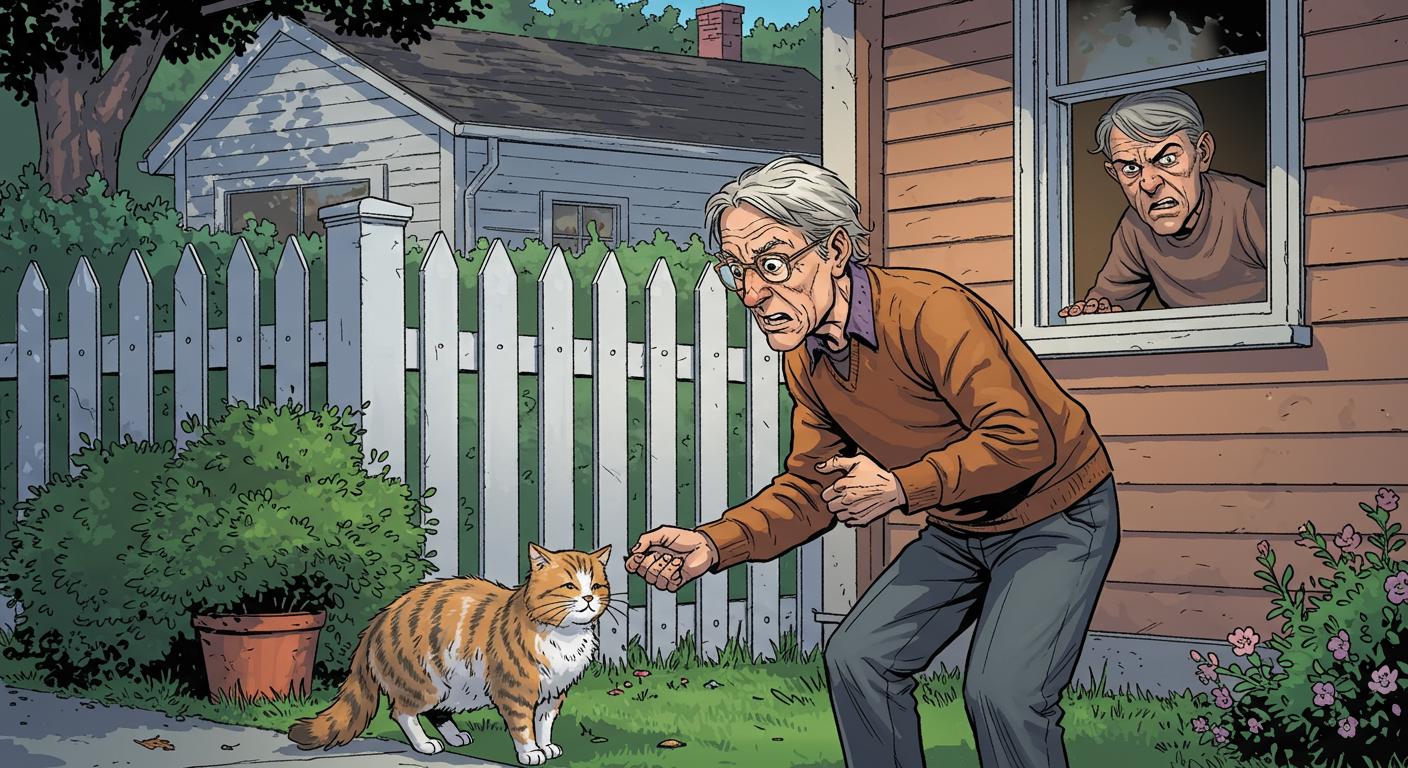
Some stories offer a rich banquet of details, others serve nothing but a bare-bones snack and expect us to fill in the sides ourselves. Oddity Central recently reported a headline that’s almost a parable in its simplicity: a pensioner is being sued for “systematically feeding” a neighbor’s pet cat. Beyond this, the story strolls quietly out of the room, leaving the specifics to our imaginations.
Lawsuit Over a Feline Feast (At Least in Theory)
To be clear, the available facts are limited to the headline itself. If there are courtroom transcripts about the precise number of offered treats, they aren’t included. Even so, the situation conjures a very particular sort of neighborhood dynamic: the intersection between a determined pensioner, a persuasive cat, and an owner who, presumably, does not subscribe to the theory that “it takes a village to feed a feline.”
The mere existence of such a lawsuit leads to, well, questions. Not just about what actually transpired—what snacks were served, how regularly, and what drove someone to assemble legal paperwork—but about the boundaries of neighborly generosity. At what point does a harmless saucer of milk transform into evidence, perhaps even an exhibit marked “C,” in a court of law?
A Distinctly Modern Cat Conundrum
With only the most skeletal summary to work from, this case becomes oddly emblematic of modern living: pets roam, neighbors observe (or enable), and sometimes, lines are crossed. No doubt, the pensioner’s routine generosity had an audience of at least one highly motivated, four-legged regular. Many an urban block has its unofficial “backup feeder”—a retiree with a soft spot and maybe a can of sardines at the ready.
But for things to escalate from knowing glances across the fence to actual litigation? That’s a flavor all its own. Past eras gave us folklore about borrowed lawnmowers and disputed hedges; ours, it seems, will be archived under “alleged surplus kibbles.”
Summary: Sometimes the Oddest Detail Is What’s Not Revealed
Oddity Central’s headline, sparse though it may be, offers a perfectly ambiguous springboard. Left to fill in the gaps, we’re reminded that sometimes the oddest news is not just about bizarre actions, but about how quietly such peculiar conflicts can unspool behind ordinary suburban curtains. One can almost picture the cat at the center, nonchalant as ever, perhaps pondering which kitchen will next provide an unscheduled snack—and blissfully unaware of its role as defendant by proxy.
Perhaps the most remarkable part of the pensioner’s saga is the mystery itself. Were nightly tuna handouts the catalyst? Was the cat’s loyalty legally binding? In the grand tradition of cats everywhere, the real story may never be fully divulged. Then again, what’s more neighborly—or odd—than that?