
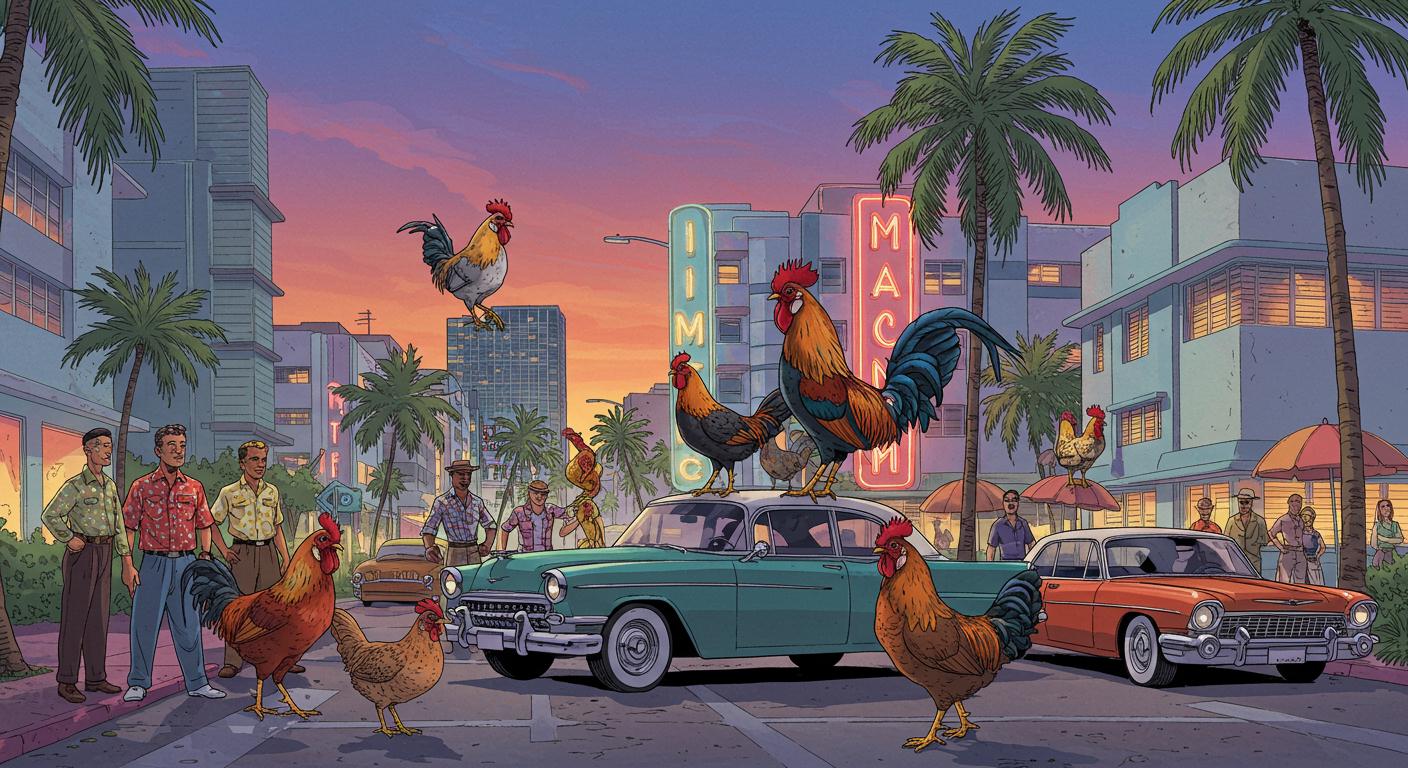
Stroll through downtown Miami and you might spot a rooster sauntering by, unfazed by honking cars and curious tourists. No, it’s not some odd PR stunt—it’s rapidly becoming an emblem of Miami’s peculiar charm. As noted in a recent Associated Press report, chickens have claimed real estate ambitions as impressive as any developer, migrating from the backyards of Little Havana and Wynwood to the manicured lawns of government buildings and skyscraper-adjacent parks.
Roots with Feathers
It might seem like the city’s been ambushed by barnyard escapees, but their presence is more cultural callback than random happenstance. Miami historian Paul George, whose remarks were highlighted in the AP coverage, reflects that for many residents—particularly those with roots in rural Cuba and Latin America—chickens have always been familiar company. The birds have been quietly shifting from household companions to sidewalk regulars over the last two decades, an evolution George began noticing firsthand.
The embrace is visible on more than one front: since 2002, Little Havana’s Calle Ocho has sported its own flock of six-foot rooster statues, a nod to the neighborhood’s heritage and a campaign to spotlight its cultural vibrancy. These brightly painted fiberglass birds, conceived by artist Pedro Damián, still attract a steady stream of camera-toting visitors. Jakelin Llaguna, owner of the Little Havana Visitors Center, described to the AP the neighborhood’s fondness for their avian residents: “The neighbors have welcomed them… Nobody messes with them, they’re our mascot.” With rooster-themed shirts, hats, and other souvenirs lining her shop, it seems there are few Miami mementos more coveted—or at least more colorful—than a cocky bird.
The symbolism apparently runs deeper. Llaguna likens the rooster’s sunrise crow to a new beginning, capturing the experience of Cuban immigrants who settled in Little Havana after fleeing revolution, and who now see themselves—and their resilience—reflected in the city’s unofficial mascot. Everyone, it turns out, wants a bit of the rooster’s pluck to take home.
The Nuisance (and the Neighbors)
Not everyone has made peace with the 4 a.m. wake-up calls. As Donato Ramos Martínez, a local who feeds chickens near the Bay of Pigs Monument, told the AP, some residents remain charmed while others might use less printable language to describe the birds—especially while searching blearily for their morning coffee. Tourists, on the other hand, seem as enthusiastic as the birds themselves, snapping photos at every opportunity. There’s a certain irony in the fact that what aggravates one local is a major draw for another’s vacation scrapbook.
The presence of Miami’s poultry is governed by a distinctly ambiguous legal status. The article documents that both the city and Miami-Dade County maintain ordinances strictly regulating or banning live chickens in residential areas if you check the codebooks. Nevertheless, the birds—oblivious or willfully defiant—continue to roam city parks, courthouse lawns, and office complexes with impunity. Municipal officials, when pressed, referenced live animal ordinances and characterized the issue as one of code compliance, suggesting a tacit understanding that enforcement might be, well, selective.
An unexpected complication is brewing in the form of an even flashier invasive species. Historian George mentions that peacocks, notorious for their volume and difficult tempers, have already overwhelmed nearby neighborhoods such as Coconut Grove and Coral Gables. The AP story notes that these larger birds are not only less polite but much louder, raising the question: what happens when Miami’s fowl competition becomes literal?
Underlying all the feathery commotion is a quieter concern. George voices doubt that chickens will remain a permanent fixture as development and gentrification sweep through Miami’s older pockets. The AP details his speculation that buyers willing to shell out over a million for a new condominium may not be as tolerant of 4 a.m. crowing, no matter how hurricane-proof their windows. The resulting pressure to enforce city codes could, he suggests, mark the beginning of the end for the city’s unofficial avian mascots.
A City’s Identity, One Cluck at a Time
It’s tempting to write off Miami’s chicken cavalcade as another oddball local curiosity, but it’s hard to miss the symbolism running beneath the surface. The city’s shape-shifting neighborhoods, layered migrations, and relentless reinvention find an unlikely parallel in the survival skills of its urban chickens. Earlier in the AP piece, there’s a sense that a rooster crowing at dawn means more here—it marks both continuity with the past and the buzz of a city refusing to stand still.
So if you find yourself roused from sleep by a rooster on your Miami getaway, maybe you’ll consider the peculiar resilience—and acceptance—that defines the city. In a town shaped by constant change, it’s oddly fitting that its most persistent residents just keep marching to their own beat, code compliance notices notwithstanding. What really makes something a nuisance, and when does it become a symbol? It’s hard to say—but clearly, in Miami, it takes more than a few complaints to keep a good rooster down.