
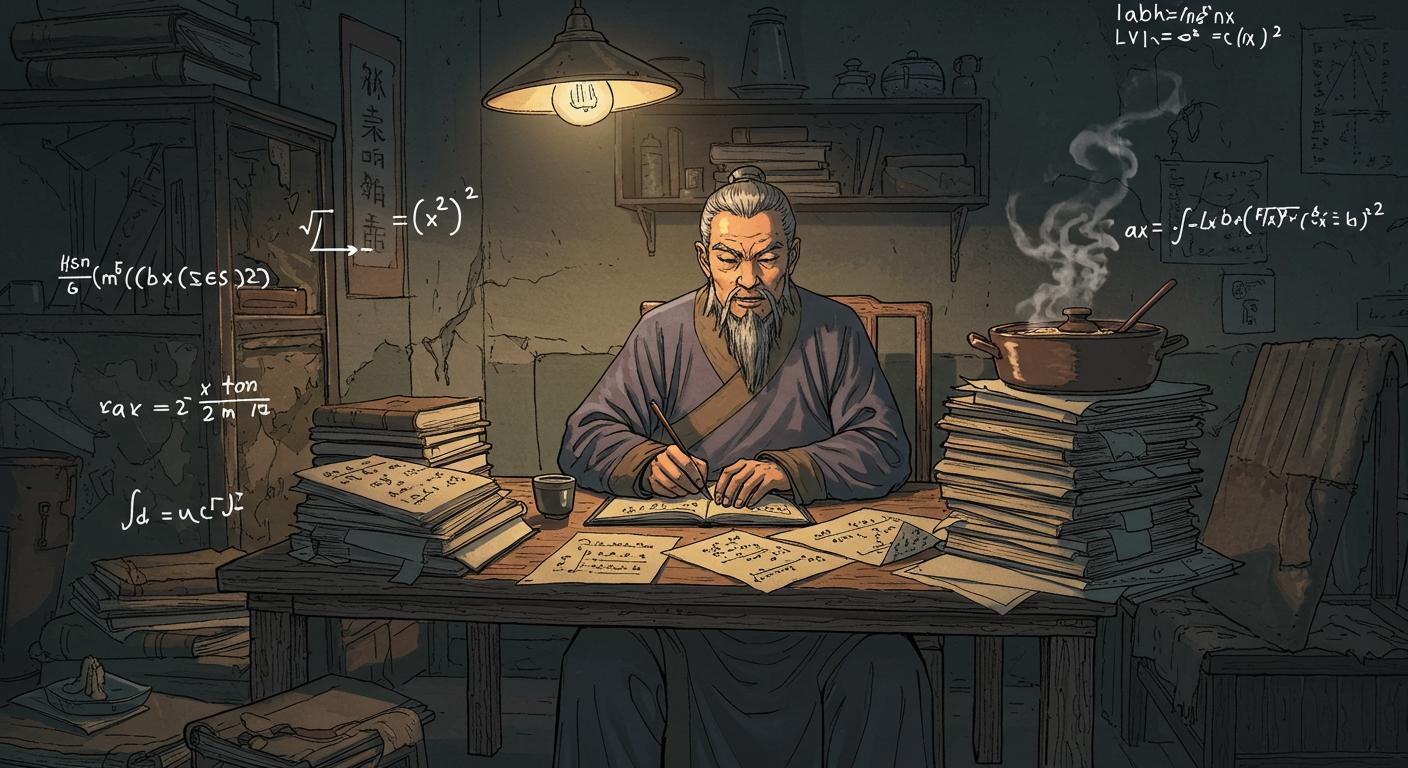
It’s not every day that an internet audience is captivated by a grocery list, but as Oddity Central documents, China’s very own mathematical “deity,” Professor Zhong, has become a viral sensation for doing precisely that. No tales of Rolls-Royce rides or gourmet feasts here—instead, the humble mantou (a steamed wheat bun) and a steady intake of water have taken center stage, leaving the digital masses somewhere between admiration and bemused disbelief.
Triumphant Equations, Modest Rations
According to the reporting, Professor Zhong has long been celebrated in China for his exceptional talent in mathematics—so much so that online fans routinely refer to him with reverent (if slightly tongue-in-cheek) titles like “god of mathematics” and “living calculator.” Yet his sudden burst of viral fame stems not from a newly solved proof, but from a window into his daily routines. Photos circulating on Weibo and cited in Oddity Central show Zhong’s lunch: consistently plain steamed buns accompanied by simple tap water, day after day. For many, it’s not just the dietary monotony that staggers, but a realization that someone so revered would choose—or tolerate—such a pared-down lifestyle.
Observers quoted in the press and across Chinese social media have responded with bewildered respect; one user was noted as saying Zhong “treats life like a mathematical function, reducing it to the most elegant outcome possible.” Others wondered aloud if sustenance this spartan is the secret to intellectual greatness, or simply the consequence of a lifetime of single-minded research.
The Everyday Logic of Less-Is-More
Oddity Central details how Zhong reportedly spends little more than a few yuan per day on his meals and continues to forgo the privileges that academic stardom might easily provide. Rather than converting accolades into worldly luxuries, he seems to have channeled his logic straight into the food budget—and perhaps found contentment, if not outright joy, in its simplicity. Online reactions, as the outlet records, are split: some fans hail Zhong’s “ascetic genius,” while others express concern (“Isn’t that unhealthy for the brain?” asks one commenter), and a few have subtly ribbed the “math god” for his utter disinterest in culinary variety.
Descriptions in the outlet emphasize that even when university officials attempted to offer Zhong more lavish dining options in recognition of his achievements, he politely declined, preferring to stick with his habitual steamed buns and water. It’s a detail that has only deepened the mythos: refusing special treatment, even after solving problems that stump the world’s brightest minds.
Subtraction, Addition, and a Side of Irony
Implicit in Oddity Central’s account is the internet’s endless appetite for novelty—not just in the outsized, but in unexpectedly modest turns as well. It’s quietly comical that what sends this renowned academic trending isn’t calculus or game theory, but a steadfast avoidance of cafeteria upgrades. There is, perhaps, a minor lesson in restraint here. Or maybe a touch of irony: for every influencer showcasing luxury diets and nutritional hacks, Zhong is content to quietly compute on a foundation of flour and H₂O.
Is genius best fueled by minimalism, or are we simply projecting values onto a man who prefers not to fuss? The public debate seems unresolved, but it’s fertile ground for wry observation.
Budget Brilliance: A Modest Equation
After years of collecting improbable tales and understated gems, I find it quietly delightful that the world’s greatest living mathematician is making headlines for the cost of his lunch. As Oddity Central points out, the legend of Professor Zhong is growing not just because of what he can solve on the chalkboard, but for the way he subtracts complication from daily life. With food prices on the rise everywhere, perhaps there’s method—even unexpected genius—in such radical thrift.
Whether Zhong’s approach is the hidden variable to a life of intellect or simply his own comfort zone, one thing seems certain: sometimes, steamed buns and water are enough to set the internet abuzz, and maybe even fuel a mind that can rearrange the universe with nothing more than a pencil, persistence, and a rare taste for simplicity. Does brilliance require more—or simply less? The equation appears elegantly unresolved.