
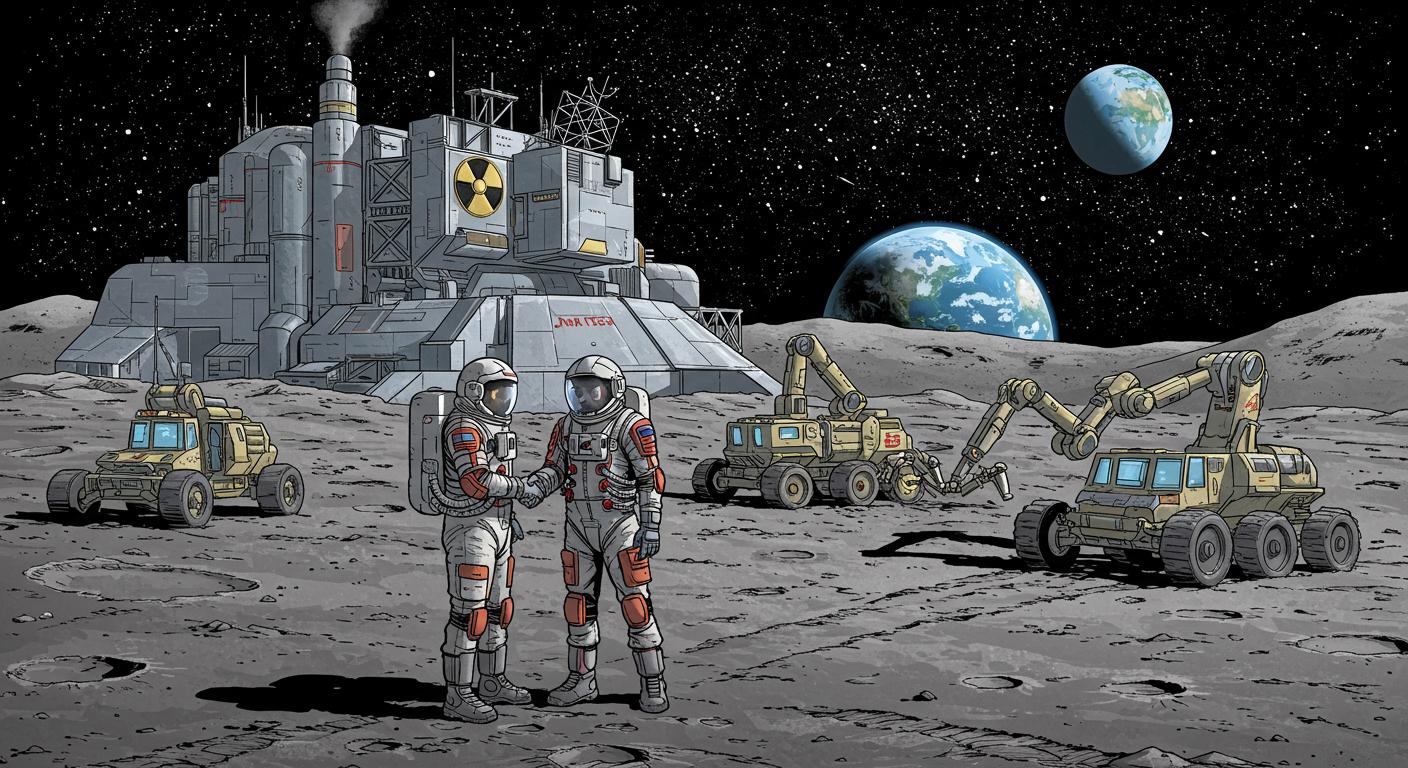
If you thought the competition for prime real estate in Portland was fierce, just wait until you see what’s unfolding 238,900 miles away. China and Russia have just formalized an agreement to plop down a nuclear power plant on the Moon—a phrase that, somehow, is still not science fiction in 2025. As reported by Greek Reporter, the so-called International Lunar Research Station (ILRS) is slated for a grand opening in 2036, powered by a Russian-built reactor and managed jointly by both countries.
Cold War Nostalgia, Now with Fission
It’s easy to forget, after decades of deep-space hibernation, that humanity used to fling itself outward with real gusto. Now, after the recent news that NASA’s plans for its own lunar research outpost have been scrapped due to the 2026 budget, a different partnership finds itself front and center atop the lunar leaderboard. As highlighted by both Greek Reporter and Wonderful Engineering, this China-Russia memorandum is being positioned as a potential pivot point in the ongoing (and occasionally awkward) global space race.
The premise: a mostly autonomous assembly—because who wants to commute to the Moon for blueprint oversight? Roscosmos’s Yury Borisov explained in a 2024 interview, cited by both outlets, that the technology for a self-building lunar reactor is “almost ready.” One has to imagine the kind of PowerPoint slides used to convince everyone on that timeline.
Not Just a Club for Two
Despite the optics of old rivals claims-staking slabs of the Moon, the ILRS is designed as something a bit more open-ended—think less “No Trespassing” and more “Bring Your Own Space Suit.” Greek Reporter notes that seventeen other countries from various continents have signed on or expressed interest, giving the project a surprisingly eclectic cast list. Countries like Venezuela, Egypt, and Thailand apparently see a future in lunar science, although whether this is driven by prestige or more practical aims remains to be seen.
According to the reporting, the research station is set for the lunar south pole, a location increasingly coveted for its rumored deposits of water ice—a handy resource should anyone want to plan science experiments or perhaps the first interplanetary coffee ritual.
Modular Ambitions—and That Nuclear Detail
Wonderful Engineering and Greek Reporter both outline the ILRS as a gradually growing project: initial robotic modules will be delivered by a series of five super-heavy rocket launches between 2030 and 2035. The plan is to expand further, establishing additional facilities including a space station in lunar orbit and bases at the Moon’s far side and equator. Wu Yanhua, chief designer of China’s deep exploration project, stated in a 2024 press conference that the ILRS “will be powered by solar, radioisotope and nuclear generators,” also featuring advanced communication networks and a veritable garage of lunar vehicles—everything from hoppers to pressurized and unpressurized manned rovers, according to both outlets’ reports.
So why nuclear? Greek Reporter and Wonderful Engineering point out the basic constraint: the Moon’s day-night cycle means that solar power is unavailable for roughly 14 days at a stretch. In that context, nuclear becomes less a sci-fi plot device and more of a practical necessity—though the phrase “nuclear on the Moon” is certainly attention-grabbing, particularly for those who already have opinions about power stations in their own neighborhoods.
Who Gets to Plant the Flag?
Beyond the headlines, there’s a more intriguing subplot worthy of note: is this the start of a new “ownership” model for the Moon? While the Outer Space Treaty of 1967—referenced frequently in both public discourse and reporting about these projects—stipulates that no nation may claim the Moon for itself, the practical reality is that whoever’s running the infrastructure (like power plants) may have a significant say in who gets to participate. Greek Reporter and Wonderful Engineering both note that while the ILRS is presented as open and collaborative, it’s fair to ask whether such large-scale partnerships might quietly shift the balance of power (and plug access) on our favorite celestial neighbor.
Notably, with the U.S. focused on earthbound budget debates, lunar ambitions from other quarters are quietly becoming more tangible. Both outlets describe the planned expansion of the ILRS as a “stepping stone” toward permanent human presence, and ultimately, a staging area for Mars-bound missions by 2050. Apparently, lunar nuclear plants are now the open houses in the universe’s most exclusive neighborhood association.
Final Reflections from the Shadowed Craters
There’s a quiet irony in racing across 380,000 kilometers of vacuum only to end up grappling for pole position all over again. Yet, if history is anything to go by, the addition of “radioactive” to our off-world lexicon seems less a harbinger of dystopia and more a reflection of how our ambitions consistently outgrow the available extension cords.
It does prompt the question: will future lunar property listings boast “direct access to nuclear grid, walking distance from international rover depot”? And as humanity settles in for the long haul, which lunar neighborhoods will enjoy the most reliable WiFi—or the quietest view of the reactor? Only time, and maybe a suitably ambitious lunar homeowners’ association, will tell.