There are mysteries you just assume will remain unsolved—Amelia Earhart, D.B. Cooper, why people still buy fax machines. But this week, an old rock-n-roll riddle decided to take a bow. According to NPR, the missing marble bust of Doors frontman Jim Morrison, which vanished from his Paris grave in the late 1980s, has unexpectedly reentered the picture. Fitting, perhaps, for a guy who once crooned about breaking on through to the other side.
A Pilfered Icon in Paris
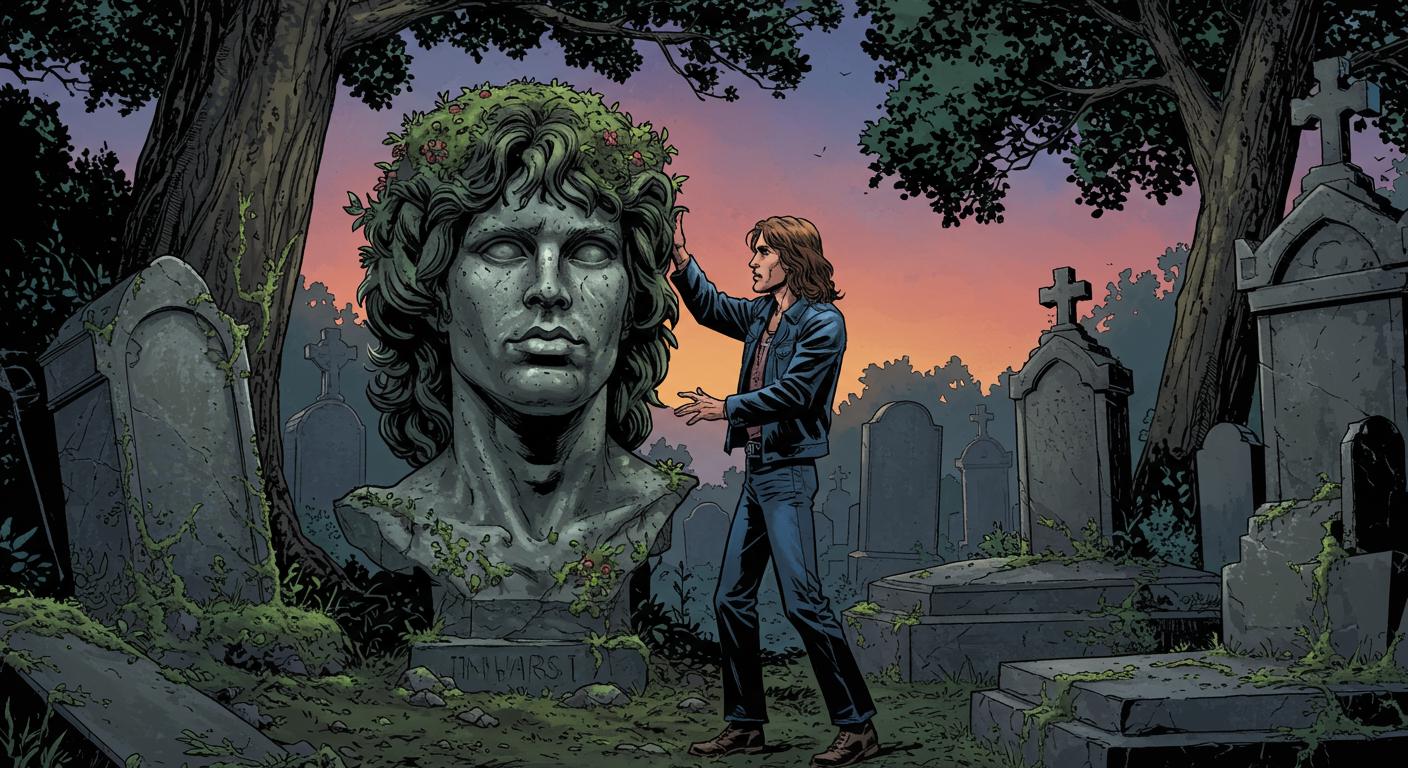
The quick origin story: in 1988, the distinctive 300-pound bust of Morrison—created by Croatian sculptor Mladen Mikulin for the tenth anniversary of the singer’s death—was swiped from its perch at Père-Lachaise Cemetery, as both NPR and the Press Democrat document. The theft occurred as Morrison was gaining yet another round of posthumous popularity and pre-Internet conspiracy theorists rubbed their hands together with anticipation. In place of the sculpture, a modestly inscribed gravestone found itself covered with lyrics, graffiti, and—because apparently rock ‘n’ roll pilgrimages run on carbs—leftover liquor bottles and strawberries.
Over the years, Morrison’s grave has become a place for reverence, revelry, and, at times, creative ritual. As a London artist recalled to the Associated Press (quoted in the Press Democrat), visiting in the era of the bust was a surreal experience: “There were people partying, smoking, music, dancing… it was just such an amazing experience.” The burial site, already nestled among France’s all-star artistic lineup (think Proust, Wilde, Piaf), transformed into a rotating gallery of poetic scrawls and spontaneous tributes. There’s a certain fitting madness to the fact that even the memorial statue itself was not immune to the cult of personality it honored.
From Cemetery to Police Locker
The resolution—or perhaps the latest act—in this saga unfolded when Paris police stumbled across the lost bust while deep into an unrelated fraud investigation. In their Instagram announcement, officials described the artifact as still daubed in graffiti and missing minor fragments, apparently chipped away by zealous fans while it sat in the cemetery, as highlighted by NPR and the Press Democrat. One can almost picture it languishing in a storage closet, alongside an overstuffed evidence locker’s worth of unrelated oddities.
What the authorities didn’t say (and, tantalizingly, may never reveal) is where Morrison’s likeness has spent these past decades. Was it a forgotten keepsake in some Parisian flat? Did it attend secret parties, or just gather dust next to vintage velvet pants and poorly tuned guitars? The mystery, it seems, is at least half the allure—even all these years later. And in typical Doors fashion, there are more questions than answers.
Should the Bust Go Home?
The find, of course, raises the most rock-historian question imaginable: does Morrison’s head belong back atop his grave, or is that asking for trouble? “It would be incredible if they put the bust back onto where it was and it would attract so many more people, but the cemetery wouldn’t even be able to hold that many,” Paris guide Jade Jezzini observed in remarks to the Associated Press, detailed in both NPR and the Press Democrat. Is this the holy grail of Doors fandom, or a logistical headache no one wants to inherit?
For now, there’s no official word on whether the sculpture will return to its old haunt, a detail the Press Democrat also notes, which seems about right for anything connected to Morrison, a man whose public image still dances between legend and enigma. Even in stone, his outsized mystique seems capable of overwhelming the tranquil aisles of Père-Lachaise.
Strange Days (and Stranger Souvenirs)
Fans of rock legend always seem to find new ways to keep the story alive. As the Press Democrat observes, Morrison’s grave has been an ongoing site of “cultural renaissance,” especially after Oliver Stone’s 1991 film reignited fascination. The bust itself, once modest compared to the grand tombs surrounding it, inspired a ritualistic scramble for tiny relics—chipped marble as a pocket talisman, graffiti offerings, or just a photo snapped before the next security guard shuffled everyone along.
So, we are left with a question as fittingly ambiguous as any Morrison lyric: Where was the Lizard King’s head all this time, and what happens now that it’s back in the spotlight? Does the statue’s journey say more about our obsession with icons—or just about the odd afterlife of inanimate objects when enough people care?
In the meantime, it seems, the bust is entombed in red tape rather than marble. Sometimes, the only thing stranger than a legend is what we do with it later.