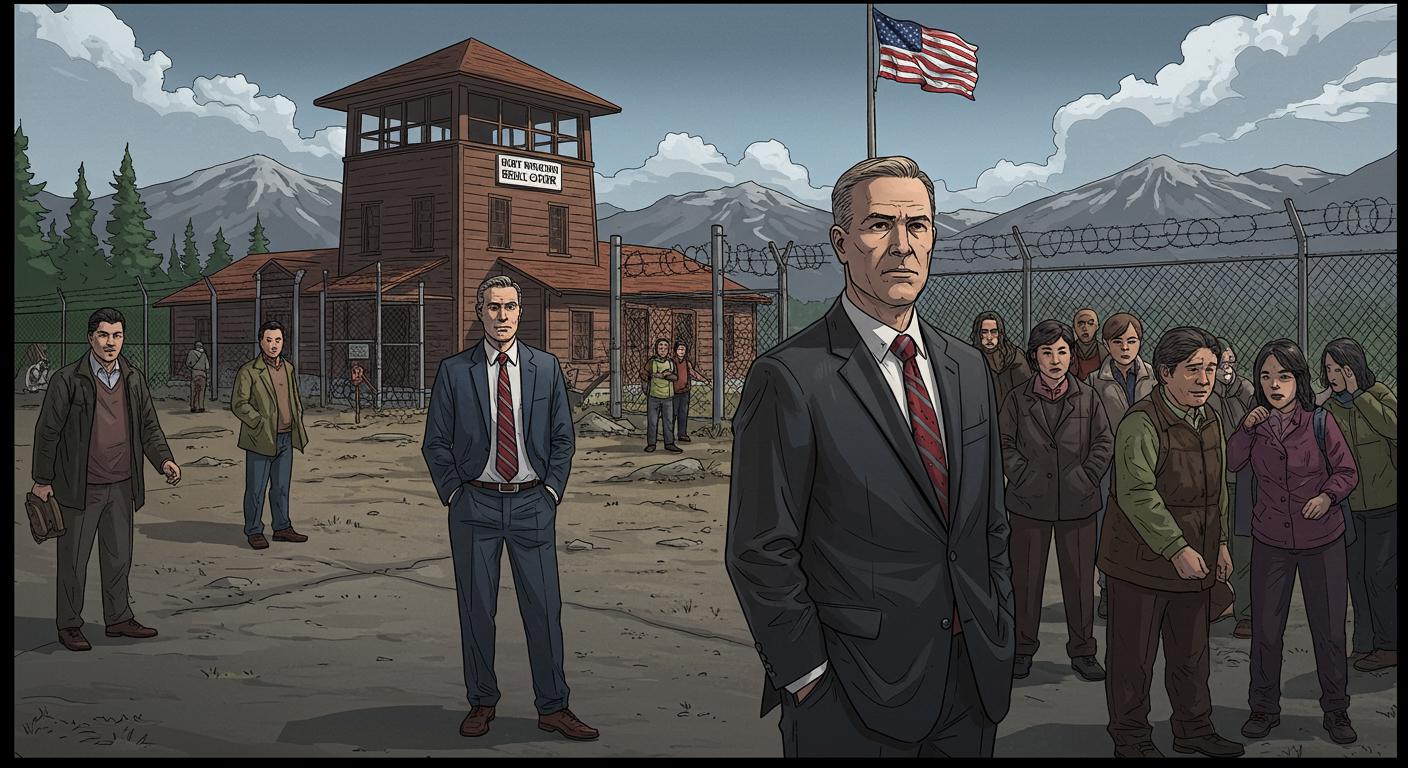
If there’s a checklist for ways not to commemorate one of America’s darker chapters, Wyoming Rep. John Winter just managed to check a few boxes at once. As WyoFile recounts in its detailed analysis, Winter—Joint Agricultural Committee Chairman and a fixture in Wyoming politics—invoked an anti-Japanese slur immediately before embarking on a tour of the Heart Mountain Interpretive Center. That’s the very site where more than 14,000 Japanese Americans were confined during World War II. I often wonder if reality writes these set-pieces on purpose, or if history is simply bent on irony.
A Slur, a Chuckle, and a ‘Historic’ Field Trip
Let’s be precise about the context. This wasn’t a hot mic moment, nor some cryptic note from the archives. According to WyoFile’s review of a public livestream, Winter, during a committee meeting, paused to mention the upcoming visit to Heart Mountain and referred to it as the “Jap camp,” punctuating it with a chuckle. The term is, as every major dictionary now acknowledges, offensive and dehumanizing—a point reinforced by activists as far back as the early 1950s, highlighted in WyoFile’s reporting through archival reference to Shosuke Sasaki and the Densho history organization.
Heart Mountain Interpretive Center’s Board Chair Shirley Ann Higuchi, whose parents were among those interned, weighed in with measured disappointment. Speaking to WyoFile, Higuchi suggested, “I feel that Rep. Winter should become better educated.” Her understated response says a lot—there’s not much need to embellish a statement that lands as quietly as it does firmly. If the moment called for introspection, it arrived to the sound of nervous chuckles and, as the video WyoFile reviewed shows, at least one lawmaker’s rueful head-drop.
Worth noting: Rep. Winter did not respond to two voicemails and a text message from WyoFile seeking comment, a silence that feels louder than any apology might have.
Old Habits Die Hard—But Should They?
There’s a certain regional and generational context shading this moment, as the outlet documents. Sen. Tim French, who grew up just a few miles from Winter, admitted to WyoFile that the term was common parlance when they were young, carried over from parents nursing postwar anger. It’s the sort of linguistic inheritance that, for some, lingers long after the rationale has faded. French described a shift after befriending a nearby Japanese American family, deciding, “You mature and you grow up.” When it comes to language, though, “That was the term. They were still angry. I grew up with that term. I didn’t know any better … [but] I’m not going to use it any more.” French is clear: “Winter…shouldn’t have said it.”
Yet the question hangs, as it often does in these stories: How long can inherited language serve as an excuse—especially for public officials? Language tells us what a community values, and when the conversations that open historic visits are salted with the vocabulary of original harm, we can hardly pretend the past is at rest.
Are We Doomed to Repeat?
Committee member Rep. Karlee Provenza, the sole Democrat present, drew a direct line from Heart Mountain’s legacy to the present day, according to WyoFile. She pointed out that vigilance against civil rights abuses is still relevant, especially as current events revive debates about mass deportations and constitutionally questionable tactics. Provenza’s observation—“a horrific display of what happens when we strip people of their constitutional liberties and their civil rights”—suggests that interpretive centers are more than just scenic detours for touring legislators. You have to wonder: did anyone leave with more than just a brochure?
The timing of Winter’s remark—immediately preceding a learning opportunity—raises a peculiar kind of existential question. Is this merely a misstep, or something deeper, a reluctance to admit history’s discomforts cut awfully close to home? The offhand delivery (as broadcast in the meeting footage WyoFile examined) carries a certain effortlessness that is itself worthy of examination.
Familiar Names, Unfamiliar Wisdom
If there’s another layer of irony, it comes courtesy of timing. Just months before, Wyoming lost Senator Alan Simpson, known for his determination to remember Heart Mountain and its lessons. WyoFile’s reporting highlights Simpson’s lifelong friendship with Norman Mineta, formed when Mineta was an internee and Simpson a Boy Scout from nearby Cody. That friendship resulted in real, tangible change, with the passage of the 1988 Civil Liberties Act.
Amusing, in a wry way, that full-circle moments are so rarely tidy: as WyoFile notes, Winter himself grew up in repurposed barracks from the old internment center, a fact he related during the committee with a casual nostalgia—“They can be made pretty nice.” Whether this is foreshadowing or just the universe’s way of making sure themes never go out of style is anyone’s guess.
In Summary: Timing Is Everything
According to WyoFile’s reporting, reactions among committee members on camera ranged from smiles to uneasy embarrassment. As for the public, the article’s own comment section became a microcosm of Wyoming’s—and America’s—ongoing tension over how we talk about the past. Some commenters, including Winter’s own estranged granddaughter, called for accountability and self-reflection. Others noted, sometimes with dry resignation, that such language remains regrettably commonplace in local politics.
The real question is not whether a single word can bring history back, but what it means when elected officials reach for the language of previous eras just as they set out to remember their cost. Is this simply the residue of an older Wyoming, or a signal that these “awkward moments” are more endemic than accidental? The placards at Heart Mountain tell one story; the words we use before ever walking through the door might just tell another. Wouldn’t it be something if we finally let the monument shape the memory, rather than the other way around?