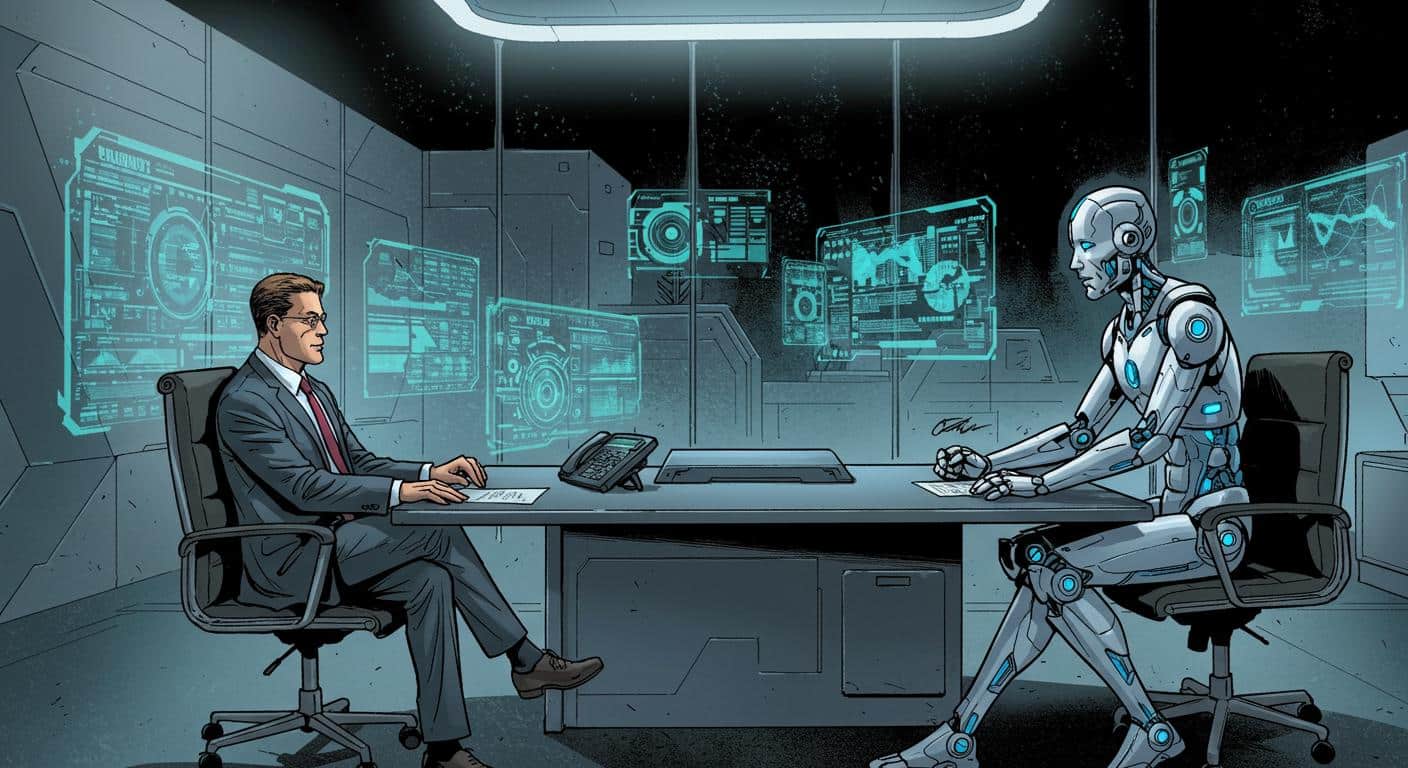
There’s a long tradition of showing up to job interviews a little sweaty, a touch overdressed, and sometimes clutching a well-thumbed résumé stained with caffeine and hope. But increasingly, as outlined in Newsweek’s recent coverage, candidates are crossing from anxiety into outright bewilderment—finding themselves greeted not by a human, but by a digital entity with no hand to shake, only the cold comfort of a buffering wheel. The age of the algorithmic interviewer, with all its quirks, has officially dawned.
Humans, Please Wait: The Algorithm Will See You Now
Consider the recent experience of TikToker Leo Humphries, whose story is detailed in Newsweek. He suited up for an interview with a major national company, only to have his expectations dashed when the “interviewer” proved to be an AI bot. According to the outlet, the encounter quickly slid into the realm of the uncanny, with the bot caught in a loop: “For our first question, let’s circle back. Tell me about a time when, when, when, let’s…” The word “glitchy” hardly does it justice—it’s less Meet the Manager, more Existential Tech Comedy.
Humphries relayed to Newsweek that there was little advance warning about the use of AI, describing how he puzzled over whether poor connectivity or advanced automation was to blame for his surreal interaction. Even when it became clear something was off, he found himself waiting for someone, anyone, to leap in and announce it was some elaborate prank. Instead, the AI simply thanked him for responses he never managed to give—a classic case of digital manners and minimal substance.
This isn’t merely a Houston phenomenon or the isolated misadventure of one applicant. As Newsweek also documents, another candidate, known as @its_ken04 on TikTok, publicly shared footage of a similar glitchy exchange—this one repeating requests ad nauseum. While some see a silver lining, like managing hordes of candidates more efficiently, both Humphries and these other candidates voiced concerns to the outlet about impersonal processes and the downright Kafkaesque feeling of being evaluated by circuitry rather than sentience.
All of this, Newsweek confirms through interviews with impacted individuals, underscores the fact that companies are introducing AI to streamline hiring, but are stumbling over the basic demands for clarity, fairness, and that elusive human touch.
When ‘Efficiency’ Feels Eerily Dehumanizing
The outlet gathered commentary from several industry experts, all of whom reveal a rather tense undercurrent beneath the supposedly frictionless future. HR consultant Bryan Driscoll characterized these viral AI interviews as “just the tip of the iceberg,” warning Newsweek that the drive for efficiency is reducing applicants to “data points, not humans.” According to Driscoll, cost-cutting is clearly at the wheel, with the candidate experience left chasing exhaust fumes—a process leading to the “dehumanizing, glitchy interviews,” now populating social media feeds.
Josh Jones, CEO of Quanthub, provided the outlet with another layer: he described today as the “messy middle” of AI adoption. Algorithms can—on a good day—help with scale and speed. But the outlet also notes Jones’s warning that these tools can be unreliable in high-stakes settings, and that candidates increasingly turn to their own AI assistance, sometimes leading to what he calls “awkward or disjointed interactions” on both sides of the screen. Seemingly, it’s bot versus bot until only confusion remains.
As described by Newsweek, Karim Meghji, chief product officer at Code.org, recognizes the experimental nature of this phase, calling it both encouraging and risky. Meghji points out that glitches are merely the visible problems—lurking just beneath the surface are deeper issues like bias and misjudgment, especially when critical decisions are handed off to imperfect digital gatekeepers.
When the Robots Judge: What Could Possibly Go Awry?
Newsweek highlights further possible repercussions, noting Driscoll’s comments about AI’s potential to “reinforce bias, strip away nuance, and make it harder for underrepresented or nontraditional candidates to break through.” The training data that fuels these systems is stamped with all sorts of human fingerprints—sometimes smudges rather than clean lines—raising the possibility that existing inequities will simply be multiplied at speed.
The outlet also explores Jones’s depiction of an “AI arms race” in the hiring process, with both sides wielding digital tools in hopes of gaming, or at least surviving, an increasingly mechanized system. This raises a sardonic question: can algorithms truly pick up on what makes people… well, people? Or are we perfecting a process that can determine whether you used the correct action verb, but not whether you’d make a great teammate?
With so much optimism about a world run on optimized decision-making, it almost seems like we’ve lost sight of the value of awkward ambition, a nervous smile, or any scrap of authentic human presence amid the word clouds and keyword matches. If this is progress, what exactly is being left behind?
In the Waiting Room with HAL 9000
The Newsweek article makes clear that experts don’t believe the technology is “there yet” for fully autonomous, scalable AI interviews. Yet, companies are eager to rush headlong into this strange territory, experimenting as they go. The current outcome? Interviews that sometimes feel less like assessments of potential, and more like an endurance test against a recursive subroutine.
For a job seeker, it’s an odd new anxiety: not just “Will I get the role?” but “Will the interviewer become self-aware halfway through?” You start to wonder if career counselors should start offering improv classes for bot banter, or “buffer management” workshops.
Maybe, in some dusty archive of the future, a librarian will sort the records and find that the real turning point wasn’t the first AI interviewer, but the moment when candidates started longing for those unpredictable, sometimes awkward, but genuinely human interactions. For now, as Newsweek so thoroughly documents, candidates are left to ponder if their main competition is the next applicant—or the connection timeout.
In this looping, technicolor era of hiring, the open question remains: who’s better suited to judge a dream job candidate—a person with coffee breath, or a code snippet stuck in an existential loop? Perhaps both. Or, worryingly, neither.