
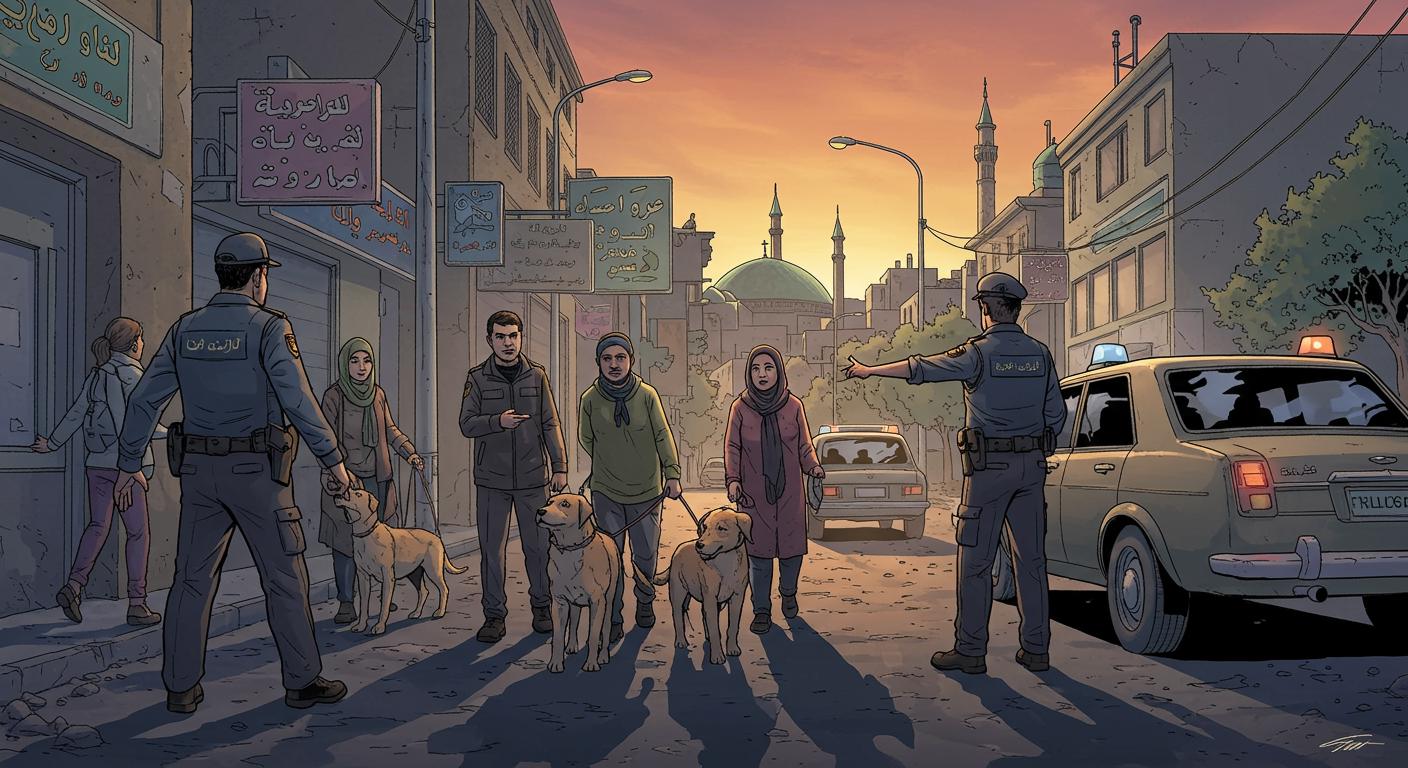
There are places in the world where the simple act of walking a dog becomes a minor sideshow in the broader drama of public order. Iran seems bent on making that act not just controversial, but flatly prohibited. This week, officials have extended a ban on public dog walking to more than 20 cities, pushing past Tehran’s earlier measures with newfound vigor. According to Arab News, local authorities are justifying the move on grounds of “public health, social order and safety,” while veering away from specifying exactly what about a Shih Tzu on a sidewalk constitutes such a threat.
The Expansion of the Ban: Rules with a Hair Trigger
Recent days have seen bans cropping up across cities including Ilam, Isfahan, Kerman, Kermanshah, Hamadan, Boroujerd, Robat Karim, Lavasanat, Golestan, and, as reported on Sunday, Kashmar. Announcements from city prosecutors have leaned heavily on the theme of “disrupting public order.” For instance, in statements highlighted by domestic newspapers and cited in reports from both Arab News and NDTV, officials in Ilam and Hamadan declared that legal action awaits anyone seen walking dogs in parks, public spaces, or while transporting them in vehicles. Abbas Najafi, the prosecutor of Hamedan, was quoted insisting that dog walking represents a genuine “threat to public health, peace and comfort,” a viewpoint echoed in the state-run Iran newspaper.
Some of these restrictions trace back to a 2019 police directive that first targeted Tehran, but enforcement appears to have come in waves—patchy and sometimes performative. NDTV notes that many urban Iranians, particularly in the capital, have continued to walk their dogs, despite threats of fines or arrest. As noted in Al-Monitor’s coverage, even the closure of “unauthorized” veterinary clinics and pet shops has been ordered in select cities, such as Isfahan, in tandem with these bans.
Culture Wars by Leash
The official explanations for these bans seem carefully non-specific, relying on repeated assertions of danger and disorder. Despite frequent warnings, authorities have not elaborated on what unique health hazards are posed by pet dogs on leashes, leaving the risk somewhere between implied and imaginary. NDTV observes that crackdowns have led to sporadic arrests and a good deal of resistance, though with little indication of a genuine epidemic of canine-related chaos.
Underlying these bans is a tangle of cultural anxieties stretching back to the 1979 Islamic Revolution, when, as described by Arab News, dog ownership began its shift from the ordinary to the oppositional. While the Quran refrains from outlawing pet dogs outright, certain Hadiths (recorded sayings of the Prophet Muhammad) reportedly discourage keeping them as pets unless for practical uses—herding, hunting, or security. Religious authorities in Iran have embraced the idea that dogs are “najis” (ritually impure). Supreme Leader Ayatollah Ali Khamenei, as Al-Monitor recounts, has asserted that keeping dogs for reasons outside these exceptions is “reprehensible,” particularly if it promotes Western-style habits or upsets the local moral order.
Law, Order, and Loopholes
Curiously, there remains no national law in Iran that outright bans owning—or walking—a dog. As pointed out in the reporting from Al-Monitor and NDTV, officials have instead pieced together justifications from parts of the Islamic Penal Code. Article 638, on public morality, and Article 688, on threats to public health, are now routinely cited in connection with local edicts. Article 40 of the Constitution, which forbids causing harm to others, rounds out the legal toolkit. In 2021, as Al-Monitor details, 75 Iranian lawmakers even backed a bill aiming to render the very ownership and keeping of dogs (and, apparently, cats) illegal, though that measure never made it into law.
Public reactions to the ban have spanned bewilderment to pointed criticism. Al-Monitor highlights social media commentary noting the irony that while officials focus on leashed household pets, over two million stray dogs roam the country, representing a far less hypothetical concern for rabies and other public health risks. One post draws attention to the lack of systematic solutions for handling stray dogs, suggesting that public health logic is not entirely—if ever—the real rationale.
Public Protest in Small Gestures
Dog walking in Iran has evolved into more than a matter of recreation. For some, it’s a quiet act of resistance, a daily insistence on the right to ordinary pleasures. Enforcement of bans has been uneven—Arab News and NDTV both observe that, especially in Tehran, many dog owners persist in walking their pets, rules notwithstanding. For every citation, there seems to be another owner out with a schnauzer at dusk, quietly negotiating the limits of civic space.
Online, debate plays out in the usual channels: some citizens view the clampdown as an unnecessary fixation, others as an affront to personal choice. Against this background, the government’s escalating attention to dog walking seems to signal not just concern about health or safety, but an ongoing tug-of-war over what ordinary life in Iran should look like—and who gets to decide.
The Everyday, Escalated
Is a leashed Poodle really the tip of the spear for Western cultural incursion, or just a harmless sight at the local park? The distinction seems less important to the authorities than the opportunity to draw another line in the sand. Behaviors that once passed without notice become, in the right context, coded acts of defiance or reminders of who sets the terms of daily life. Al-Monitor, drawing on a wide range of public reactions, notes that for many dog owners, the act now feels quietly political.
It is, perhaps, a familiar pattern: rules designed for social control struggle in the face of ordinary stubbornness and the low-key mischief of people who want to walk their dogs. You have to wonder—if dog walking stirs up this much legal and rhetorical energy, what does that say about the broader contest over public and private life in Iran? With every additional city added to the list, the rules become less about canines and more about control. And so, for now, the leash stays taut—not just on the country’s dogs, but on anyone hoping to stroll with them in plain view.